Our first of several builds this season looks at spiral or acid wrap for better performance.
Custom rod building has always been about purpose. Every choice — from blank selection to guide style and grip configuration — should match the way a rod is actually going to be fished. Nowhere is that more important than in the world of blackfish, where rods are asked to lift heavy sinkers and drive hooks home in tough tautog mouths, while turning powerful fish away from unforgiving structure in just a few seconds.
For a build centered on the Point Blank Katana PBKT761XXHMF, a 7-foot, 6-inch extra-extra heavy blank rated for 20 to 60-pound line, performance is the priority from the start. Outfitted with Fuji K-Series KW double foot casting guides, an EVA split grip layout, and a Fuji trigger seat, this is a modern bottom rod designed to fish hard over deep wrecks and sticky rockpiles. But one decision elevates the build from powerful to purpose-built and that’s the choice to acid/spiral wrap the guide train.
While it may look unconventional at first glance, spiral wrapping offers real advantages that line up perfectly with how blackfish actually fight. On a traditional casting rod, every guide sits on top of the blank. When the rod bends under load, the line pulls from above, creating a sideways rotational force. That force is called torque, and it’s what makes a heavily loaded casting rod try to roll over in your hands.
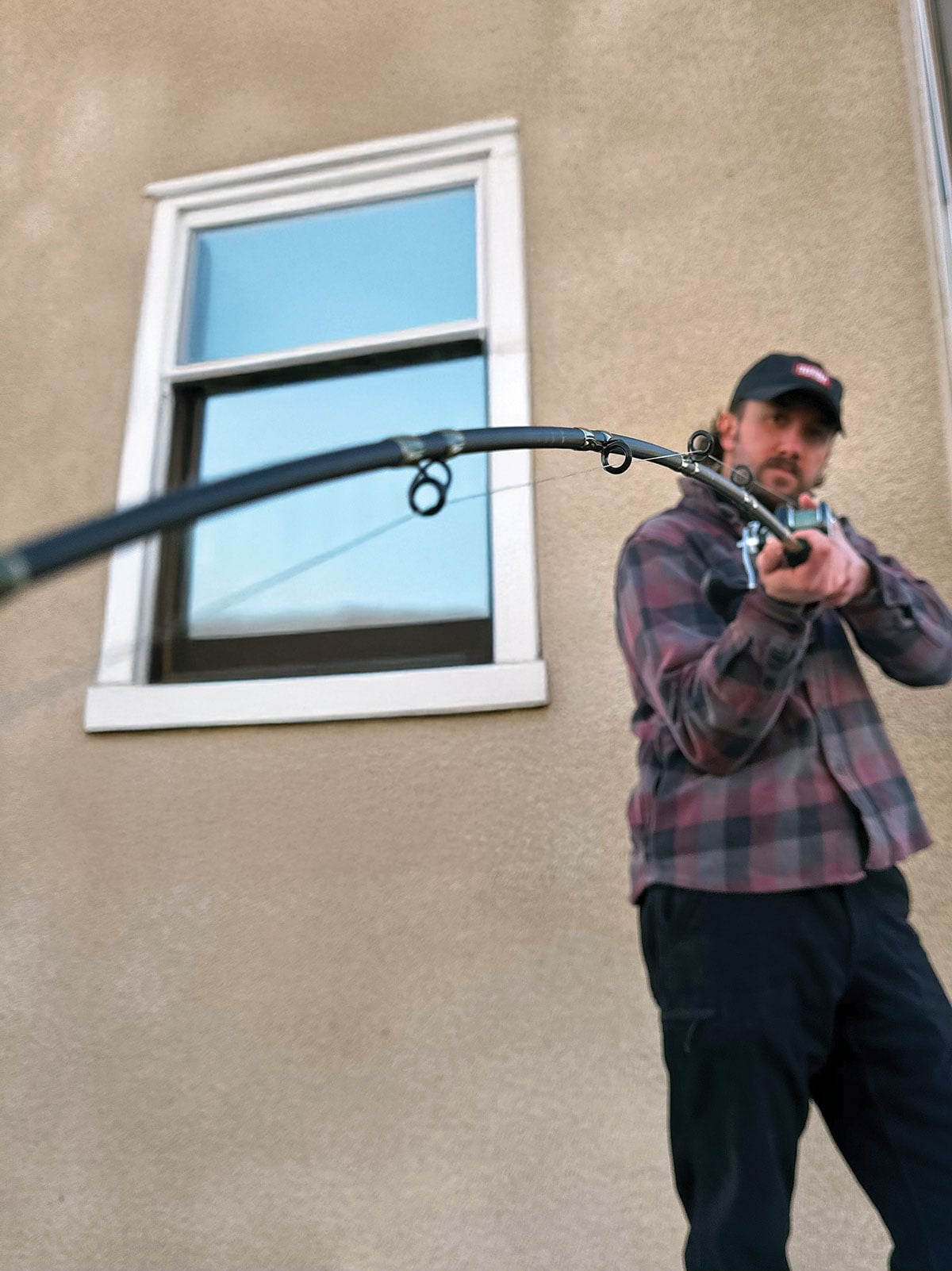
Spiral wrapping changes the direction of that pull. The first guide or two begins on top of the blank, but the line is gradually transitioned around the rod until the remaining guides run along the bottom, like a spinning rod. Once under load, the line is now pulling from beneath the blank instead of above it.
It must also be noted that the direction of spiral must be opposite of the handle on your conventional reel to work properly. For example, on this build, the spiral goes to the left since I’ll be using a conventional reel with the handle on the right side of the reel. For those that use a conventional reel with handles on the left side of the reel the spiral should run right to negate the torque of the rod when you hold it in your hands.
That one change completely alters how the rod behaves during a fight.

No Torque, More Control
Blackfish are not open-water sprinters. They are bulldogs that live in tight structure and instinctively dive back into it the instant they feel steel. The first few cranks after the hookset are often the difference between a fish in the boat and a break-off in the wreck.
When a conventional casting rod loads up against a strong fish, torque forces the angler to fight the rod as well as the fish. The blank wants to roll, and your wrist and forearm have to counteract that rotation just to keep the rod upright. That wasted effort slows reaction time and reduces how efficiently power is transferred to the fish.
With a spiral-wrapped rod, torque is essentially removed from the equation. Once the line is running under the blank, the pulling force naturally stabilizes the rod. Instead of trying to roll, the blank stays upright and tracks straight. All of the angler’s effort goes into lifting and turning the fish, not into correcting rod twist.

On a powerful blank like the Katana XXH, that stability translates into faster, more confident control when a tog makes its inevitable dive for the bottom. The blank used in this build is built with lifting power in mind. Its extra-extra heavy backbone and responsive midsection are designed to apply serious pressure while still maintaining feel and recovery. But a blank can only perform as well as the forces acting on it allow.
When torque is present, part of the rod’s energy is redirected sideways instead of straight through the bend. Spiral wrapping aligns the line with the natural curve of the blank under load. As the rod bends, the guides on the underside follow that curve, keeping the line in a straight, efficient path.
The result is more direct power transfer. When you lift, the pressure goes straight to the fish instead of being partially lost to twisting forces. That efficiency is especially important in deep water, where heavy sinkers and strong current already add extra load to the system.

Reduce Angler Fatigue
A day of togging is a workout. Between dropping and retrieving heavy rigs, setting hooks hard, and constantly lifting fish away from structure, the rod is rarely at rest. Even subtle torque repeated over hours adds strain to wrists, forearms, and elbows.
By eliminating that constant rotational pull, a spiral-wrapped rod simply fishes easier. The rod stays aligned with the load without the angler having to fight it. Paired with the EVA split grip and Fuji trigger seat on this build, the overall setup stays balanced and comfortable, even during long sessions over rough bottom. Less fatigue doesn’t just mean comfort — it means better performance late in the day, when reaction time on light bites can make the difference between feeling a pickup and missing it.
Blackfish rods live hard lives. They’re leaned against rails, bounced around in rod holders, and asked to handle high drag pressures and sudden shock loads from hard hooksets. Guide choice matters, and the use of Fuji K-Series KW double-foot casting guides with Fazlite rings fits the role perfectly.
Double-foot frames offer extra support and durability for heavy-duty applications, and the K-Series design helps manage line flow while reducing tangles. In a spiral wrap configuration, once the line moves beneath the blank, the load is distributed more evenly along the rod’s natural bend. Guides are no longer being pulled sideways under heavy pressure, which can reduce long-term stress on wraps and frames.

For a rod that will spend its life near wrecks, rocks, and barnacle-covered structure, that added stability can help extend the lifespan of the guide train. Speaking of guide train, I’m sure you’re wondering how much to spiral your rod if you are going to go the path of building it for yourself. I’ve seen a few different variations of spiral wraps done throughout the years but I’ll cover the specifics on the one that works for me and also worked on this blank.
You will always start off with the first guide directly on top of the rod, in line with the reel seat. Your next guide will be 45 to 60 degrees offset of the first guide and your guide after that should be another 45 to 60 degrees offset your second guide. The rest of the guides will go directly under the rod, opposite of the side the reel sits on. The reason I give a range of 45 to 60 degrees is different rods have different actions to them and slight adjustments should be made to keep the line off the blank and going in a proper rotation around the blank until running straight again.
Before wrapping guides, secure them to the blank securely, attach the reel you plan on using, run the line through and do a static bend test to make sure the layout works. Make your adjustments according depending on how the line runs through the guides.

Sensitivity Isn’t Sacrificed
| GUIDE SPACING (FROM TIP) |
| Spacing based on 16” handle length from butt to the bottom of reel seat*
Guide Distance BCKWFG-16 50” |
Much of modern blackfish fishing happens on party boats and charter boats where space is tight. A rod that twists under load can bump into rails, your forearm, or neighboring anglers as it tries to roll sideways during a fight.
A spiral-wrapped rod tracks straight up and down. When a fish makes a surge, the rod stays aligned with the line instead of rotating unpredictably. That makes it easier to maintain control in close quarters and keep your line clear of others when multiple anglers are hooked up at once.
It’s a small detail until the bite turns on and every inch of rail space matters.
Some anglers worry that moving guides to the underside of the blank will dull sensitivity. In practice, the opposite is often true. Because the rod is more stable under load and not fighting torque, subtle movements at the tip translate more cleanly through the blank and into the handle.
On a high-performance blank paired with a firm EVA grip and solid trigger seat connection, bottom contact and light pickups remain easy to detect. The spiral wrap doesn’t mute feel; it simply removes unwanted rotational interference.

Looks Good & Fights Hard
| COMPONENT LIST |
| PBKT761XXHMF X 1 TCSM-18BC X 1 4-1/2” EVA (foregrip) X 1 3-1/2” EVA (below seat) X 1 2-1/2” EVA (above butt cap) X 1 GRC-19 X 1 BCKWFG-16 X 1 BCKWFG-12 X 1 BCKWFG-10 X 1 BCKWFG-8 X 5 BCLGFT-8-5.5 X 1 |
There’s no denying that a spiral-wrapped casting rod looks different. Guides starting on top and ending underneath the blank still draw comments at the dock. But custom rod building has always been about function first. Once anglers feel how stable the rod is under load, appearance quickly becomes a secondary concern.
On a purpose-built tog rod like this one, every component — from the heavy-lifting blank to the rugged guide train to the comfortable split grip — is selected for performance. The spiral wrap is simply another step in that same direction.
Blackfish don’t give second chances. They hit, they dive, and they try to break you off in the first few seconds. A rod designed for them should maximize lifting power, maintain stability, and reduce wasted energy.
By eliminating torque, improving power transfer, reducing angler fatigue, and stabilizing the guide train under heavy load, acid wrapping checks every one of those boxes. On a serious bottom rod built around a powerful blank and outfitted with durable guides, it isn’t a novelty — it’s a performance advantage tailored to the way this fishery really works.
For anglers who measure success in hard-earned fish pulled away from unforgiving structure, that advantage can make all the difference.