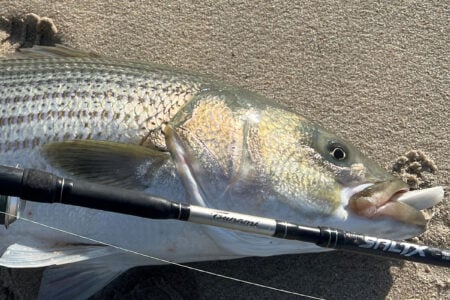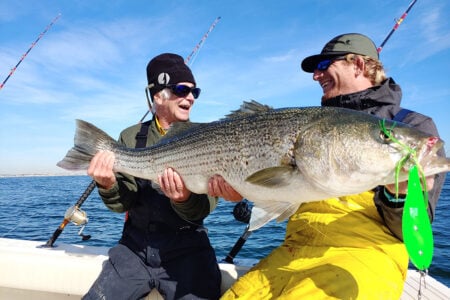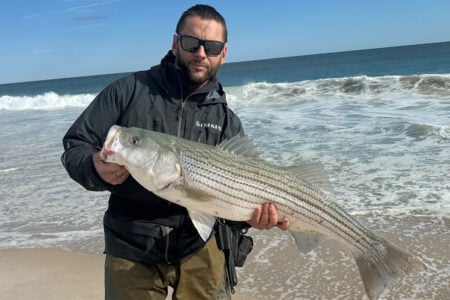
April stripers seem to be getting bigger and bigger, here’s how to cash in…
Walk up to anyone right now, whether it’s your best friend, that neighbor that refuses to make eye contact or some rando at Wal-Mart and say, “What a winter, huh?!” You’ll get the same exasperated, ‘knowing’ scoff no matter who you talk to. This winter was a monster, by any measure, and the New England collective revels in the shared trauma that resulted from the late-February blizzard. We can compare inches, ice dams and hours without power until we’re blue in the face, but it’s April now and it’s time to raise our chins, look ahead into the warmth of spring and start thinking about pounds instead of inches.
My experiences over the past few years have mirrored the dip in recruitment, where for as far back as my striper memories go, we caught schoolies in big numbers in April, which seemed to slowly grow until someone would break 20 pounds around the first or second week of May. Over the past five years though, things have changed. All of a sudden, we’re starting our seasons off with 28- to 40-inch fish, some years these fish arrive in early April! It’s been common to see 20-plus pound fish simultaneously in western Long Island Sound, Narragansett Bay and Buzzards Bay. And I’m pretty sure it was 2022 when a 40-pounder had already been landed in Narragansett Bay, before we turned the page to May.
Looking back through my years of full-on striper obsession, I would have given anything to have these bigger fish showing up so early in the spring 10-plus years ago, but it’s funny how perspective changes. Now I head out and enjoy an afternoon on the river catching slots and overs to 40 inches, and all I do is worry about what this spring fishery will consist of after another five years. Maybe we’ll be pleasantly surprised.
Two Fronts
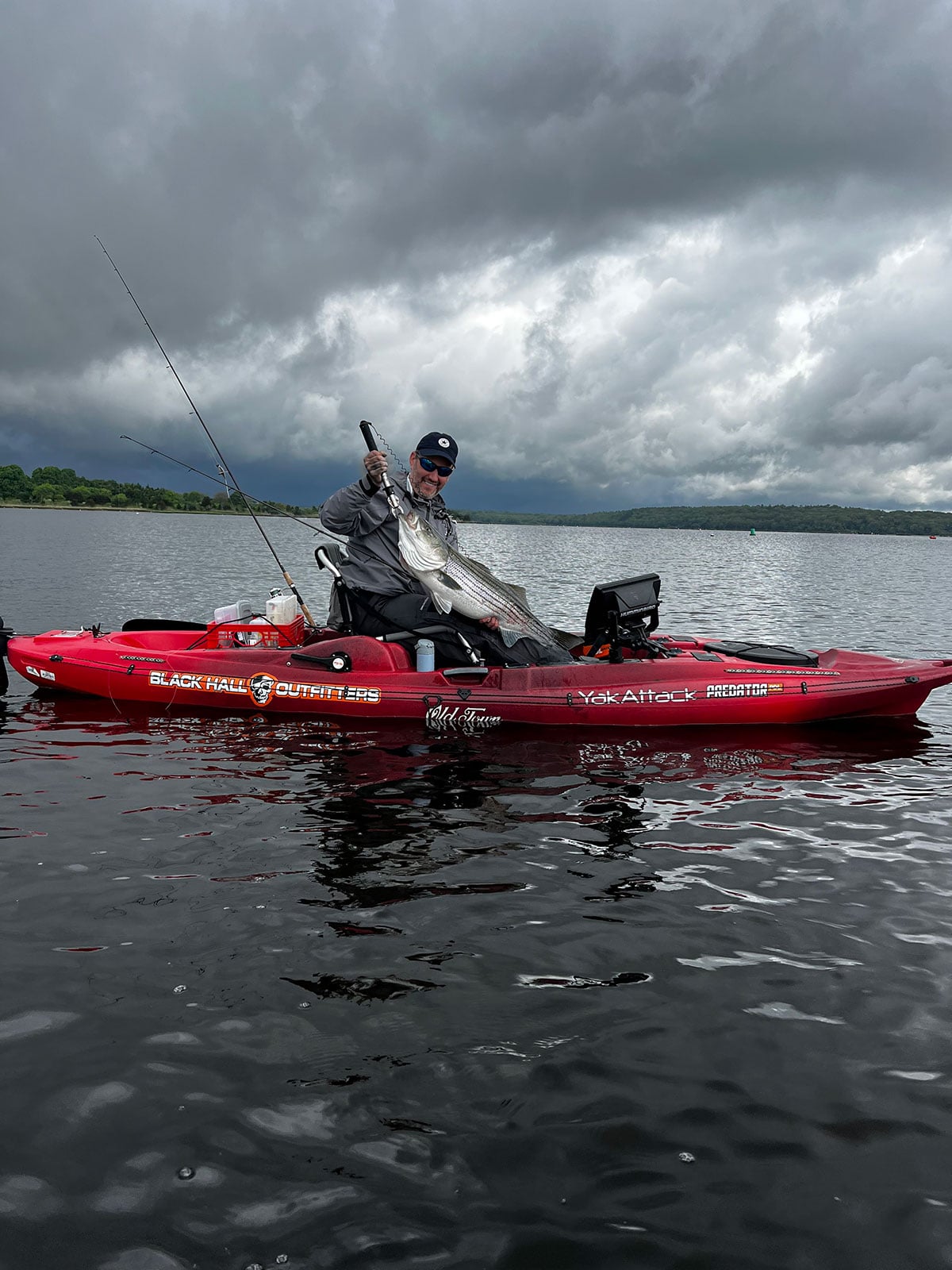
While for many years I was strictly a surfcaster, over the past three seasons, I have been splitting time between the shore and the kayak. Some might say I’m getting old and soft, but I would rebut by saying that I needed that juxtaposition to inspire new thoughts and to benefit from the discoveries that come from taking on new challenges. And I have to say, it’s really opened up a heretofore unearthed layer of understanding and possibility.
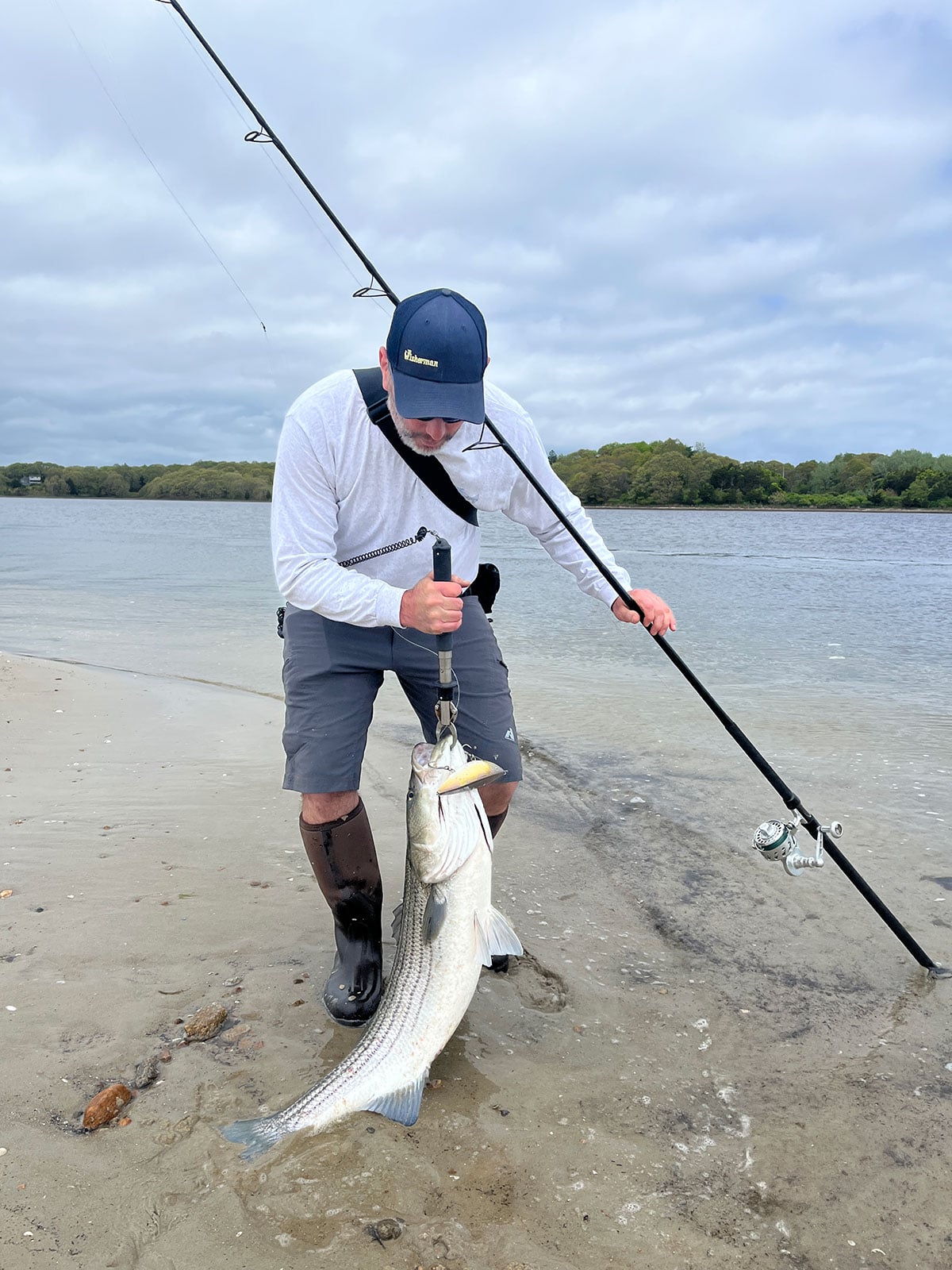
These last few years I have made my first focused trips with the kayak. With fewer fish in the rivers and bays when compared to the major schoolie influxes of the past, the ability to cover water offers a huge benefit and the use of electronics really helps narrow my efforts down to productive water. Once I find the fish, it gives me the option to come back and hit those spots from shore, either using the yak as a ferry or by finding shoreline access later on. Something I’ve learned since fishing in the kayak is that I regularly find these fish in amazingly shallow water, mere inches to 3 feet. The other spots I find them regularly is around deeper holes and along channel edges.
Mode Changes
I will fish any time of day or night, especially as we near the changeover into May. An interesting thing I’ve learned over the years is that daytime fishing typically calls for appealing to the fish’s sight and their competitive nature, while nighttime tactics are crafted to appeal to their other senses, and therefore require slower presentations overall. A mistake I made in my early years of striper fishing was assuming that the cooler water in conjunction with the striper’s assumed ‘need to bulk up after a long migration’ was the reason why they would attack a topwater plug so aggressively in the spring. What I’ve learned since then is that when a population of fish is compressed into the narrower, shallower estuaries of the spring, it sets the stage for a competitive feeding scenario. Add in the bigger baits of springtime like herring, bunker and squid and you get that explosive daytime aggression that we all love about this time of year.
Regardless which lure I choose to throw in daylight, I take an approach that I feel appeals to their vision. I tend to favor colors that stand out from the natural environment; white, bone, yellow and chartreuse are my favorites. On a cloudy day I’ll add a reflective black over silver, or something close. I tend to start with a slower presentation and increase the speed until I start to see life or feel that I need to change size or eye level/depth. When I draw interest, I like to make my plug or plastic react in a way that I think the pursuing striper will expect. Put simply; I pick up speed and try to make it look like my lure is trying to get away from danger. This works, maybe 75% of the time; if I see a pattern that it’s not working, sometimes staying on the steady cadence is the key. Other times, if the fish makes contact with the plug, stopping altogether is what turns them on.
I tend to keep my daytime lineup of plugs pretty simple, but I will say that I have started to carry bigger plugs earlier in the year over the past five seasons. So what you’ll notice is that I carry plugs that are basically different versions or sizes of the same basic style. For example, my top daytime choice is a spook-style plug. I will always have a Jumpin’ Minnow, a Yo-Zuri TopKnock, a Hydro Pencil, a Tattoo Sea Pup and both the 7- and 9-inch Doc; more recently I have added the Yo-Zuri Mag Pencil to my arsenal as well. You can see the progression there, from smallest to largest.
For pencil poppers I carry the Gibbs 1-ounce, a Beachmaster 2-ounce, a Guppy Round, a Guppy 3-ounce and the largest Surface Cruiser. A couple others I keep close at hand are the Banana Plug and the Sebile Magic Swimmer (6.5-inch, slow sink). I will also carry soft plastics mounted on jigheads and swimbait hooks. Some of my favorites include Alibie Snax (and XL), Slug-Go’s, the MegaBass MagDraft freestyle (6-inch) and the DuraTech paddletails from Game On Lures.

Quiet Nights
After dark, my mindset changes. In these placid backwater areas, during the quiet of night, I put a lot of thought into not “crashing the party” so to speak. I want my presentation to enter the scene naturally, not smash through the ceiling like the Kool Aid guy. I should add that this level of care is only taken in specific areas; in waters of 6 feet or less, with calm conditions and nothing more than moderate current.
Another thing I put a lot of consideration into is the sounds that I make; if I’m wading, I’m going slowly, I’m not splashing along the shoreline like a 7-year old chasing a dog. I’m placing my steps and trying to be quiet enough that my impact is minimal and hopefully ignored. In the kayak, I’m thinking the same way. I try to keep the cockpit clear of clutter so I don’t clunk a plug on the deck or kick my thermos or pliers. When I enter a shallow area where I feel stripers are likely to be, I try to use wind, current or momentum to carry me into the area, because once you’ve spooked them, your likelihood of hooking the bigger fish goes way down and, I feel, that the longevity of the bite is likely to be truncated as well. I often try think of it as though I want everything I do to be no louder than my breathing.
Listening plays a big part at night; it’s how I gauge the impact of my personal imposition into the area, how my lure enters the scene, the overall activity of the spot I’m fishing and even how much interest I’m drawing from the fish. I try to choose lures that – for the lack of a better term – “sound right” when they land; it’s not a big plunk, it’s a natural splashdown, no louder than a bunker flipping. And during these dark, calm hours, I try to make my presentation appeal to the striper’s nighttime senses; their hearing and lateral line.

Dark Thoughts
You will notice that these backwaters seem extra peaceful in the dark and I believe that this overall feel continues below the water. I also believe that baitfish instinctually understand that their predators are using their vibration, water displacement and sound to find them in the dark. And in the quiet of the calm shallows, baitfish seem to limit their movements, in favor of using stillness to camouflage themselves. During these times I rely heavily on lures that sink very slowly and don’t have a ton of built in movement. Slow sink needles that rest in a level position, various sizes of glidebaits tuned to sink very slowly, soft plastics like the Fin-S Fish or Slug-Go. My favorite though, is the Berkley Nessie, in the 9-inch size. There’s a lot of tech packed into this soft glidebait and – trust me – its diminutive price is not relative to its effectiveness.
The method, for all of these baits, is to maximize the amount of time they are moving with the drift and resist the urge to impart too much action. This easier to do from a kayak because you will usually be drifting at the same speed as the lure. From shore, you have to cast way up-tide and try very hard to keep up with the drift, while not affecting it. In either case, you will need to impart action, at times. I try to keep these movements short, I think of them as a baitfish making mistake. A few twitches with a soft plastic, a dart to one side with the glide or two or three steady cranks with the Nessie. These are designed to alert a nearby striper that something is there and invite them in to investigate.
Much like in the daylight, the time to make a bold move is when your lure would react to danger if it were alive. If you feel a bump, lose contact with the bait for a moment, or hear a swirl in the general vicinity of your offering, kick it into freak mode for a few cranks and if haven’t already hooked up, stop it and give it a 5-second pause. Typically, the bait will be crushed before you get too far into that pause… if not, go back to the “drift and bump” retrieve and wait for your next engagement.
Stay Engaged
I feel it’s important to say that these are guidelines that run down the middle of a wider gamut of retrieves that I will use to hunt for the larger April bass that we’ve been seeing in recent years. Nothing is more important than experimentation, in fact, it’s my tendency to continually change methods while using the same lure that lead me to these conclusions in the first place.
Sometimes the “environment” will tell you what’s going to work. A windy night with a moon tide, I’m automatically working my baits faster, because those conditions will force baitfish to work harder. If I’m hearing or seeing a lot of surface feeding, I’m going to change my tactics (day or night) to appeal to the competitive nature of an active feed. If I’m drifting in my kayak and I keep spooking big fish off the surface, sometimes so close I could touch them, I know I need to be extra quiet and I will make long casts into water I haven’t drifted through yet to try and keep my ‘shadow’ out of the equation. I read those larger fish hanging right at the surface as bass that are hunting… drifting motionless in the tide, waiting for something to get too close and that’s what I try to sell with my presentation.
If you want to take your spring fishing to the next level, I urge you to keep your senses plugged into what’s going around you. Use your head, and make some creative inferences about what might work. The worst thing that can happen with experimentation is that you’ll be wrong. But if you keep experimenting, and you keep your head in the game, you will eventually be right. And that’s when the fun begins…
God, I just love this stuff.