The relentless cold of February presents unique challenges to the year-round striper hunter.
I love the changing fishing seasons of New England, but I have to admit, I’m not so fond of February. It’s a tough time for those of us who focus our fishing addiction on open water; it’s not that I don’t like ice fishing but, personally, I would rather be fishing open water!
February is by far the toughest month to catch a striper, between the winter conditions and the cold water attitude of stripers, it isn’t an easy task to get on the board. Though, a methodical approach and finesse tactics will get it done.
When I bought a fishing kayak in 2003, part of my calculus for the purchase was extending my fishing season; I hadn’t really considered kayaking in February. As the striper season ended in the fall, I realized that I wasn’t really geared up for winter fishing, but I was able to get out on a few good weather days as the calendar moved toward Christmas. Those trips proved to be more successful than if I had been shore fishing and this opened my eyes to the opportunity to go harder for stripers through the winter.
The Boston area doesn’t have a big winter-over population, but there are enough pockets of fish that you can catch fish through the winter, usually without seeing another angler. In years where the water was open through the winter I was able to catch stripers every month of the year and for the last 20 years, I have only had a few months without a locally-caught striper.
Cold Conduct
It is interesting to watch the behavior of stripers in the offseason. During November and December, there is still considerable bait around, young of year herring, bunker, and silversides stay late in the season and provide plenty of forage. January gets a bit more difficult, with ice forming everywhere and many very cold nights. By February, stripers have gone into winter mode, hanging out in pods and often spreading out into the river systems and inner harbors.
While February bass tend to be less active, they have their moments. Winter stripers follow the same feeding patterns that summer stripers do, new moons stimulate the bite, and even in non-tidal areas, stripers feed on the tide. February means very tight feeding windows and fewer active fish. The month is a game of picking the right place and time to intercept more active fish.

Channel Surfing
Almost every river in New England has some resident winter stripers, they will go in and out of the rivers and will sometimes head upstream into some pretty shallow water. Channels are frequently the easiest place to find fish, cruising channels with a Humminbird sidescan is a good way to locate pods of fish. In southern New England you may see big schools of fish, but most of us are targeting small pods of just a few fish, learning to pick them out on channel edges is a skill that requires time and dedication to master.
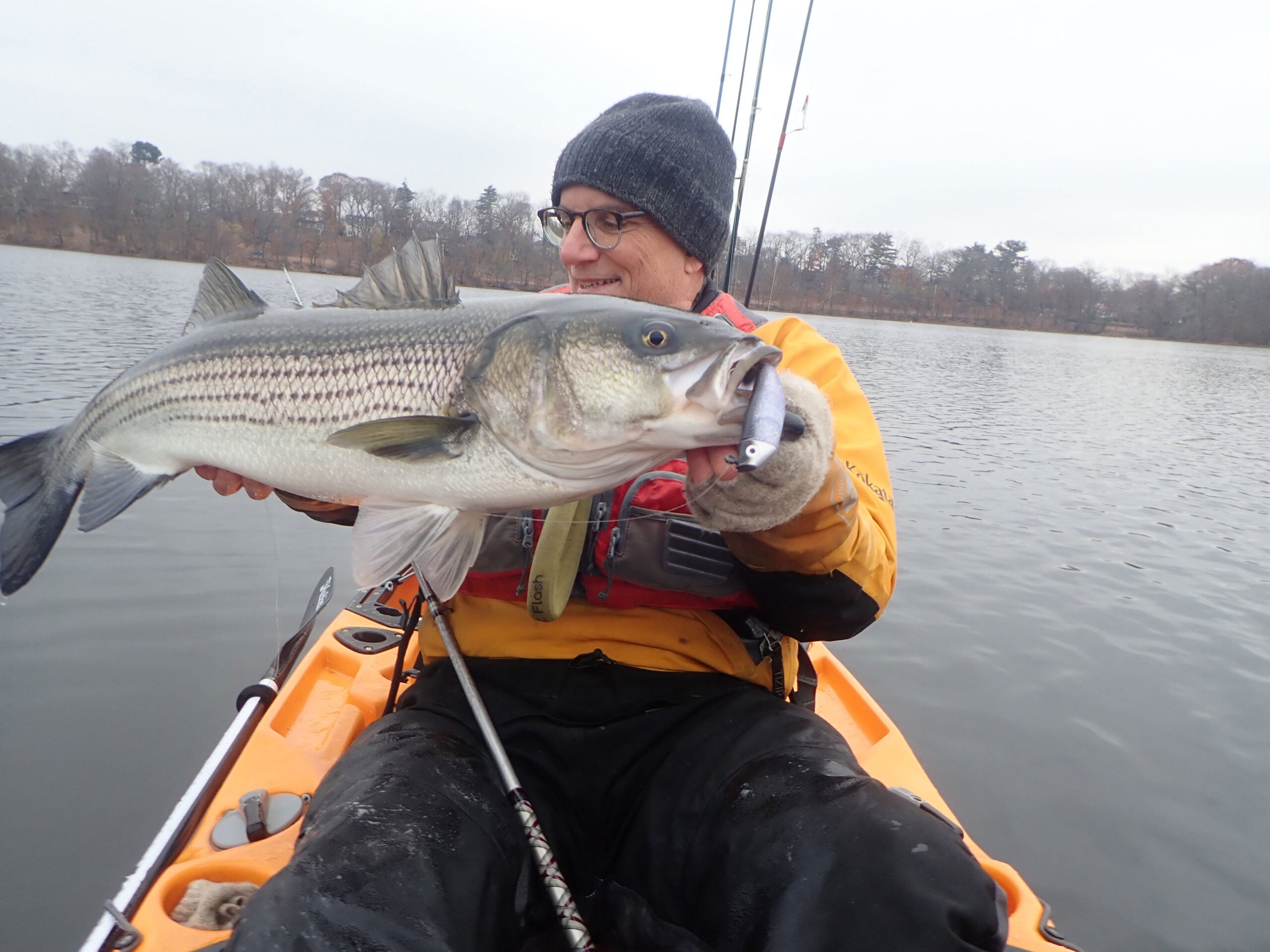
Fishing channels is best done with jigs, I prefer soft plastics, but bucktails can be effective as well. Depending on the size of the bait around, plastics in the 5- to 10-inch size are very effective. Braid, a sensitive rod, and a jighead light enough to give the bait a natural fall are important to this technique. The bait should slide into the strike zone and move very slowly through the area with fish, if I’m marking fish underneath the kayak I will stop and deadstick the jig right where the fish are. When I’m deadsticking, I hold the bait almost completely still, then slowly lift and give it a twitch followed by a slow drop back down. Most fish will strike as the bait settles back toward them. Slow finesse fishing like this may seem like a job for smaller baits, but always keep at least one 7- to 10-inch bait at the ready, even in the winter, some stripers are only interested in a bigger meal.
In The Dark
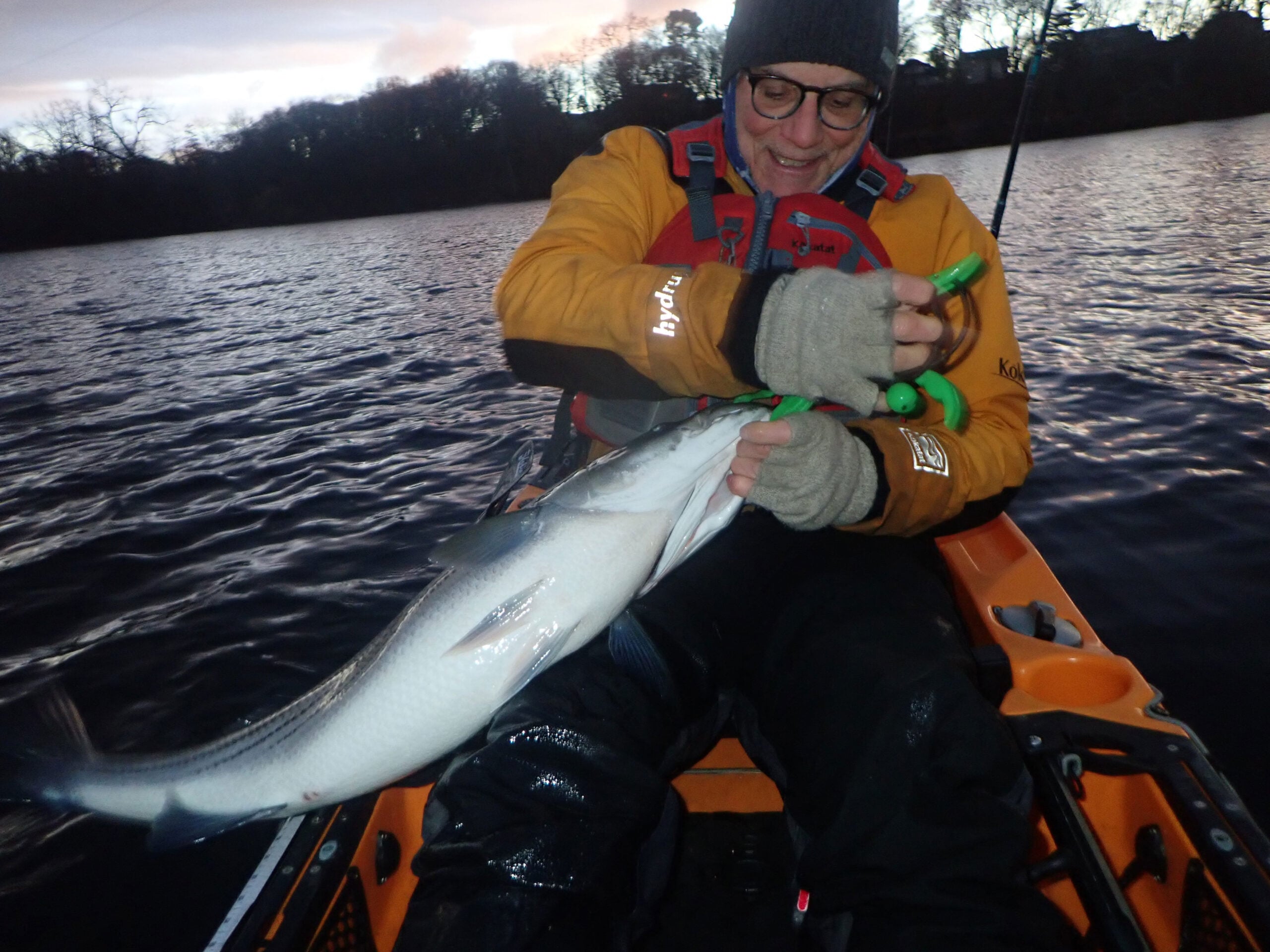
Nighttime is still the best time to pick off stripers, even in the middle of winter. There are the occasional nights when schools of fish will move up onto shallow flats, I’ve caught them in 2 to 5 feet of water on nights where it was just warm enough to keep ice from forming. When you find fish on the flats they are typically a bit more active and willing to feed, so my strategy is to fish various lures in the middle of the water column.
Stickbaits like Red Fins can be very effective, diving a foot down with a thumping wiggle is irresistible to stripers summer or winter. My go-to flats bait is a weightless 7-inch Hogy, I go from swimming it like a stickbait to a super slow needlefish-style retrieve. The nice thing about a weedless plastic is that you can throw it anywhere without hanging up. Even though the water is cold and the fish are generally inactive, give yourself a chance to find more active fish by looking in spots other anglers won’t, imagine where they may push bait onto a flat and take a few casts in that area. It won’t always work, but when it does, it can be the best of winter fishing.
Activity Centers
There are always docks and piers around river channels and they all provide hangouts for stripers, most won’t hold fish, but by thoroughly checking pilings along river edges, you will locate areas that consistently produce. Pilings can be tricky to fish, stripers will get right up in them and the fight can quickly turn into a tug-of-war to get them out of their barnacled lair. Look for piers right along channel edges, especially where a current flows by.
In many rivers north of the Cape, February can mean a smelt run, if you can find a smelt run, you will find some stripers behind them. When I see smelt in a river, I will fish white or amber 6-inch Slug-Go-style baits on very light jigheads. Opportunities for this style of fishing often show up around the end of the month, especially at night under lights where you can see smelt schooling.
February stripers are difficult to pattern, if you find yourself marking fish, you know you’re in the right place, but if you aren’t getting bites, you may just be there at the wrong time. Classic striper patterns like moon and tides still matter, but it is hard to beat the impact of a winter storm, especially if it’s a warm rain. Some of the best February fishing I’ve had came after a day or two of warm rains, a slight increase in the water temperature coupled with a little stronger current seems to get them going. Of course, too much rain can be a curse, when the water turns brown and filled with snowmelt, it can shut off the bite.

Rigged & Ready
| SAFETY SMART |
| Kayaking in the winter is no joke. Even on warm days, the water will be cold enough to make any mistakes in judgement very costly. Safety and comfort start with the right gear, I wear a Kokatat drysuit and layer up underneath, winter kayaking is cold, but it doesn’t have to be uncomfortable. My drysuit setup allows me to fish for a couple hours and feel safe because I’m insulated from direct water contact, you never want to fall out of a kayak into cold water without layers of protection to keep the water from reaching your skin, proper gear will give you the time to self-rescue.
Under my drysuit I wear non-cotton gear, usually fleece long-johns with heavy fleece pants and two or three fleece tops. It took me a few years to solve my footwear problem, I wear two pairs of quality socks and use waterproof boots like Boggs. My drysuit features footwear gaskets that fit perfectly over the top of my Boggs to create a waterproof seal. I experimented with wading boots, but they held water and my feet were encased in ice—that was definitely a recipe for short trips! |
When I go out in the winter, I always bring a few setups rigged and ready to go. The last thing I want to do in the winter is to have to tie knots with frozen fingers, so I will rig rods to meet the opportunities that I expect to find. Mostly I will fish a spinning rod with a 2500 size Shimano and 15-pound braid, this is a great setup for finesse fishing 5- to 7-inch baits. I will usually bring a couple rods rigged with different size jigheads, so I can switch as I move in and out of channels. A baitcaster with a bigger bait and a little heavier head adds some versatility to the presentation. I prefer to fish with baitcasters, but in the winter, a good splash on a baitcaster can lead to a frozen reel. I’ve found spinning reels easier to keep ice free, but I still bring a couple because I’ve had those nights where I dunked a reel and it wouldn’t work until I thawed it out again!
For effective fishing in February, try some short trips, don’t stay on the water until you are frozen, watch the weather, moon and tides and get out at times that you typically do well in the summer. February fishing will be cold even on the best of days, the water will be in the low 30s and it will probably be breezy. Make sure you have the appropriate dry gear to avoid all water contact as well as safety gear to self-rescue. Chemical handwarmers can keep your hands fresh and wool fingerless gloves can keep your hands nimble and sensitive enough to fish. It’s a fun challenge, trying to catch a striper in all 12 months of the year, and if you can land one in February, there’s a very good chance you’ll be able to go 12 for 12.