As a surfcaster and kayak fisherman, I might be a little more… intentionally… aware of sharks than the average inshore angler. I’m not necessarily scared of sharks, but I certainly don’t want to encourage surprise encounters, and I don’t want to put myself in situations where I’m inviting a shark to make a painful mistake, like keeping a mesh bag of eels on my hip while wetsuiting. Over the last three years, we’ve seen a growing and troubling trend in the waters stretching between the Connecticut River and at least the Nantucket Sound Beaches of Cape Cod; where hooked striped bass are being attacked and killed by a suddenly burgeoning population of brown sharks, (aka, sandbar sharks).
These attacks have been happening with such regularity during the summer of 2025, that having a hooked striper ‘sharked’ has become a ‘rite of passage’ for striped bass fishermen who frequent these shorelines, and charter captains that fish these same waters are starting to call for change. Capt. Mike Roy of Reel Cast Charters out of Old Saybrook, CT said, “These sharks are now so abundant that nearly every school of stripers seems to have a few sharks hanging around nearby and after 15 to 30 minutes of catching bass, a shark will appear and then, an attack is imminent. Maybe it’s time for fisheries managers to change their protected status and let us target and keep a few of these sharks.” He continued, “We’re now forced to fish a school of bass until we see sharks, then we move to a new spot. The hard part is, we’re seeing sharks at pretty much every spot, along a 25-mile stretch of shoreline!”
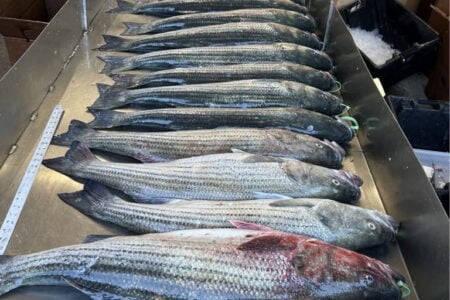
Before I talked to Mike Roy about this problem, I’d seen a few social media posts where anglers were showing off five to 10 stripers, chomped in half by sharks, over the course of a single day of fishing. I get the shock and awe factor, I had a bass chopped off at the gills while fishing from my kayak just the other day and it’s very “Nat Geo” and really displays that stark contrast between “vibrantly alive” and “stone-cold dead” in the blink of an eye. I also accept that nature is going to do its thing, bigger fish are gonna eat smaller fish and a few of those might be fish we’re trying to catch. But we cross over into an area of questionable ethics when sharks are repeatedly killing bass we’d otherwise release and we continue to fish without attempting to do something to stop it.
You may be asking yourself, “what could I possibly do to try and stop it!?” And you’re right, the options are few. The easy answer is to move to a new spot, or at the very least, take a 10-minute break and see if the lack of commotion is enough to turn the shark off and send it looking elsewhere. Some anglers have turned to trying to catch the shark, which comes with its own list of questions, starting with the fact that brown sharks are protected and illegal to target, but we all know that brown sharks are caught by accident and accidently-on-purpose, all the time and without consequence.
Just the other day I caught one on a soft plastic, legitimately an accident and legitimately one of the most intense battles of my kayak fishing career! I’ll let you decide where you draw your personal line of ethics on TRYING to catch the offending shark, but continuing to catch stripers (or any other species) after multiple shark attacks in one area should give you pause if you think of yourself as a conservation-minded recreational angler.

This issue is not confined to the Northeast, anglers and charter captains all over the East Coast, with a particularly intense hotspot in Florida, have been loudly calling for change. These calls have been answered in Washington with the passage of the “Sharked Act of 2025” introduced by Rep. Wittman, (R-VA) in January of this year. The bill passed in the House of Representatives and, if made into law, would assemble a task force of fisheries managers, biologists, shark experts (and presumably, anglers) to study and understand why encounters between sharks and recreational fishermen have increased so significantly over the past several years. In Florida, charter captains have observed that sharks are learning to follow fishing vessels, knowing that their catch will make for easy pickings. And if what Capt. Roy and other local captains have told me is correct, our exploding population of brown sharks is learning to do the same thing and it’s only getting worse.