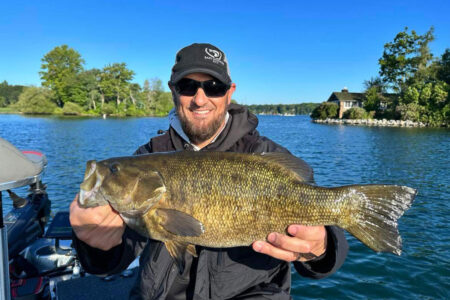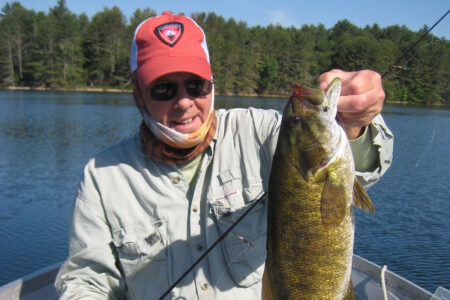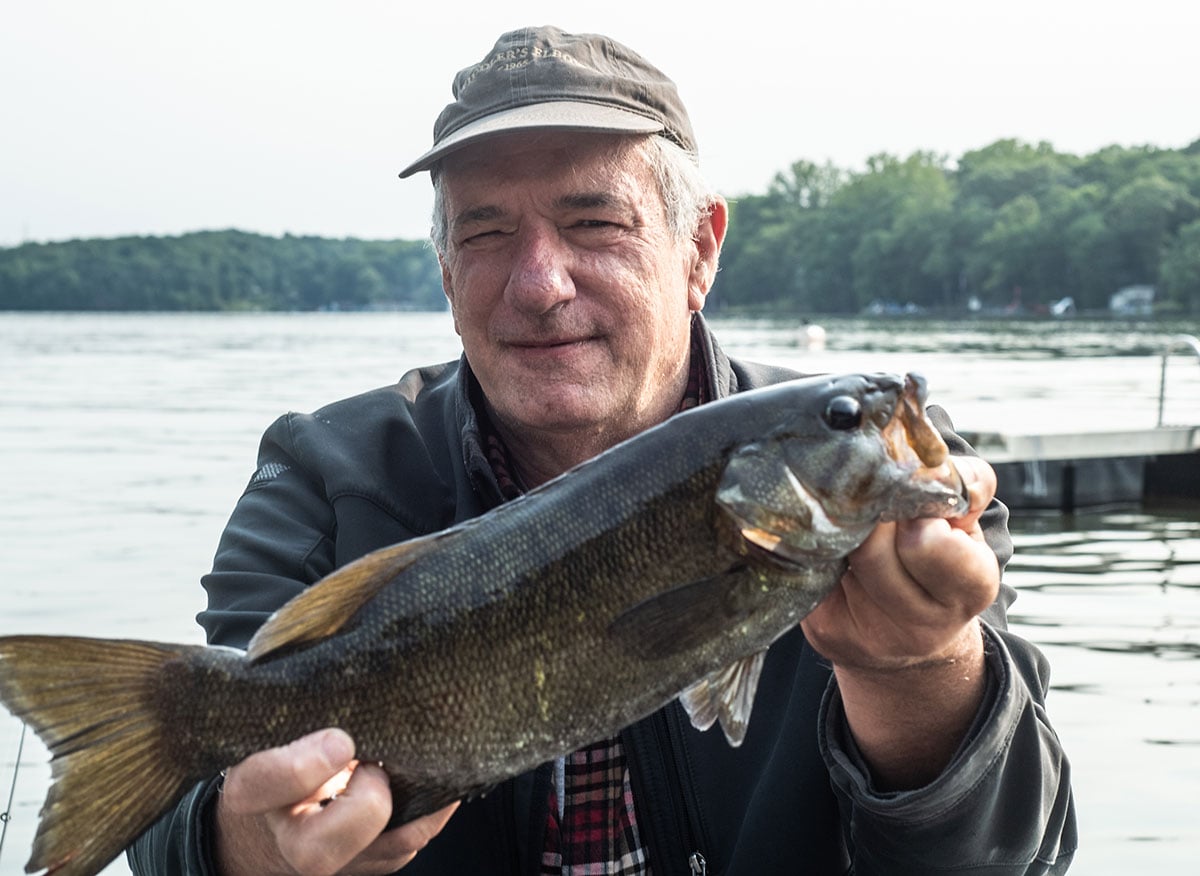
Skipping baits under docks works with smallies as well as largemouth.
Docks are commonly thought good for largemouth bass, but in recent years, I’ve been hauling bronze from pilings as well. The action teaches me smallmouth don’t only associate with rocks, but if you find a pile of stone while casting to the wood, give the hard stuff careful attention.
Smallmouth bass are thought to prefer deeper water than largemouth, and docks don’t necessarily situate in shallows. The lakeward end might be 20 feet deep, and yet, when the likes of that is the case, a big smallmouth might instead situate in 5 feet of water near the bulkhead. If so, that fish is ready and willing to feed, rather than to snooze safely. It probably does sink into the depths when fed.
Many docks do entirely situate in the shallows, and it doesn’t mean bass need spectacular structure nearby from which to launch feeding forays among the supports. On the contrary—as much as my sensibility resists the notion—I believe docks covering water only 5 or 6 feet deep are enough structure for 4-pound smallmouth.
That’s not likely the case in July and August. You can catch bass in the shallows of docks early in the morning, but the typical feeling out there in the July heat when the broken surface is caused more by boats than by wind is that the bass simply do not feed in the middle of the day. You might find some action around sunset, but the typical problem with that is boat traffic persisting until dusk.
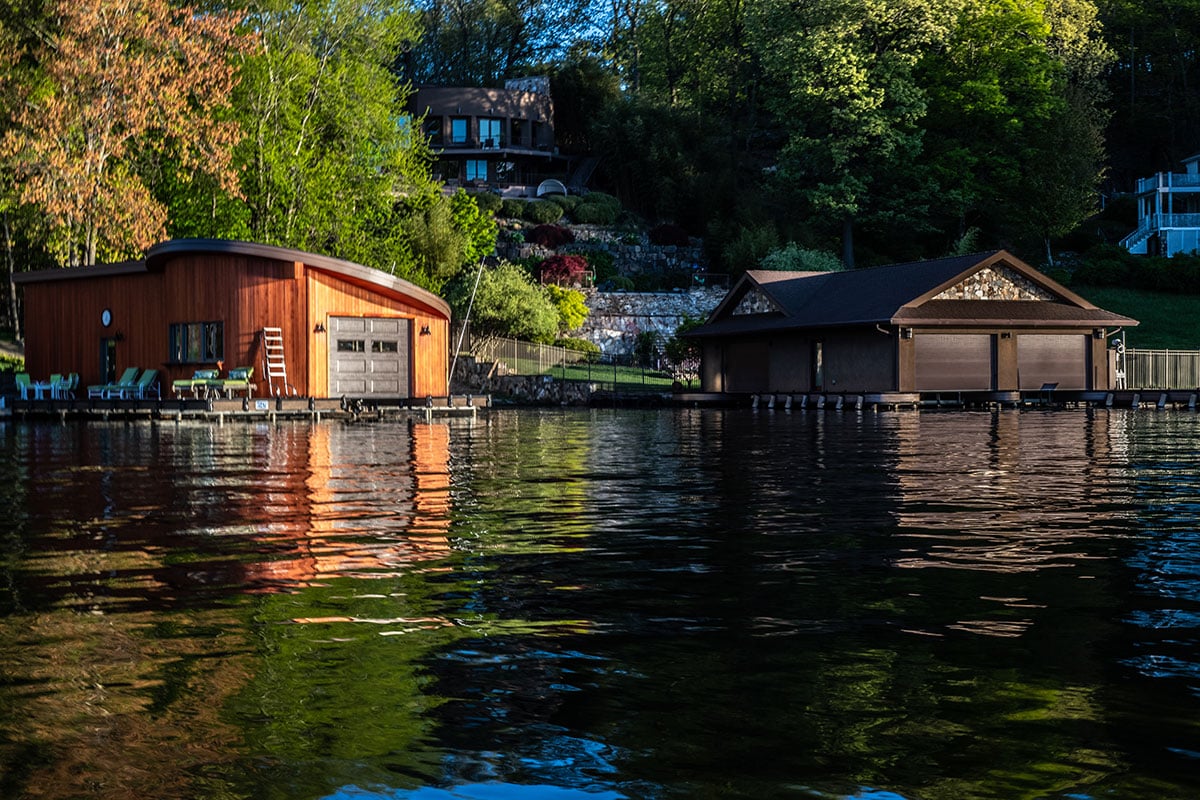
May and June are dock fishing’s best months. If your lake is like mine, May doesn’t see a whole lot of fishing pressure and boat traffic, and even the second week of June isn’t terrible. That’s truly a blessing, because right when the fish are still feeding on larger forage items they can chase down—in water that probably hasn’t warmed out of the 70s—they’re not being hassled. At least, not as badly. And they forget about lures they see when the pressure’s high. September and October are also good months, but September can amount to greater fishing pressure than during May and June. Not necessarily so, but I’ve seen it happen. October has less.
Whatever the month from May through October, you can depend on the same lures. Lots of dock anglers use a jig’n pig. Others use an array of tube jigs, spinnerbaits, weedless frogs, or Chatterbaits, but I’ll recommend a lure plenty of other dock anglers concur is a good one: the Yum Dingers, Shim-E-Sticks, and Senkos. The fat-bodied worms.
I’d never throw a pig, because I believe it sinks too fast. While it might be true that the faster sink rate triggers an immediate reaction—the bass launches itself at the jig—more often a bass feels tentative. And it loses interest after the jig hits bottom. Meanwhile, my Yum Dinger is still descending and the bass gets interested!
The case of spinnerbaits and Chatterbaits is much the same. These are heavy-bodied lures, and while they never earned their reputations as top dock producers without catching bass, I don’t recommend them any more than to tell you others do.
The weedless frog? I use weedless frogs successfully on top of weed mats. But I can’t help but feel that a weedless frog, when fishing docks, is a joke. Like I’d put one up on top of the boards. Others will tell you they work. I’m sure they do, but I’ll stick to my Dingers. Rigged Wacky, hook in the middle, on Medium-heavy spinning, 20-pound-test braid, 3 feet of 20-pound-test fluorocarbon leader tied to that braid by uni-to-uni splice.
I’m not always skipping the lure to get underneath docks, but the weight of a heavy bodied worm helps me get it there when I want. Most of the bass take it when I set it down lightly on an edge; casting accuracy is important and a game in itself! A smallmouth will strike with more ferocity than a largemouth. Always be ready to set the hook. The worst is when you don’t know a bass is on until it’s making for open water and spits the worm as you try to tighten up. They don’t always swallow a worm when they swim off fast.