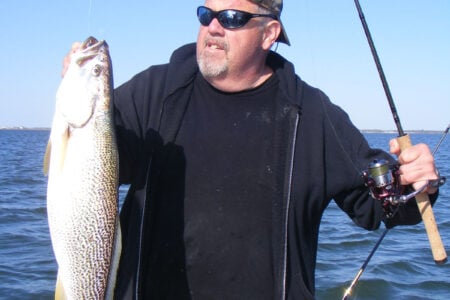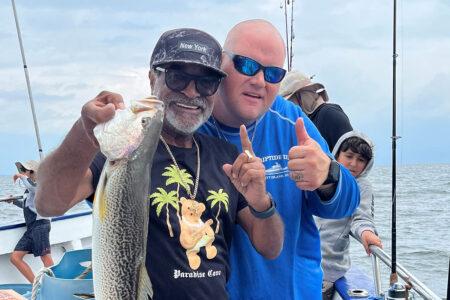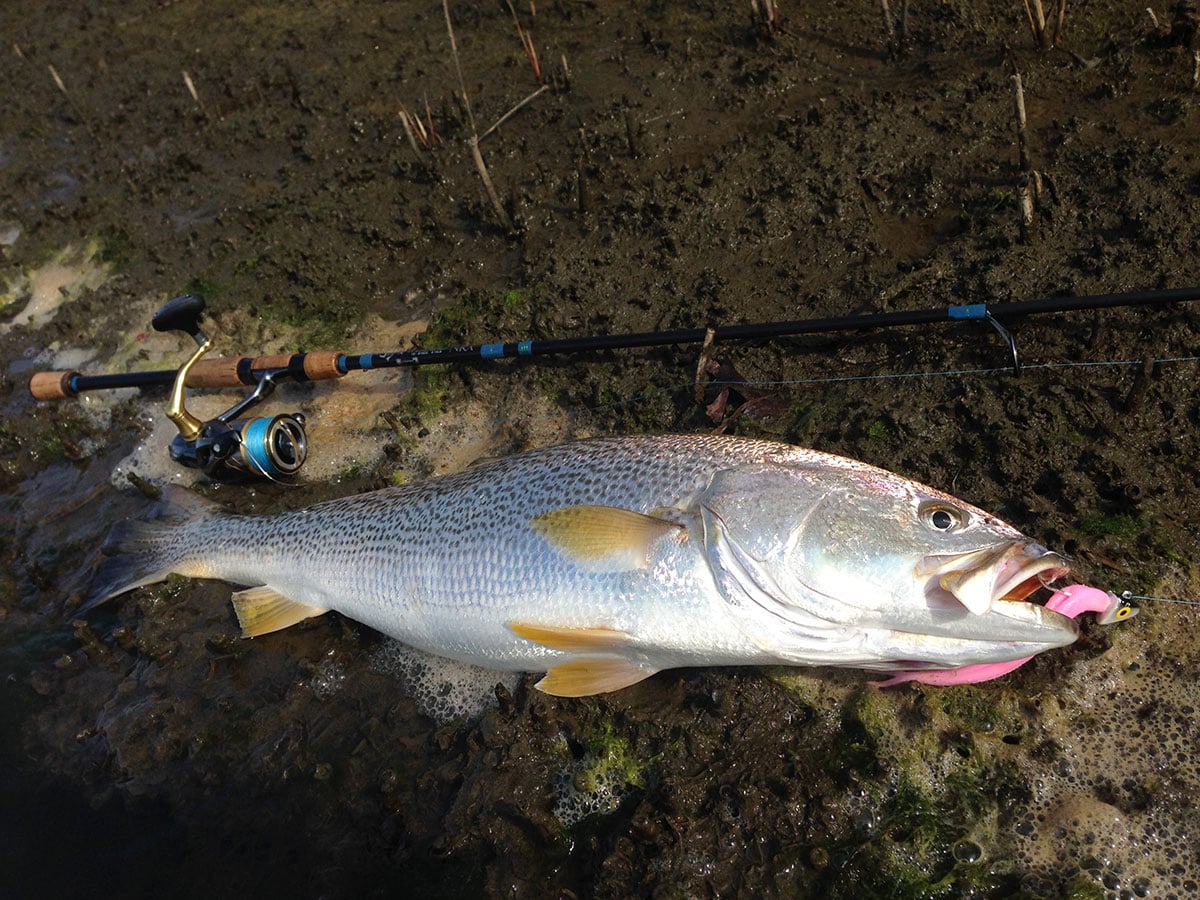
Ol’ salts will tell you, a Chesapeake winter freeze is a sign of good weakfishing ahead.
My first encounter with a weakfish, or trout as we call them in Delaware, occurred during the late 1950s when I was fishing from Slaughter Beach with my grandfather, Roger Culver. Pop had a 25-horsepower Elgin outboard that we lugged down to the water and attached to a wood boat brought to the water’s edge by a sweet, delicate lady who could pick Pop up with one hand and me with the other. She would drag those heavy, wood boats from up by her house down to the water and back up again as if they were light as a feather.
If the tide was out, I would have to push the boat until we had enough water to drop the motor. Then, I had to set the choke and the throttle just right before pulling the starter cord or else the motor would flood and we would be there for an extended period of time. Meanwhile, Pop sat in the bow like Queen Cleopatra going down the Nile.
We used cut strips of squid and the primary target was croaker. As the tide flooded the croaker bite was steady at what is known as the Coral Beds. Actually, the structure that sort of resembled coral, were worm casings that built up over the bottom and made good fish attracting structure. We would drift over the beds, catching croaker and the occasional dogfish and oyster cracker so long as the current kept running. When we hit slack water the croaker bite died and we broke out our lunch.
I don’t remember who caught the first big trout, but during slack water both Pop and I caught a trout that exceeded 30 inches. To say both of us were excited would be a massive understatement. That was it. Once the current started running again it was back to croaker catching. No more trout.
Weakfish World Championship
Pop and I along with my stepfather Medford Hatfield, fished from Slaughter Beach several times in the 50s and in 1960 before I joined the Navy in January of 1961. During all of those trips I don’t recall catching any weakfish. For the next 4 years I did my fishing in Florida. First in Jacksonville, when I was stationed on the USS Saratoga and then in Pensacola when I was on the USS Lexington. Caught some interesting fish, but no trout. My first summer back in 1965 was spent fishing the surf at 3Rs Road and Indian River Inlet. I caught blues, kings, stripers and a few small trout.
As the years went by, the number and the size of the trout increased. Finally, the Director of the Milford Chamber of Commerce, Jack Nyland, got the idea to start the World Championship Weakfish Tournament. Like most good ideas, this one started out small then it grew into a giant. In its heyday, the tournament ran for a week with 150 boats fishing three days out of Slaughter Beach. Add to that the regular guys who just wanted to spend a day fishing on Delaware Bay and you had some exciting encounters at the Slaughter Beach boat ramp. I kept my 20-foot Bertram at a marina in Milford and ran down the Mispillion River to the Delaware Bay. Unfortunately, that marina is now abandoned and filled in with mud.
I was able to spend every fishing day on the water with special guests such as Al Ristori, George Reiger and Russ Wilson, as well as sponsors of the tournament, all fishing from my 20-foot Bertram. We fished, took photos and generally had a great time.
The fishing was stupid easy. On the trip with Al, I headed to a favorite shoal and soon marked a big school of fish. We set out two dead sticks and fished with two other rods. All were rigged with yellow bucktails with yellow worms. At first, we had no action, but when the trout turned on, they all turned on at once. Both dead sticks went down and both of us had fish on. We could not stop to put fish in the cooler and we had them flopping around under foot.
Back at the dock, folks from the Delaware Department of Fish and Wildlife were doing scientific work on some of the trout that were brought in. That study is used in a very detailed report by Susan K. Lowerre-Barbleri, Mark E. Chittenden, Jr. and Luiz R. Barbieri. The report was completed in May of 1995 so while the information is good, it is a bit old.
One of the things I found interesting in the report was the fact that they gutted the weakfish before weighing them. Trout can eat large fish such as spot or menhaden and that can throw off their weigh against a fish that has not eaten lately. So, to level the playing field the fish are gutted before weighing.
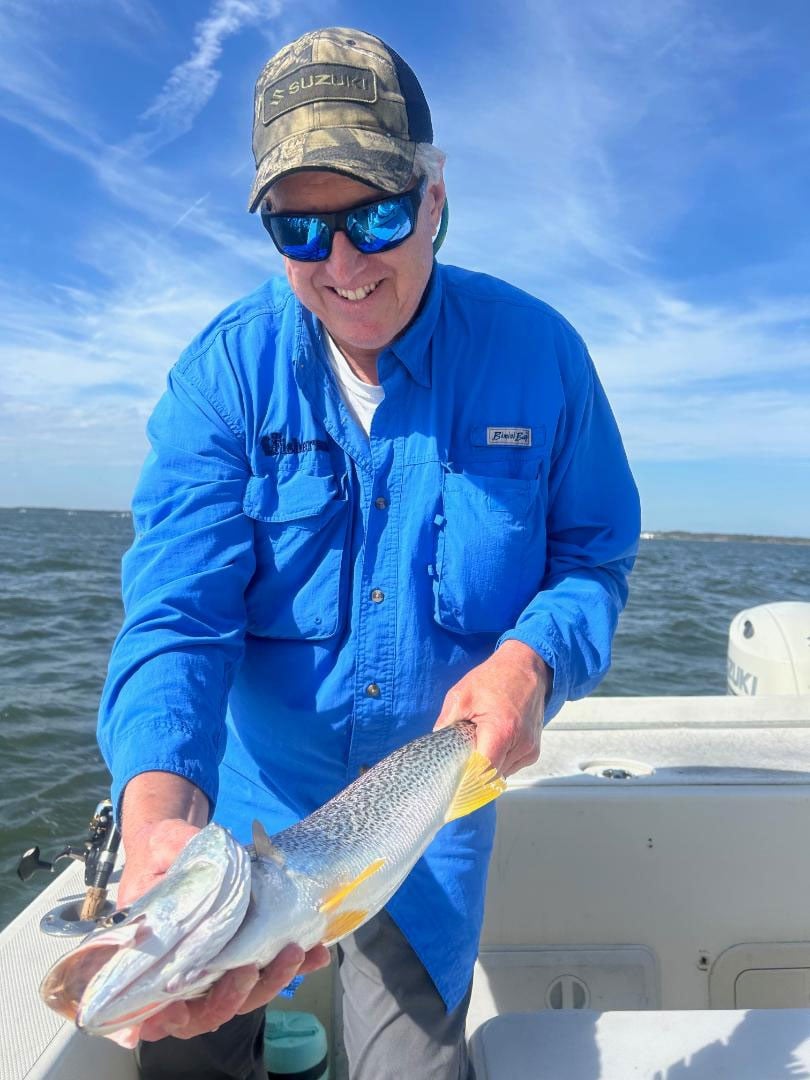
Impending Storm
The study included weakfish from Delaware and Chesapeake bays. Of those aged by reading the otolith the oldest was 17 years. Otoliths read by two separate readers showed a 99.8% agreement. The report showed a continuous increase in size and abundance of weakfish in both Delaware and Chesapeake bays until 1989 and 1990. Delaware Bay reported 981 weakfish over 751 millimeters total length in 1989 and that fell to 11 millimeters in 1990.
The World Championship Weakfish Tournament suffered a fatality during the 1989 edition. I was not in attendance as I was home packing up for a move to Virginia Beach when a nasty, tightly wound thunderstorm crossed Delaware Bay and caused one of the boats in the tournament to capsize. The captain was lost. The storm later moved to the Chesapeake Bay where it killed two boaters in Maryland and two more in Virginia.
You didn’t need a boat to cash in on the weakfish bonanza. I caught them from shore at Indian River Inlet on bucktails. The best location for me was where the beach and the rocks come together on the southside. I would fish incoming water at night and allow my bucktail to drift across the sandy bottom on the inlet side and usually find a willing customer. Fenwick Island was another good location for land-based fishing. Here you used live spot in the fall and caught large trout on every cast. Everyone in Virginia Beach was targeting striped bass. I did catch a few trout on bucktails meant for stripers and of course, I fished for speckled trout with Mr. Wiffle. It wasn’t until the last few years, after I returned to Delaware, that I began to see more and larger weakfish.

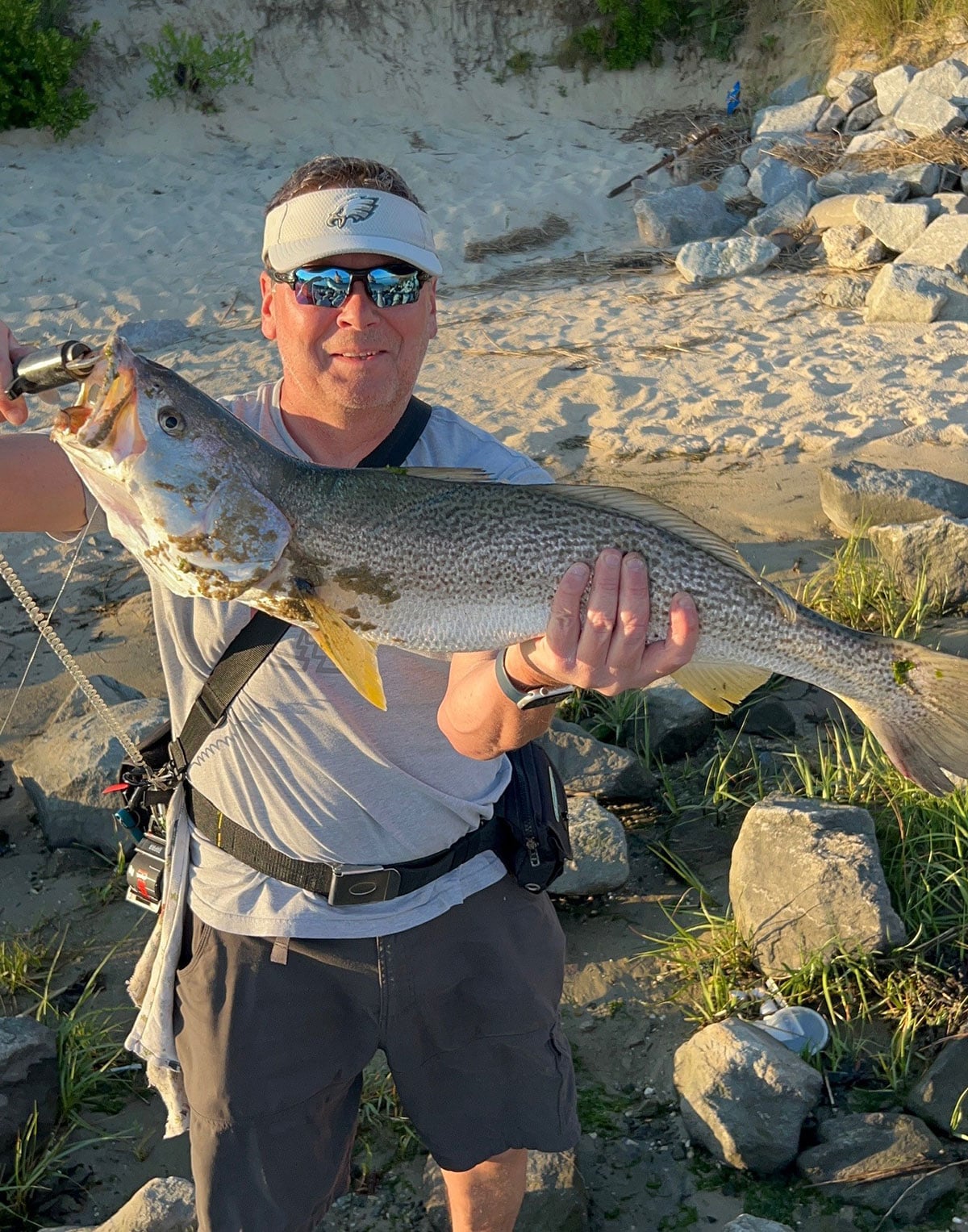
I currently do fishing reports for three outlets, The Fisherman Magazine, the WGMD radio station and the Delaware Department of Natural Resources. As such, I am seeing more large trout being caught every week. I also have personal experience of catching small weakfish in various locations in the Lower Delaware Bay. These small trout are usually schooled up and when you find them it is a fish on every drop. When this occurs, I have to move because weakfish do not survive catch and release as well as some other species such as bluefish and striped bass.
Delaware does do a young-of-the-year (YOY) survey on weakfish and beginning in 1980 they used a 16-foot trawl to survey Delaware Bay and in 1986 they began using the same equipment to survey Indian River and Rehoboth bays. I was surprised to see a high number, 11.486 for 1982 and 12.938 for 1986 when the weakfish catching was going downhill. Other numbers for the same time period were 4.72 for 1980, 4.71 for 1983 and 6.666 for 1984.
The Inland Bays did not produce large numbers of YOY. Most were in the range of 1.142 in 1986 to 2.997 in 2016. The highest YOY in the Inland Bays was 5.089 in 2020. The YOY in Delaware Bay that same year was 5.796.
Finally, Delaware uses a 30-foot trawl in Delaware Bay and records the number of weakfish caught per nautical mile. The first year this was done was 1980. The relative abundance was 28.2. That number increased to 311 in 1996, then dropped to 39 in 2005, 38 in 2014 then back up to 162 in 2024. There were three good years in a row, 2017 at 101.98, 2018 at 133.19 and 2019 at 213.02. I believe we are seeing those fish today as the number of larger weakfish show up in recreational catches.
There was a time when I believed we could control the fish in our oceans and bays by careful management. Then I was sent to the State-Federal Striped Bass Management Board as Delaware’s Recreational Representative. I soon saw that fish have their own agenda and man can only follow along. We can try to protect what they leave behind when their population drops to keep their species from going the way of the passenger pigeon.
What we cannot do is manage a species to our specifications.
The author is a freelance field editor for The Fisherman, and he’s been penning columns here since 1973. In 1982, he served as founding editor and publisher of what was to become the Mid-Atlantic edition of The Fisherman, an edition which is no longer in print.