April’s prespawn bass fishing is as good as it gets across southern New England!
So, you want to catch a true trophy largemouth bass? Well, you’ve come to the right place. But I should start with a warning: what you’re about to read isn’t just about a hobby. For me, this is a seriously unhealthy obsession. There is nothing on planet earth better than the pursuit of a giant bass. I’ve been at this for over 27 years, and I can tell you plainly that it takes an immense amount of dedication, passion, and patience.
You’re going to face a rollercoaster of ups and downs, wins and losses, but I wouldn’t trade a single “skunked” day for anything. This is the hardest game in the world. I fish for everything – freshwater, saltwater, you name it – and out of every species I target year in and year out, the Northeast trophy largemouth is by far the most challenging. The mental game, the microscopic attention to detail, and the pure discipline required is enough to drive anyone crazy.
But that’s the price of admission. These fish don’t get big by being dumb.
The Big Bass Mindset
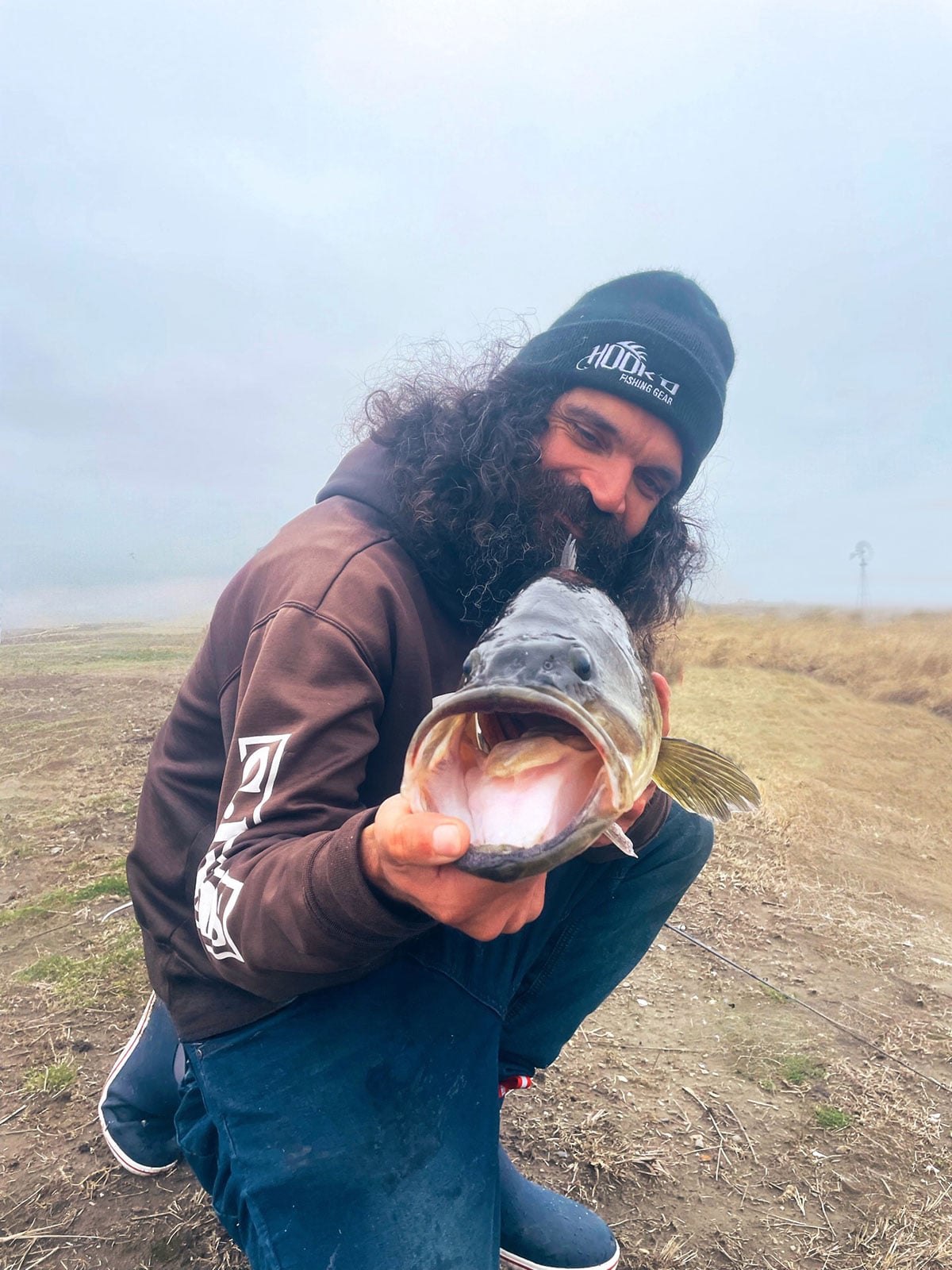
When you decide to chase giants, your entire mindset has to shift. You have to throw the “numbers game” out the window. Most fishermen want to see the rod bend every 20 minutes; if you want a trophy, you have to be okay with silence and repetition. You might throw a single bait for weeks without a single tap.
In this arena, you aren’t looking for “fish” you’re looking for the fish. You are hunting that one specific moment, that “Hail Mary” bite that changes your life. If you can come to terms with the fact that quality trumps quantity every single time, you’re in the right frame of mind to land a true monster.
I call this “Pep Talk 101.” I might sound a bit crazy, but you have to talk to yourself out there. You have to keep your mind rolling and stay confident when the water feels empty. You have to sort things out in your head, asking yourself, Where does the biggest fish in this lake live right now? What is going to make her commit to my presentation? If you lose your confidence, you lose your focus, and when that one giant finally strikes, you won’t be ready.
Hunting The Alpha
To find a true giant, you have to understand that big bass are the undisputed alphas of their domain. They aren’t social creatures, and in their world, sharing is definitely not caring; they want total seclusion, easy access to a high-calorie meal, and a sanctuary that requires minimal energy output. When I approach one of these isolated spots, I go into it with the assumption that there will be one alpha fish hanging on that prime location, and that’s when presentation really has to be perfect.
You will also find these giants on staging highways – deeper structure immediately adjacent to spawning flats – where big females wait for the perfect moment to move up. If they aren’t on the move, they are likely buried deep in the jungle, haunting the heaviest vegetation they can find. For those fishing from a bass boat, kayak, or canoe, offshore humps, ledges, and deep reed edges are the primary target zones where roaming giants congregate. Perhaps the biggest secret of all is the drawing power of isolated cover. A single big stump, one lonely dock, or a solitary rock pile in the middle of nowhere can serve as a queen’s throne. A giant bass will claim that solitary spot because it offers 360-degree hunting views and the total security they crave.
Timing is everything when it’s time to hunt for giants, and understanding the windows of opportunity is what separates a lucky day from a legendary one. The pre-spawn period in late winter and early spring is the golden hour; those big females are feeding with a reckless aggression before they settle onto their beds. Low light is your greatest tactical tool – dawn, dusk, overcast skies, and even heavy wind or cold fronts can increase your odds exponentially by catching these fish completely off guard.
The impact of a storm front is a double-edged sword that requires a sharp eye. When the pressure drops, big bass often go absolutely nuts, but those same fronts can just as easily shut the bite down and kill the action for a while. You have to pay close attention to how they are eating your baits to know if they’re still “on.”
Heavy Artillery
If you want to catch a giant, you have to offer a high-calorie meal. A massive bass isn’t going to move 20 feet for a snack; she wants a steak dinner. My top big-bass presentations are designed to appeal to that ‘big meal mentality’ and trigger her predatory instinct.
When you step into the world of the swimbait game, you’re entering a realm where names like the Huddleston Deluxe and its close cousin, the 68 Special aren’t just lures, they’re legends. Success here depends on mastering the Rate of Fall (ROF) system for precision fishing. You’ll rely on the ROF 5 as your “slow-play” king, drifting it through shallow waters where its five-feet-per-ten-second sink rate just hangs in the water and looks perfectly natural to a wary giant. But when you’re grinding in big reservoirs, you’ll need the ROF 12 which punches down 12 feet in that same 10-second time period, reaching the deep structure where the true alphas hug the bottom.
This heavy artillery is bolstered by a tactical arsenal that includes glidebaits like the River2Sea S-Waver or the Berkley Nessie. These lures draw fish from a distance with a wide S-pattern gliding action, they may not eat it but they will usually follow, revealing a monster’s location even if she doesn’t commit. Here again, the glide’s ability to hang naturally on the pause and to swim as if it were alive are the keys to getting that big old girl to come out for a look. It’s important to remember that while an 8- to 10-inch bait might still tempt a smaller fish, its true purpose is to signal a meal so calorie-dense that a massive female decides she simply cannot pass it up.
A Size Smaller
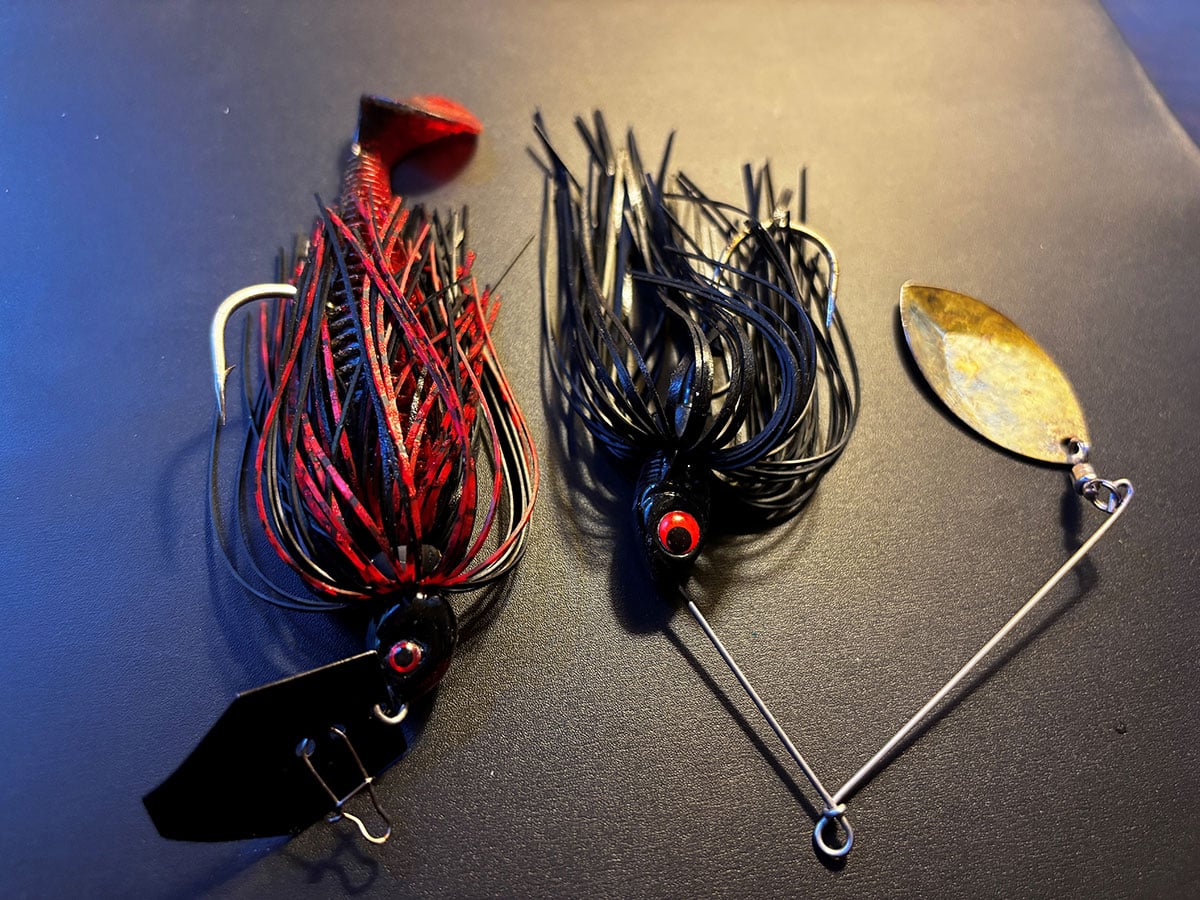
In addition to the heavy artillery detailed above, in April there are two ‘smaller’ baits I simply will not put down, the bladed jig and the spinnerbait. I’m obsessed with this dynamic duo because they are an incredibly deadly and diverse one-two punch. Big bass love to crush these baits; the vibration, the flash of the blades and their “edible” size range, makes them hard to pass up.
If you know me, you know there is nothing I like more than aggravating a big bass into a strike. For those lazy, post-front fish, you can slow-roll a spinnerbait or a bladed jig through the same high-percentage areas – shallow grass flats, bluff walls, ledges, and rock piles – without being kicked out of your pattern. I often see guys get carried away, switching from a jig to a topwater every ten minutes, which leads to “junk fishing.” My advice is to stay the course, keep the pedal to the metal, and don’t be afraid to make small, calculated tweaks.
I remember one night in particular last spring where I had been on a big bass bite for a week straight, having figured them out just before the April full moon. It was absolute gangbusters until a flash front rolled through around 2 a.m. I had those fish timed down to the hour, knowing exactly when they were pushing up to eat, but the moon and the front shut them off. Scrambling to make sense of the situation, I knew my window was closing fast. I decided to improvise: I slightly bent the blade of my jig and cut the tail section of my paddle-tail trailer vertically to create a more subtle, fluttering profile. That tiny adjustment was like throwing a lit match into a haystack.
What I’ve noticed over the years is that you have to be creative and thorough. It’s all about the “angle of the dangle” – covering water effectively and making sure you give them the right look. If things get slow, don’t be afraid to improvise by switching up your blade colors, skirts, or trailer styles. Think outside the box and, most importantly, have patience. Hunting big bass is a specific mindset that not everyone possesses.
Be On Time
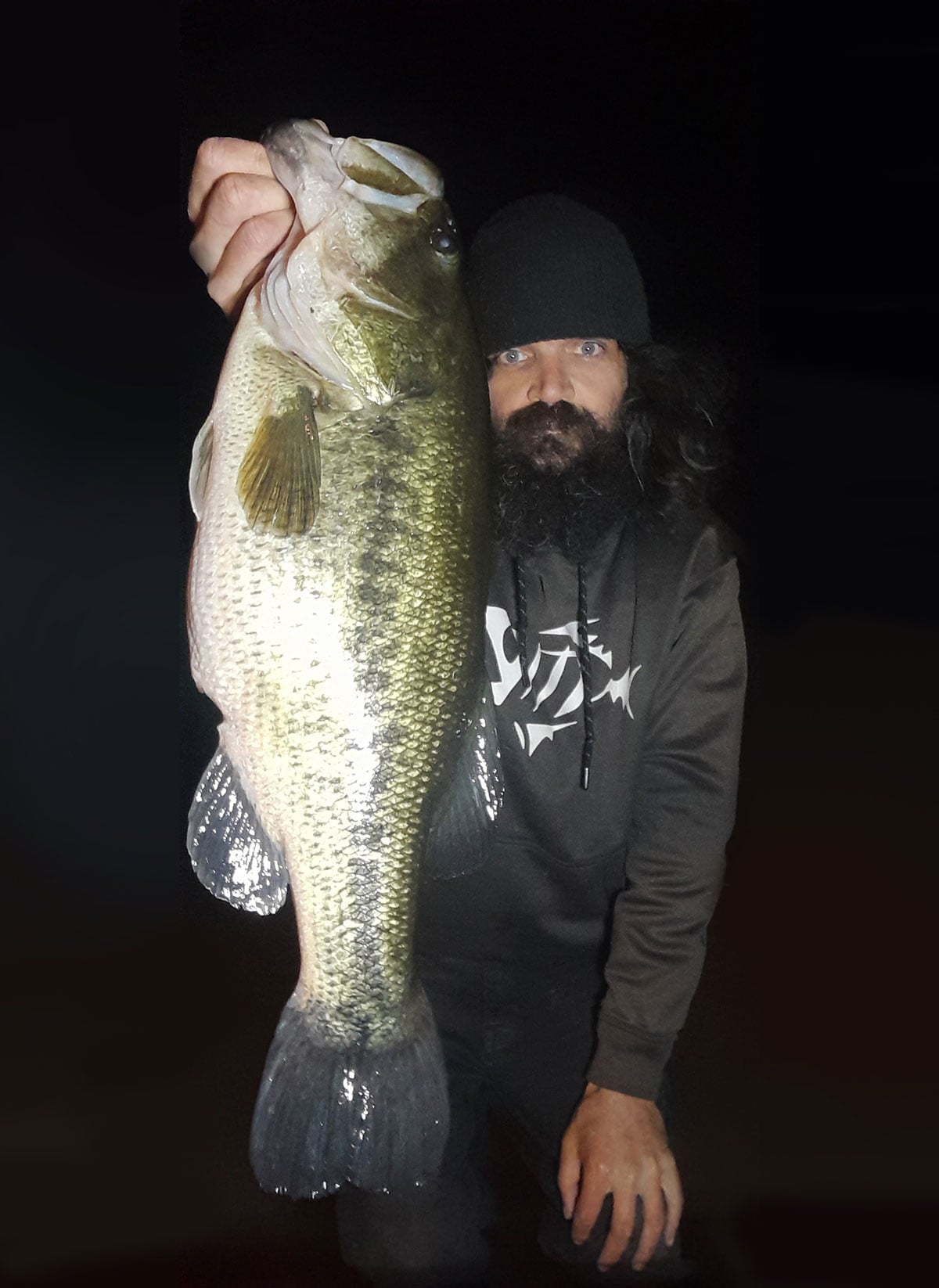
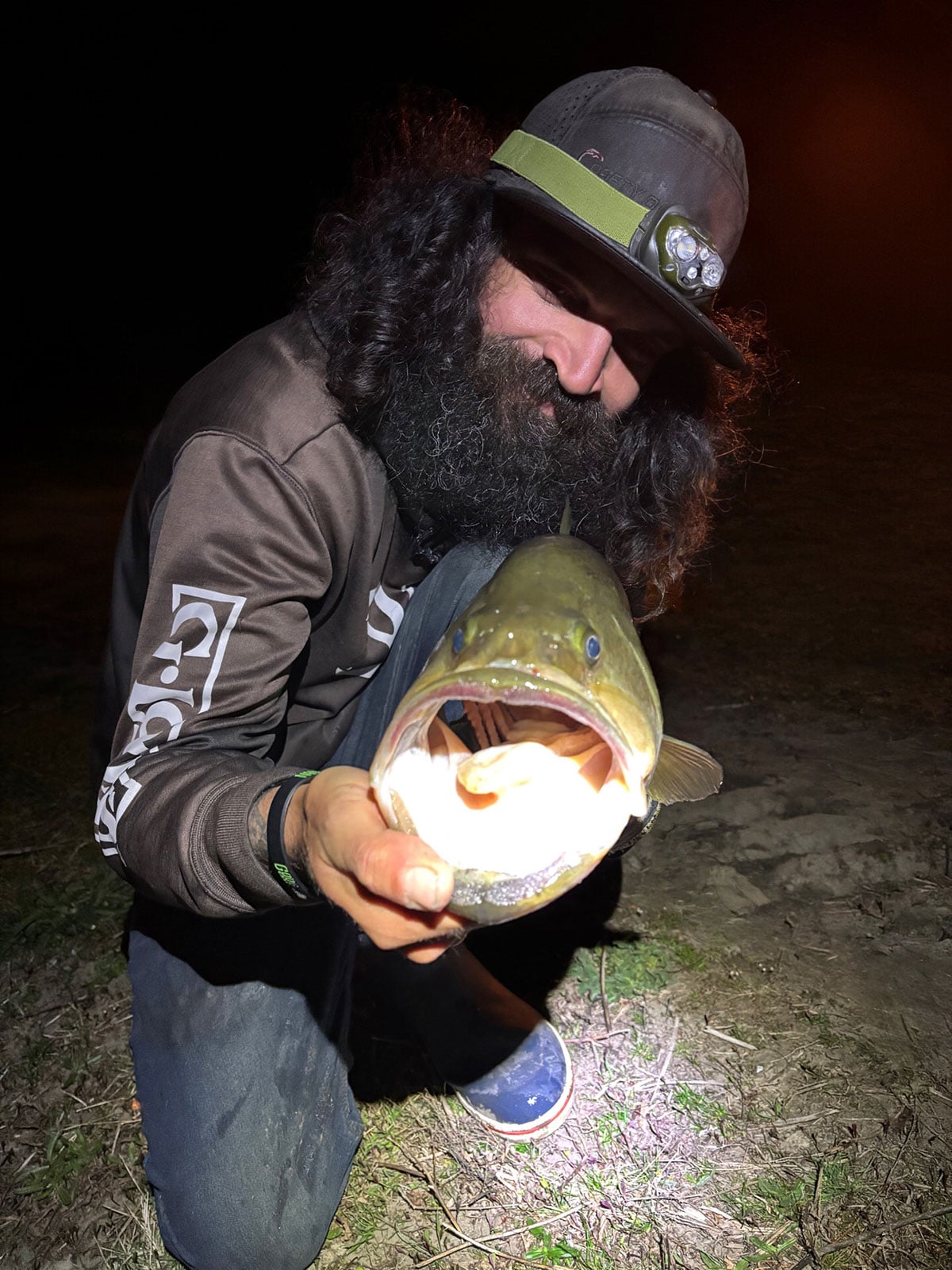
Of course, having the right bait means nothing if your timing is off; you are on the fish’s schedule now, not yours. You have to hunt the peak windows. These moments are highlighted by the new and full moons, storm fronts and factors like herring runs or perch spawns which really get these fish in a feeding mood. And if you really want to cash in this month, you have to be ready and willing to go at any time of the day or night. In fact, nighttime might be the best time to connect with these prespawn giants.
Hook a few giants, suffer a couple defeats and you’ll quickly realize this is “Battle Bassin’,” and you had better leave your finesse sticks at home. You are going to war, and that requires gear that won’t explode when a 7-pounder surges under the boat. You need the “All-Rounder” Dobyns 7- foot, 9-inch, or the “Heavy Hitter” 8-footer to launch those 6-ounce baits with ease. These are paired with high-capacity, slow-retrieve reels like the Shimano Calcutta 400b or Corvalus 300 to keep your presentation steady and natural.
Your connection to the fish is a heavy-duty 50- to 65-pound braid main line joined to a 20- to 40-pound leader of Opsin fluorocarbon connected via a rock-solid FG knot. In this game, there are absolutely no compromises; a giant bass will find the weakest link in your tackle and exploit it instantly. Use the strongest hooks available, buckle your seatbelt, and ensure every detail of your rig is perfect before you make that first fateful cast.
Chasing giant largemouth isn’t just about the weight on a scale or the photo on your phone. It’s about the pursuit. It’s about the long nights spent rigging gear, the hours spent breaking down maps, and the discipline to stay focused when you haven’t had a bite in three days. When it finally happens – when your plan, your mindset, and your skill all collide – there is no better feeling in the world. You’ll lift a fish with thick shoulders and an oversized jaw, a fish that feels unreal in your hands.
So, do yourself a favor: press the mute button on your buddy’s fake 10-pounder story. Stop waiting for the “perfect” day. Go out there and make something happen. That fish of a lifetime is only one more cast away. What are you waiting for?