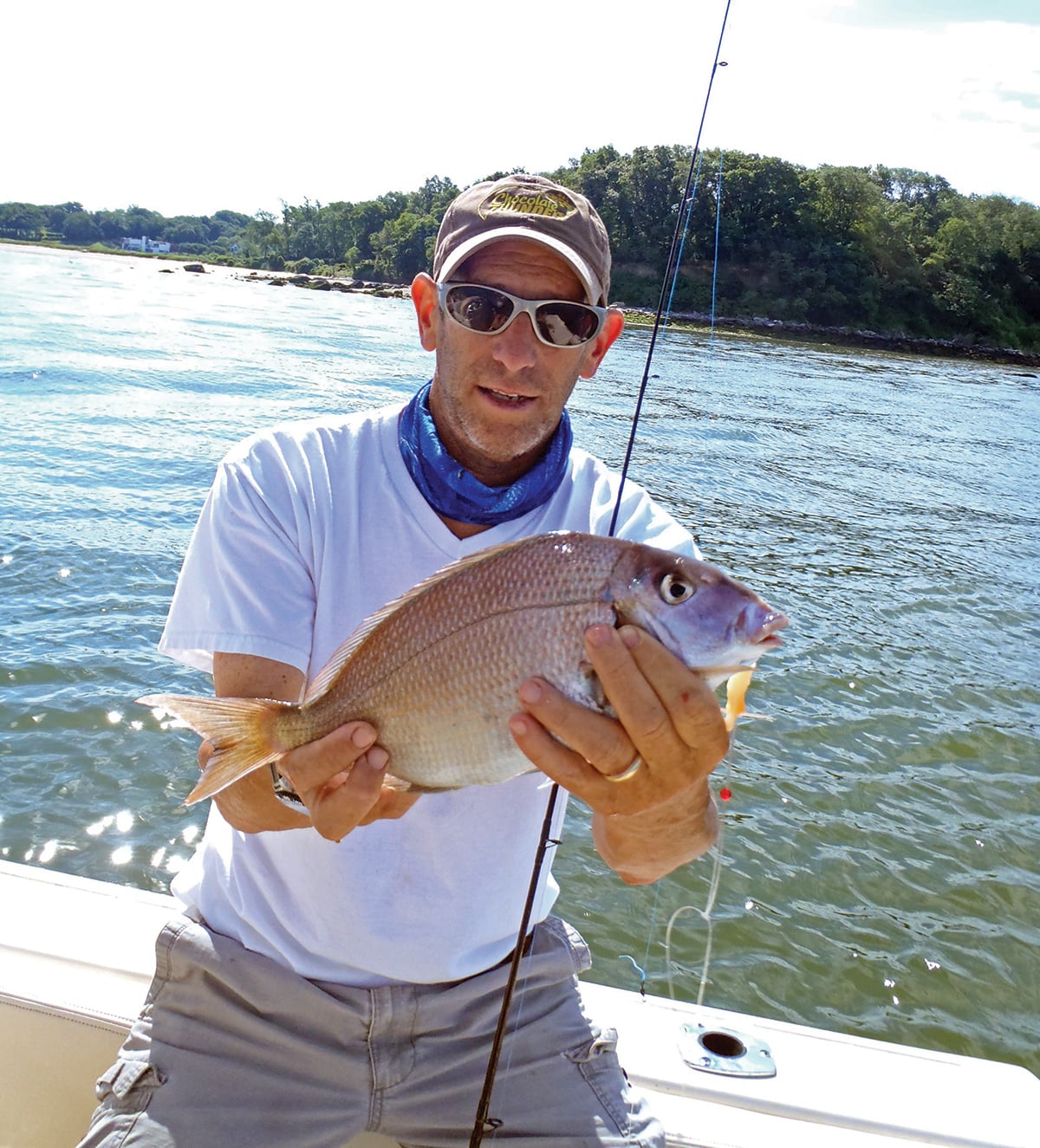
This is the era of abundant porgies: a rebound in population after a major decline in the mid to late 20th Century. This is exciting, not only because porgies are abundant inshore and offshore, but there are lots of big ones, too. In fact, for those with bigger boats who are able to explore deep structures and wrecks, it’s no feat at all to find monster porgies. But what about the inshore angler wedded to a small boat?
There are always more younger and smaller fish in a population than larger older ones. That’s just reality no matter what species we are talking about. Where we ask, can smaller more vulnerable porgies that require smaller food items hide out? On offshore wrecks, they’d be sitting ducks for everything from sharks to big stripers and blues, to large cod, and who knows what else? Therefore, larger porgies are more common than little ones in deep water spots.
Smaller porgies scatter into the shallow estuarine areas where they can hide in rock piles, weed beds, and the shallow nooks and crannies that abound in the estuaries. Yes, there are predators on the inshore grounds, but both the variety and the actual number of out-size predators is smaller. Besides, it’s easier to grab an adult bunker than chase a porgy around the bottom. In the first few years following a large year class the porgy grounds may be overrun with small or “sand” porgies, and this sometimes creates problems for inshore small boat anglers. Anglers may experience great action, but most fish will be very small. That’s not to say one won’t catch big fish on any of the well-known porgy spots. Rather, in the quest for bigger fish you will consume lots more bait, do more rebaiting, spend tons of time unhooking small fish, as well as become frustrated. Clearly, in my experience, abundant little guys are the biggest impediment to catching big porgies in the shallows. Many anglers settle for slightly deeper spots where sand porgies don’t usually go, but even here the truly large specimens may be few and far between.
Solutions
Can the goal of catching bigger porgies in the estuary be achieved? Yes, but an angler will usually need to do a little exploring and experiment with different techniques, baits and chumming. This is a mind set and a discipline that an angler must commit to. If, as an angler experiments and explores, the itch for a bite becomes too strong, there will be pressure to throw up your hands and settle for the action of little fish. My pals and I know all about that “itch” that begins with a tickle and soon becomes too strong to resist.
Rich Lazar and I have spent a number of trips seeking but not always finding bigger porgies, but we continued to return to familiar places like Execution Light, Prospect Point and Centre Island. Why didn’t we explore? Hard to say, except that the anglers on board trusted those spots. Eventually, after spending weeks not finding big fish, a willingness developed to sacrifice the sure bite in favor of a hunt for bigger fish. So, we set upon a new strategy. Every trip we tried a new area. True, most of these spots either produced nothing, very little, or a ton of 5- to 7-inch fish, but we kept trying nonetheless: that was a key. Eventually, we began to realize that we needed to think out of the box.
In the beginning we reasoned that bigger porgies might be in deeper water, so we plied spots that were new to us in 20 to 40 feet of water. We had some success doing this, but although the number of fish caught was impressive, we only caught a few big fish. We began to adjust our strategy. Rich, for example, tried a dock line in the harbor in about 10 feet of water. He thought that old established docks would have barnacles, mussels and even worms growing on the wood, and the thick posts would also represent some structure. That night he called me all charged up. He’d caught a mess of big porgies and we both believed he’d figured something out. However, we made a number trips to those docks after that and caught nothing. The moral: sometimes success can fool you. However, one of the chores that must be done in order to consistently catch big porgies in the estuaries is to eliminate the water that holds no fish, small fish, or an unsatisfactory mix of fish. It was important for us to be persistent.
Isolated Spots
Next on the list were isolated high spots that produced current immediately around the elevation, but no current even 20 feet off the rise. Exploring these places was a move way out of the box because we never saw anyone fishing at these spots. Although the first few drops were fruitless, soon things began to change. I dropped clam baited hooks onto virgin bottom while Rich filled the chum pot. I landed three big fish before the pot hit the bottom. Now, let me make this clear about porgy fishing. If you get hits and catch fish as soon as you lower those baits, you know there are lots of fish around. Although pleased with our success, we discovered the following season that porgies don’t arrive on that spot until mid-August. We suspect it’s about the bait and the spot doesn’t attract porgies until young of the year baitfish grow to about one inch. The spot also cools off early as the baits continue to grow and then are chased into open deeper water by stripers and blues. I guess what I’m warning is that the out of the box spots may produce big fish, but perhaps only under certain conditions of moons, seasons, baits and tides. If you find a spot like this, work out the idiosyncrasies rather than give up on it.
Old Spots
Yes, old spots but not old porgy spots. How about blackfish spots? At first, we dismissed this because we never saw any boats on these grounds during porgy season. We also considered that blackfish spots are rough structure places and we’d likely lose a lot of rigs just as you do when you fish for blackfish. But, what if the porgies are there, and you can catch 14- to 16-inch fish? The decision to fish these spots is a tough one: especially if you lose a few rigs in a hurry, because you know there are lots of locations where you can enjoy hot action and not lose a ton of rigs. The decision to fish in very rugged structure is one that requires a commitment to bigger fish, but they are found there.
Reefs and Wrecks
Not all reefs and wrecks are located in deep ocean waters. There are reefs and wrecks scattered about from the Throgs Neck Bridge to Orient Point. Some of these are charted, but others are not. Indeed, there are big-time structure areas in the extreme western Sound such as around Execution Light and Centre Island waters that are loaded with rock reefs. The problem is the charted reefs and wrecks are well known to most anglers, and therefore experience a ton of fishing pressure. However, there are lots of small pieces, too, that are not charted and not well known. An angler has to search for them, and finding a productive one takes time and effort. Rich Lazar and I found several such spots and in water less than 15 feet deep.
In another example, I fished a few years back with young John Richy for porgies. He took me to a spot in the middle of nowhere in Smithtown Bay. There were no other boats in the area and it took him some time to locate the small reef and then anchor correctly on it. Even if I knew how to find this spot; and I don’t, I wouldn’t give up a spot that a fellow angler worked so hard to find. Boy, did we ever bale the porgies.

No Formula
Sadly, there’s no formula for finding these small honey-hole locations, except to say that time, work, disappointment, planning and eventually exaltation are all pieces of the puzzle. One tip I can offer that should help you eliminate water is, don’t fish where there’s a queue of boats, because those places are the well-known and well-traveled spots. Even when big fish are caught in these spots, they are often picked over pretty fast, while the locations you ferret out will not be picked over. Of course, even though most small bottom pieces will hold fish, not all spots hold big fish. Finally, the spots you find may not hold big fish on each visit. Try to correlate the appearance of big pork chops with a precise set of conditions such as moon phase or stage of a tide. For example, a few big fish spots we found only produced big specimens for a few hours on a particular tide, although smaller fish were generally always available.
Anchor & Chum
Generally inshore, the bottom structures you find are smaller, so drifting across them is problematic. Not only will you be in the productive zone for a short time, but a slight shift in your drift and you’ll miss the spot completely. Anchoring and chumming is the best way to approach these small bottom pieces, and patience is essential. Often, the porgies will range off the piece in all directions, and it may take a little time to gather them up with the chum. We use a 20-minute rule: if nothing happens in 20 minutes we leave. We also found that the smallest porgies are the ones that bite first, perhaps because they don’t range far off the piece. Again, be patient. We have found when we wade through the smaller fish we usually have a flurry of big fish.
Not Like Deep Water
Boat anglers who work ocean spots or even the eastern end of the Sound, get on big fish and only big fish. There’s little doubt that the biggest porgies typically, but not always, prefer deep water bottom areas, and eastern waters over western areas. Therefore, when we fish in shallow water, we are looking for flurries of big fish rather than two continuous hours of big ones, and that’s a realistic expectation. Fishing is always a trade-off between various components. Deep water ocean bottom anglers typically make longer runs that require more fuel and thus more money and, must also put up with rough seas. Folks in the estuaries have shorter runs and calmer water, and spend less money on fuel.
So, my message is, don’t give up on bigger porgies because you fish shallow in the estuaries. Get away from time-honored spots that are heavily fished and sooner or later you’ll find a few small spots that produce bigger porgies.