Rumblings from the federal management level are causing concerns in the Northeast.
By most accounts, our 2026 bluefin fishery hasn’t exactly been gangbusters. Most folks I’ve spoken to believe the Angling category success – or relative lack thereof – has been impacted as much, if not more, by the higher price of gas and rising tackle costs as compared to actual bluefin availability. So when NOAA Fisheries announced that the General category was being shut down as of September 24 due to harvest, many anglers became enraged.
Fret not, the General category is commercial rod and reel quota – there’s also harpoon (which is now closed), longline trap, and reserve quota. According to NOAA Fisheries, General category bluefin quota was 216.1 metric tons for the month of September, while updated federal landings came in at 221.8 metric tons. For the two time periods to follow (October-November, and December) for overall General category quota one would assume that the overage will come out of the148.4 metric tons of General quota remaining in ‘26.
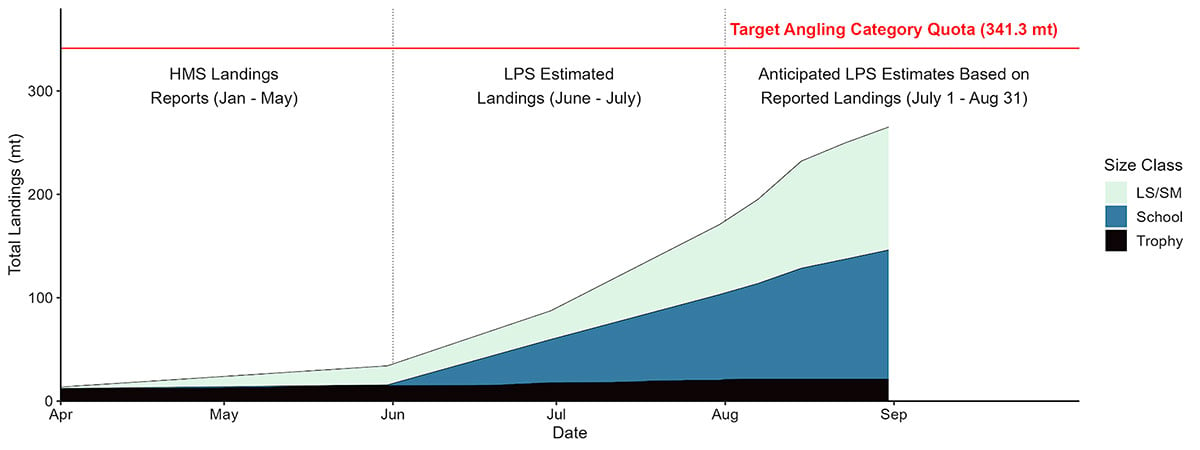
Keep in mind the General category segment historically shuts down with more regularity than this season; generally speaking, it’s normal operating procedure. But that doesn’t mean we’re out of the woods in the Angling category. During a Highly Migratory Species (HMS) advisory panel meeting in late August, NOAA Fisheries revealed that recreational bluefin landings, at its current pace, could lead to action this fall to close the Angling category fishery.
For some recreational fishing representatives who sit at the HMS advisory table, this rather dire warning from the federal government doesn’t sit well given the clear socioeconomics of this year’s recreational fishery, as well as what clearly seems to be a reduction in effort, availability, and landings of school size fish this year compared, for example, to 2024. “What we are seeing across the region, tackle sales, fuel sales, and reports for bluefin tuna diehards is that the 2026 season has been lackluster, fewer boats catching them or looking for them,” said John DePersenaire, Director of Government Affairs & Sustainability and Viking Marine Group. “In short, 2026 is nowhere near the 2024 season in terms of availability or catch,” he added.
Fellow ICCAT Advisory Committee (IAC) member Nick Cicero of the Folsom Corporation, a major wholesale fishing tackle distributor nationwide agreed that retail indicators are noticeably down. “We typically know that tackle sales, especially consumables usually keep pace with the activity in any fishery,” Cicero said, adding “This season merchandise that could be associated with recreational size bluefin was on par at the beginning of the summer but fell off sharply after a few weeks.” Cicero went on to say, “Most retailers report inconsistent fishing and high fuel prices as being the reason.” That seems fairly intuitive, Recreational Fishing 101.
Another IAC member, Capt. Mike Pierdinock from the Stellwagen Bank Charter Boat Association (SBCBA) in New England, noted how weather has also played a part as well. “Up her the winds and weather have also kept many at the dock, winds 15 to 25 knots or more and ongoing NE/E/SE, winds that are not safe or conducive for fishing,” Capt. Pierdinock said. He also noted that for-hire trips are down 30%.
“Recreational fishing was spotty earlier in the season and the rec fish are tough to come by the past few weeks, nowhere close to the closure in 2024,” Capt. Pierdinock told The Fisherman on September 18, adding “Rec guys are being selective as a result of fuel cost and few leaving the dock unless they have a good shot.”
For those who participated in the trophy bluefin fishery this season – fish from 73 inches and over in length – it was a rather brief fishery again this first part of the year. But heading into the fall, there are concerns about how NOAA Fisheries will view their large pelagics survey (LPS) information for angler catch and effort through the entire length of season, which appears to be approaching the targeted Angling category quota of 341.3 metric tons.
“No one believes we are anywhere near the 341-metric-ton angling category quota for 2026,” DePersenaire observed, noting how industry leaders are currently gathering retail and for-hire data to support claims of lower activity in 2026. “There is absolutely no reason NOAA should shut down bluefin tuna prior to December 31. We need to have a full year’s season to help restore that confidence that there will be a fall fishery,” DePersenaire added. Hopefully, NOAA bean counters don’t discard logic and experience when reviewing these numbers.
In addition to the total poundage of 341.3 metric tons in the Angling category quota, there’s also school bluefin quota that’s more of a hard number; Those school bluefin in the 27- to less than 47-inch represent 10% of the total allowable catch (TAC) along the Atlantic Coast. As DePersenaire noted, “Exceeding that size class quota is a bit more concerning because it’s absolute and can’t exceed 10% of the total US TAC.”
As we head into the heart of our fall bluefin fishery, keep your fingers crossed and your tuna hooks sharpened.