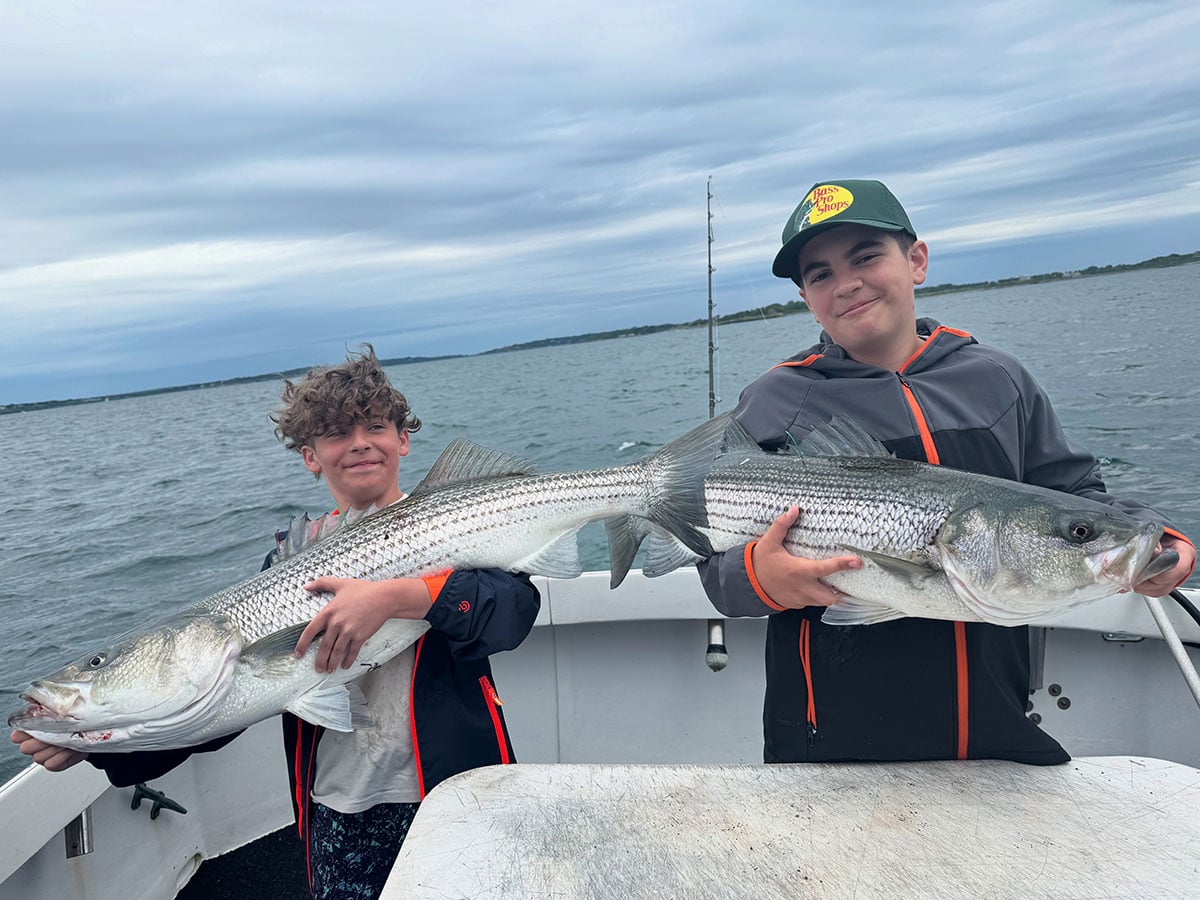
When the fish feel a sense of urgency, it ignites the bite!
I can definitely be considered an “old school” kind of guy. You know the saying, “If it ain’t broke, don’t fix it!” That basically sums up my way of thinking. And I’ll be the first to admit, I can get stuck in my ways when it comes to fishing techniques. Over the years, my daughter, Coral, has introduced me to some new ways of fishing. Different lures I never would’ve thought to use, lighter gear when us old timers only used broomsticks, new electronics… the list goes on.
About six years ago, Coral and I were on a charter targeting stripers. We’re usually very successful with them, and we have a lot of different techniques. One of our go-to methods, especially when we’ve got limited time or less-experienced anglers onboard, is trolling a tube and worm. For a few days straight, that bite just wasn’t happening. We were marking plenty of fish on the screen, conditions looked perfect, but nothing would touch the tubes. It had us scratching our heads.
I remember Coral digging through our gear looking for something different to try. She pulled out a couple parachute jigs. I had used them before, but honestly, I wasn’t very practiced with them. Coral had never used them herself, but she knew what they were. She looked at me and said, “You’re always talking about urgency. Let’s try these. If we troll a little faster and work them, it might trigger a bite.” And just like that, success! The fish reacted immediately. That moment really stuck with me. It was a perfect example of how changing your presentation and creating some urgency can flip a switch, even when everything else seems right.
When I talk about “urgency,” I mean those moments on the water when everything lines up and fish feel pressure to eat “right now”. The dictionary definition says urgency highlights importance and defines a situation that requires quick action. From the fish’s side, we’re trying to recognize the conditions that put them in that urgent mindset. For example, when current, bait, light, tide, weather, or pressure come together and increase their chances of feeding. When that window opens, fish tend to get more aggressive because they know the opportunity won’t last long.
From the angler’s side, you can also create urgency. The way you work a lure can make a fish feel like it has to strike now or miss the chance altogether. Speeding up, slowing down, changing direction or adding a pause. These small changes can flip a fish from hesitant to reactive.
Read The Room
We’ve all heard knowledgeable anglers make broad claims, such as, “I prefer the outgoing tide” while another might claim that he only fishes the incoming. Then there are the claims about the moons, that often contradict each other, some might say that you should skip the full moon while others might say to never miss them! I guess it would be great if you could collect all your data every day over the years and figure out the perfect conditions that would tell you when to go fishing. The fact is if you were to rely on data alone, there would probably be a lot more days that you talked yourself out of going and you’d almost certainly catch fewer fish!
As a charter captain, I don’t have the luxury to let the conditions dictate when I go and when I don’t; if the weather is safe and comfortable for my clients, we’re going fishing. Coral and I make our schedules months in advance and we have to accommodate our anglers and find the fish in the allotted time. On a half-day charter, we don’t have time to dillydally, we’ve got to find the fish and get it done for our clients.
This is why most of the time we start by trolling with wire line, this gives us the opportunity to cover ground and locate areas where fish are more plentiful. This also gives us clues about how to adapt by taking note of how the fish react to our presentation. If we see fish on our sounder, we know they are there, and if they won’t bite then we know we need to adjust. When this occurs it’s usually because there’s no urgency. They might be comfortable, not pressured, keyed in on a different bait, or not willing to move much for a meal. All fishermen know that fish can be picky sometimes!
That’s our cue to adjust and change speed, depth, lure size or profile. Sometimes even a small tweak is enough to flip that switch. The fish didn’t disappear, the urgency just isn’t there yet. Our job is to either find the window where urgency already exists or create it with our presentation. If changing techniques or size/profile doesn’t do the trick, I believe that there is a sweet spot in the tide, whether it’s coming or going that creates this urgency to bite. It doesn’t matter if the fish are there, if they’re not biting, it’s time to move and find a more desirable current that will create that urgency.

Current Events
In Newport, Rhode Island where we run our charters, there is a lot of current to work with. We have the East Passage which is the main channel that empties Narragansett Bay. Just outside the East Passage is an area known as Brenton Reef, this long rock formation is often awash with breaking waves and marks the unofficial edge of the East Passage, the water to the east of the reef is typically between 8 and 40 feet deep, while the East Passage itself reaches depths of over 200 feet. As you might expect, this area builds a ton of current on both tide directions and it is known for producing some very large striped bass.
To have the best chances at hooking bigger fish, we have to find optimal tide. A good rule of thumb is that if you’re catching schoolie bass and small blues, the current is likely running too hard and you may need to move east to find slower tide. But sometimes, the tide may run too slowly and we combat this by moving closer to the East Passage and the funneling effects of the reef to increase our chances. This is just an example that illustrates how you can move around to stay in the kind of current that fosters an urgent feeding scenario.
No wind, no tide, no fish: it’s an old saying but holds true. Sometimes a parachute jig works well to help create a sense of urgency with how we work the jig. For example, we often see people trying to use a parachute jig but the key here is work the jig correctly to initiate that urgency. It’s not as easy as some may think. Oftentimes people just go through the motions, thinking hey I put on this jig, I’ll catch fish now. Wrong. The action needs to be a quick, short bursts. I often explain to my clients jigging, think of it as a baitfish that’s trying to get away, the fish sees it and their instincts kick in which triggers them to strike.

Words in Motion
Here’s a quick story of how presentation matters to create that urgency. A few years ago, we started off using the parachute jigs on a charter, myself or Coral will jig one rod, while we have a client jig the other. This helps our clients understand what we mean by jigging. We came up on a pile of fish and it was time to start, I give the ok and Coral and the client start to jig. Coral hooked up every pass while our client didn’t even get a bite. It became comical as our client insisted that Coral had the better jig color or she was just on “the right side of the boat”.
Sometimes color matters but In this case, the client was having a hard time working the jig correctly, their movements on the jig were slow as if they were rowing a boat. Coral then offered to switch rods and sides with the client to prove it was the motion of the jig that was creating the fish to bite. And you guessed it, Coral hooked up on the other side when we went over the pile again and the client did not. This was a prime example of urgency and how Coral jigged, made that sense of urgency to the fish which provoked it to bite.
When there is a lot of baitfish around, the stripers may become competitive, which sets up another type of an urgent scenario, this time the fish are extra aggressive because they’re competing with each other for food. When we see these situations unfolding we find that an umbrella can work well and take advantage of that urgency that’s already being created by the abundant baitfish. An umbrella rig rushing by looks like a school of bait trying to get away and the competitive stripers will usually attack.
When the tide is slack, you have lazy water; and lazy water means lazy fish. This will affect the fish’s sense of urgency. Now, I don’t know for sure why slack water makes fish less likely to bite but a theory of mine is, perhaps the baitfish have an easier time evading predators and the baitfish don’t move around as much. Slack tide almost makes it too easy for the fish, and it’s more comfortable for them to just sit and wait for something to swim by. This is when we use a tube and worm, drift eels or set up for some good old-fashioned chunking, which we love to do with lighter tackle. Sometimes we need to target another species in the meantime, like sea bass, until the tide comes up to speed and restores that sense of urgency.

Nature is Nature
It seems like all fish are affected by the urgency created by the tide, even tautog can bite ever-so gently and other times their bite can be so aggressive it yanks your rod down. I have seen this time and time again while targeting tautog, you may be fishing on a slack tide with no or very little activity and then the tide starts to move and the bite is on. This may happen because like the stripers, tautog are in no rush to feed, everything is calm, including the bait they feed on. In the case of stripers and tog, it’s the fact that a certain window of current presents a positive scenario that is more likely to yield feeding success, the urgency – in these cases – comes from the fact that they don’t want to miss that window.
Pretty much all the great bites you’ve experienced or heard about were brought on by something that made the fish feed with intensity. The fish may have been feeding heavily before a big storm to gorge themselves before the water gets beat up and the visibility goes to zero for a few days. Or maybe it was a massive influx of bait that stripers, or albies or bluefin corralled and blitzed on for hours. Or perhaps it’s something more reliable, a tide window you’ve uncovered after years of ‘putting in the work’ – in all of these cases, it’s a sense of urgency triggered by factors or conditions that came together to create a positive feeding situation.
So whether you’re creating the sense of urgency by stomping the gas on your presentation, giving the illusion of a baitfish ‘getting away’ or it’s a set of factors that signals an urgent feeding scenario, it pays to tune in on what’s making these fish react. Although I’ve been fishing the Northeast for more than 47 years, commercial and recreational, with the last 30 years as a sportfishing captain, I don’t consider myself an expert, I’m more of an observer. I’ve always believed in this sense of urgency and worked my whole career at trying to learn to use it to my advantage.
As I’ve gotten older, I’ve realized that I don’t know as much as I thought I did. But it’s that attention to detail and that tendency to observe that has carried me through this lifetime of fishing, and I hope my experiences help you catch more fish this season.