A segmented plan of attack for spring striper success in the Garden State.
Before we go further, let’s clear up a common misconception: big bass do not act like small bass! Yes, there is some overlap, like in some mixed-size blitz situations. However, like humans across age ranges, striped bass of different sizes behave differently. This has important implications for anglers who consistently seek quality over quantity.
With different migration patterns from their smaller counterparts, trophy-class striped bass frequent alternate regions at different times of the season, and at each, the optimal tactics by which an angler employs to find and subdue them differ. Personally, I like to segment the upcoming striper season into timeframes based on the regions giant stripers frequent. Understanding these regions, and the best strategies for each, will help a New Jersey trophy hunter increase their productivity.
For our purposes, the spring run in New Jersey can be sectioned into three distinct time intervals: beginning, middle, and end.

1 – Beginning
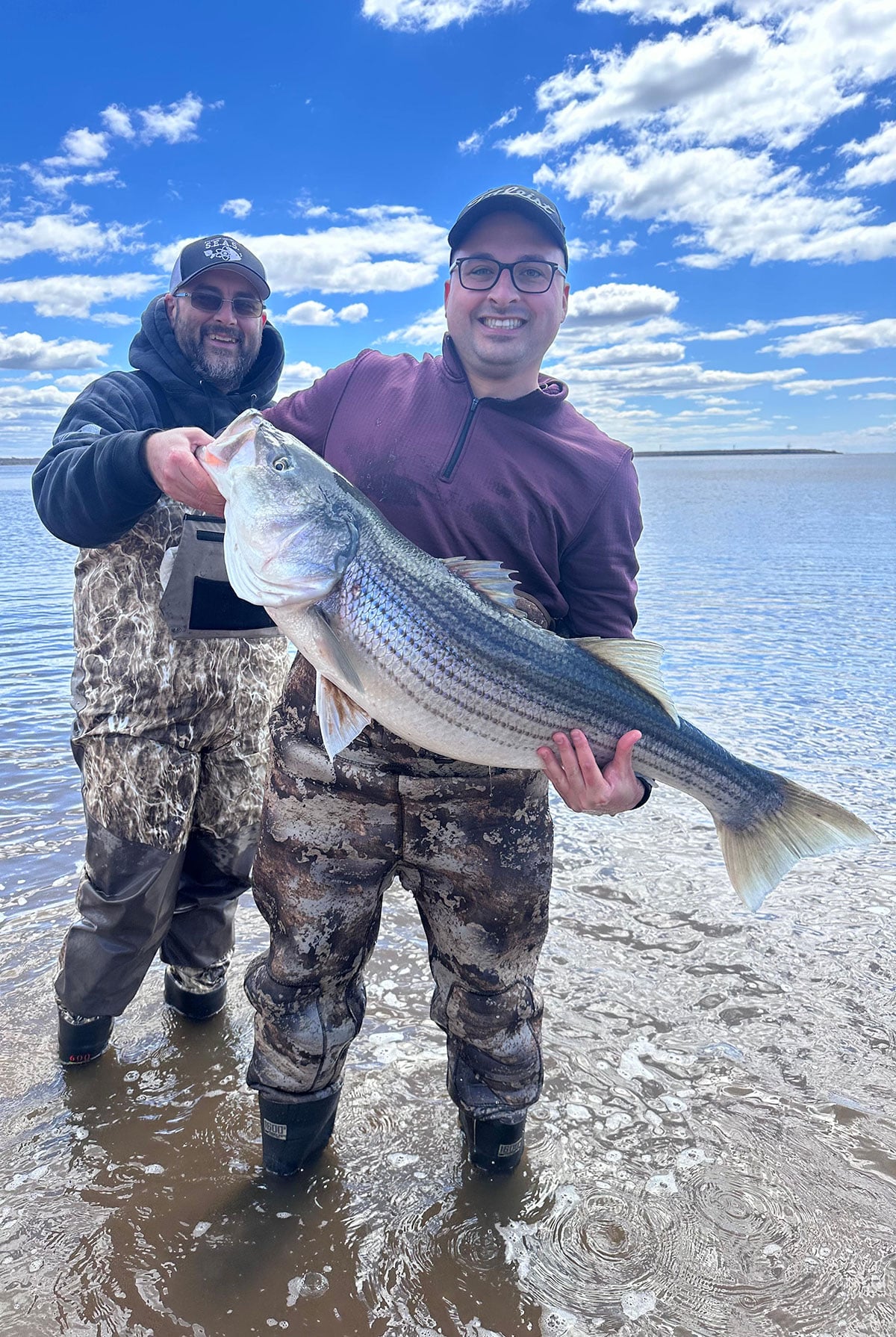
I define New Jersey’s “beginning” as the middle part of March through April, with a central focus on the last week of March and the first two weeks of April. This is the time of year when New Jersey anglers can land what I call “super-stripers”—when bass are heaviest, gorged on herring and carrying eggs for the upcoming spawn. Anglers who solely focus on “migratory” or otherwise post-spawned fish often don’t appreciate the extent to which pre-spawned fish are heavier. Bass at this time of year are literally 15 to 20 pounds heftier than later in the season. For example, at most times of the year, a 50-pounder is usually 50 or more inches, but in early spring, it’s not uncommon to see a 47-inch fish hit the 50-pound mark. One of my larger Delaware River fish of 2025 had a girth of 34.5 inches, which is over the length of what a keeper slot bass would be later in the year.
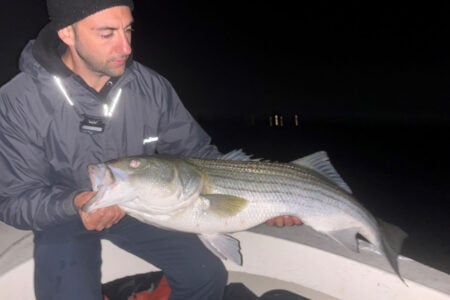
Another reason why major spawning and pre-spawning reaches are enticing for trophy fishermen is that they act as bottlenecks where fish of this size concentrate. Mature bass, especially large ones, are compelled to these areas each spring in order to spawn. The travel and process of egg development require a lot of calories, and hence a lot of feeding and fattening up. A savvy angler understands and exploits this. It should be said, too, that these same savvy anglers also understand the concept of proper handling: minimize handling time with big spawning fish, try to keep the fish in the water at all times, keep hands away from the gill rakers, and avoid the vertical lift. If you want a quick photo, place a hand on the jaw, cradle the belly, smile for the camera, and release the fish as quickly as possible.
Micro-spawning grounds like the Great Egg and Mullica rivers can hold big stripers this time of year, and they typically do. However, these places pale in comparison to the major spawning grounds. The Delaware River and upper Delaware Bay are collectively one of the two hot zones to focus on during the ‘beginning’ of spring. The Delaware River is one of three major spawning areas for the Northeast striper population, along with the Chesapeake and Hudson, and its adjacent bay is a staging area for and bottleneck to the river.

The other hot zone, of course, is the western half of Raritan Bay. The Hudson River is a second major spawning ground, and the massive population of Hudson spawners arrives in western Raritan Bay first to stage before the spawn. Adding to the region’s fruitfulness, this body of Hudson-bound bass temporarily merges with fish aiming for the adjacent micro-spawning tributaries of the Passaic, Hackensack, and Raritan rivers.
Two main tactics are optimal in these zones at this time of year. Bloodworms are arguably the top choice, especially in the lower half of the Delaware River and the shallows of Raritan Bay. Cast them around sand or mud flats. Flats are where these worms naturally reside, and the small volume of water there heats faster, invigorating the otherwise cold-adjusted bass to feed. Bloodworms can be fished in a variety of ways: on a fish-finder or high-low rig, and either in meshed “blood-bags” or directly on the hook.
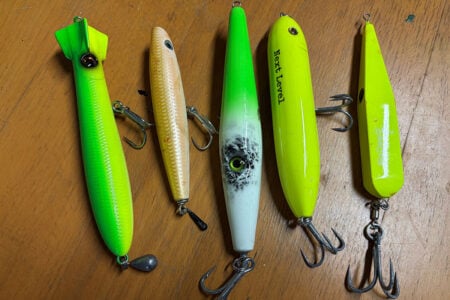
The other main tactic is using plugs, especially getting into April. Plugs that look and act like herring will work amazingly in Raritan but even better in the upper stretches of the Delaware. These include Bombers, Redfins, and SP Minnows. Strong hooks and split rings are essential. Through-wired plugs are strongly encouraged, not just because the bass are big and amped up on spawning hormones, but because these lures are best fished in and around current with structure. Tighter drags are therefore needed, putting more tension on the terminal gear.
The caveat to Raritan is that menhaden are the more predominant bait. Plugs that look and act like adult bunker will therefore outperform. Because the bay’s most productive spots are on or near flats, surface or sub-surface plugs are best. When reeled slowly, for example, gliders and big metal-lips—especially white in color—will get crushed.

2 – Middle
Although the last five or six years have shown Central Jersey to be the state’s autumn MVP region, it is the complete opposite in spring. Southern New Jersey is where to focus one’s attention for trophies from mid-April through the end of May, with the epicenter being the last week of April through the first two weeks of May. Many of the Raritan cows from the previous time frame have been siphoned to the Hudson, whereas South Jersey stripers represent a commingling of the post-spawned migrants leaving the Delaware River and those traveling up from the Chesapeake. These are indeed still trophies, but they are appreciated more now by length (instead of girth or weight), as at this point most bass are skinny from dropping eggs and traveling such distances. They’re hungry and looking to replenish their calories (like this chubby author after an hour on the treadmill), which can benefit anglers hoping to land them.
These migrating cows tend to stay inshore and along the surf zone. Though only speculation as to the reason, simply look at the map of the state. Notice the coastline, specifically south of Barnegat Inlet with the northeast curve; in theory, northerly moving striped bass must unavoidably hit land at some point! The same can’t be said for areas north of Barnegat Inlet, which run almost directly north to south. This is likely one of multiple reasons why the fall run in Atlantic and Cape May counties pales in comparison to Ocean and Monmouth, but also why South Jersey rules the spring.
Without spot-burning specifics, let’s zoom in more on where and how to focus one’s time. The open surf and sandbar cuts can produce, but far superior are the grounds in/near inlets and flowing waterways. These particular regions share depth, current, structure (rocks and/or massive shoals with nearby drop-offs), and a proclivity for large quantities of bait species to traverse the waterway. Thus, starving giants temporarily stick to these buffet-stops like Velcro. They move in and out of these inlets, remaining for days within a half mile of the outer and inner inlet openings. Once they’ve had an adequate fill, they move farther north until the next pit stop. This can cause a few-day lull at the prior locale until the next wave of big fish arrives following the same protocol.

Not every inlet is hit by the same cluster of fish, as there’s likely leapfrogging involved. As bass hop from inlet to inlet, though, so too do sharpies who understand this broader pattern.
There are three main tactics for catching trophies this time of year. The first tactic is a carry-over from the Raritan discussion earlier. Bunker-like plugs will work well inside sandy inlets and inlet pockets. Since these areas have more depth, the plug bag can be expanded to include lures that address the mid-to-lower parts of the water column. So, in addition to large metal-lips and gliders, a trophy hunter should have big Mag Darters and bottle plugs.
The second main tactic addresses those deeper areas of the water column. Big soft plastic shads, jigs, and NLBNs can do some damage. All should be large-profile with durable hooks/jigheads, and some degree of current should be present for them to work best. Let the paddle-tail types swing down and with the flow. Don’t reel; just keep the line taut. The offering does the work for you, especially if it’s presented a few feet off the bottom.
The last of the main tactics may be one of my favorites: live eels. The larger and livelier, the better. They should be hooked under the jaw and out the top of the head. Being very durable, they will keep wiggling for at least 30 minutes of casts. Do not treat these as lures exactly, nor as traditional dead-baits. There is a middle ground of motion where the angler should be reeling, but only to keep the line tight. Eels should be employed even closer to and within inlets, and at their tips. Particularly rocky inlets are where live eels work best. Slower to slack currents are normally great for using live eels, but rubber-cores and egg sinkers could be used to get them down into deep currents.

3 – Ending
The final timeframe starts mid-to-late May and ends mid-June. Roughly 15 to 20 years ago, Monmouth and Ocean counties used to be known for their late-spring bunker blitzes in which pencil poppers and livelined bunker would be staples in landing cows on the surf. Recent history is different. Whether it’s due to the different water temperatures and/or more of the bait pods remaining offshore, most of the larger fish seem to veer off from land once they near Barnegat. During this time of year, though, the central counties’ sands are still the place for a surfcaster looking to hook a rogue trophy.
The best chances for these increasingly lazy lunkers come by an alternative tactic: chunking. Chunking is properly done on open beach, but in and around soft structure. Troughs, and especially sandbar cuts, are where one wants to place their presentations. Bunker heads and chunks both have pros and cons, but the fresher the bait, the better! Contrary to popular belief, a shorter leader is what to use, even as little as 6 inches. This reduces tangles from casting and currents. It also helps with casting distance (though at times, giants are as close as a few feet from the waterline). A shock leader may be needed if throwing extra-sized bait or lead. Head out in daytime during low tides to locate and record locations of the best beach structure so that it can be fished effectively at a later time.
Regardless of some alarmism out there, do not be ashamed of getting a picture with a fish. Pictures are fine; it is excessiveness and a lack of attention that really influence mortality rates. So, no prolonged photo shoots. Get the fish back in the water as soon as possible, minimize its handling time, try to maintain its slime coating, use circle hooks when bait fishing (especially when worming for pre-spawned giants), and don’t hold bass by the gill rakers or flare out the gill plate. Lip-gripping devices help with landing and managing big bass.
All these considerations are important and should be at the forefront of the mind, especially when targeting trophy stripers.