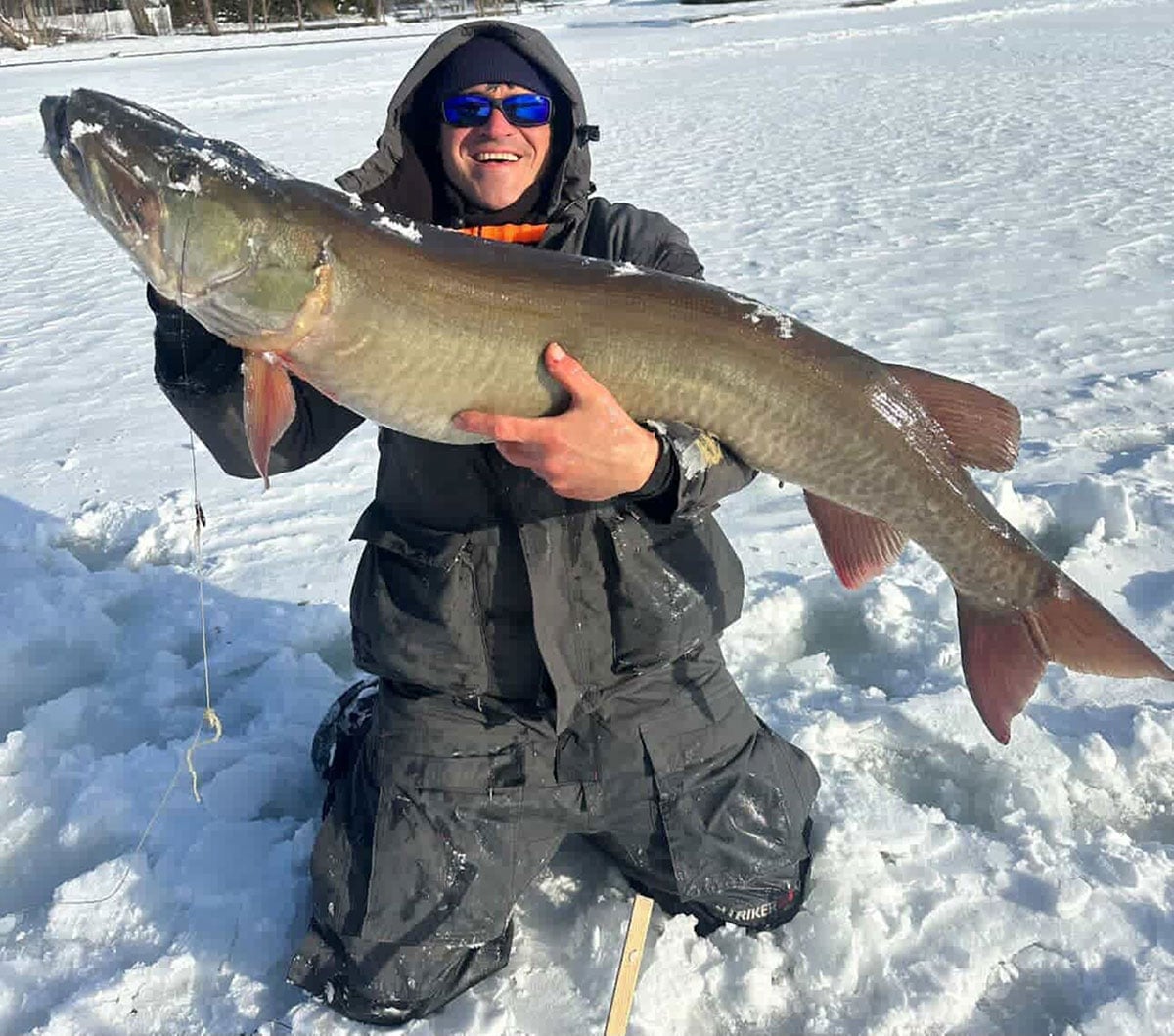
Despite the drama, one angler’s ice catch stands as a truly amazing fish.
How often does a record-sized fish get caught in boundary waters while creating a cauldron of controversy? If the majority of people wanted the fish confirmed as a New Jersey state record, many of them hold on to the hope of change in NJ Fish & Wildlife rules.
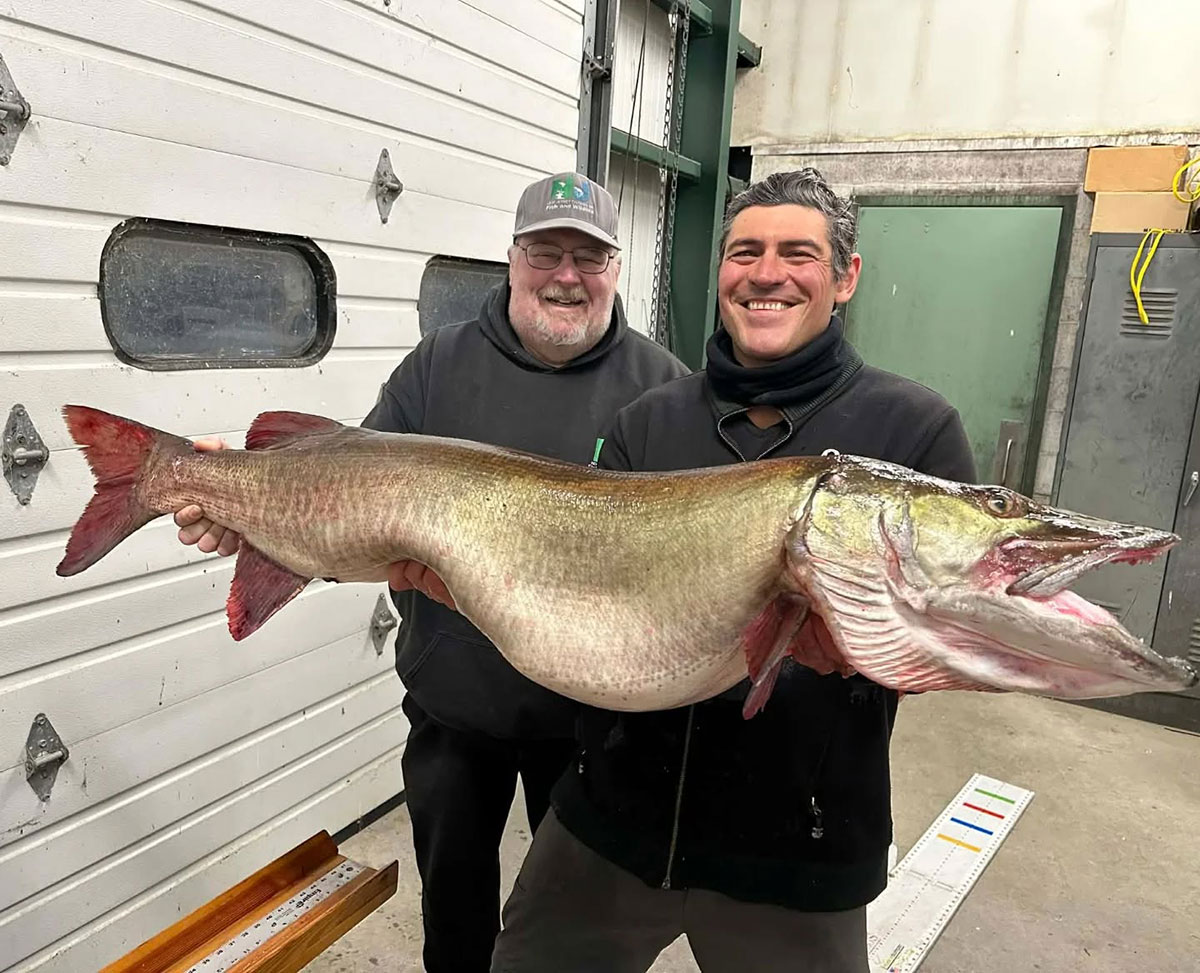
Victor Gelman’s giant true-strain muskellunge of 45.03 pounds, taping out at 51-1/8 inches, was caught on February 24, 2026 from Greenwood Lake. On an episode of the NJ Multispecies Podcast back on March 16, Gelman said, “This is the only muskie I’ve caught through the ice.”
“Prior to 2023, I didn’t know what a muskie was,” Gelman said on the podcast, adding “During my first two months fishing them, I caught 11 fish.” But in talking about that biggest one of all, Gelman added, “As I lifted it out of the hole, I felt it was a different weight-class than (others) I’ve caught. I’ve handled 38 (pounds); I’ve landed 41, 42 from the St. Lawrence River.”
Gelman wanted to release the big muskellunge, and by cutting the ice, he made a live well. However, the fish was badly hooked. Tip-ups baited with live suckers had occupied his fishing shortly after the blizzard that ended Monday, February 23. He waited eight hours before the flag most distant from him went up. He had to trudge through deep snow and “8 inches of slush,” getting to where, earlier, he “had come to the point where (he) felt exhausted.” That’s where the hole most distant from him got cut and he set that tip-up.
The State Line
“We made an official decision,” said New Jersey’s Bureau of Freshwater Fisheries chief Shawn Crouse. “We decided not to honor it as a New Jersey record. It wasn’t caught within the boundaries of New Jersey. It was caught approximately 3-1/2 miles north of the border of New Jersey and New York.” According to Crouse, the top five ranking people in New Jersey Fish & Wildlife agreed. “You could call it a democratic process,” he explained.
The New Jersey state record true-strain muskellunge remains Bob Neals’ 42-pound, 13-ounce fish, also caught through the ice. Neals used a tip-up on Monksville Reservoir in January 1997. Presumably the bait was a live shiner. A lot of muskies get caught through the ice on shiner-baited tip-ups, although suckers do get used frequently. Clipping the fins keeps a sucker from swimming off with the line and tripping the flag.
Crouse remains deeply sympathetic towards Gelman. The fish wasn’t going to survive, so Gelman wanted the record, but above all, the angler wanted a fair decision-making process. Crouse believes he’s delivered on that. Which is why Crouse discussed issues concerning the possible confirmation of the record with the five other staffers, but he also referred to the Angler Affidavit on the application for a state record fish. It states: “I, the undersigned, attest that the fish described in this application was hooked and landed by me without assistance and that it was caught in New Jersey waters, and that all aspects of the catch conform to NJ State Law and the rules and regulations pertaining to freshwater fishing.”
Many people have questioned the meaning of “New Jersey waters.” As Chris Pereira put it during that March 16th NJ Multispecies Podcast, “The precedence is set to go in either direction.” The issue of boundary waters is overlooked and not mentioned, and otherwise, the only decision is for state record catches inside the state line. Pereira has listed nine states on his Facebook page addressing not only border waters, but how they allow state record fish from those waters regardless of where state lines fall. Otherwise, he said, 11 other states do require state boundaries to define record catches from boundary waters.
But the point is the addressing of the issue explicitly; Gelman’s catch is a great oversight because New Jersey had nothing spelled out regarding boundary waters.
Favoring Record Status
The NJ Multispecies Podcast has posed a number of issues. “Why are they going to put so much money into these fish, if they’re not going to count toward our state?” host Joe Santiago wondered aloud during their March 2nd episode. Pereira spoke of Greenwood Lake sharing fishing regulations from both states, drawing an analogy to fishing from the bank on the Pennsylvania side of the Delaware River. “That’s a New Jersey fish if I keep it, because I’m using a New Jersey license,” he said.
These assertions imply contradictions exist at levels close to the bone. If you’re fishing the Delaware River from the Pennsylvania bank with a New Jersey fishing license, and you catch a record-sized musky, you can take the fish home as your own catch, but the application for the state record may forbid certification.
Arguments in favor of record status further assume, as Pereira explained, that Greenwood Lake shares fishing licenses and regulations between both states, and since New Jersey is responsible for the stocking of all the muskies in the lake, it should be understood that a musky of record size caught anywhere in the lake is certifiable in New Jersey.
With respect to the Angler Affidavit, New Jersey waters might be thought to exist anywhere on the lake and from the bank. But as Crouse pointed out it’s not entirely true that both states share the same regulations. And certainly, the lake doesn’t share a dual statehood.
Why Origin Doesn’t Matter
About retail purchases of live baitfish, when using any baitfish above the New York State Line, a license holder must be able to show a receipt, proving the baitfish are certified, to a conservation officer asking for a receipt. That is true, according to New York State Department of Environmental Conservation, whether he has a New Jersey or New York fishing license. No such need exists in the New Jersey portion of the lake.
Another point about differences between the states and the assumed singularity of the Greenwood Lake fishery is New York’s Angler Achievement Awards Program, similar to New Jersey’s Skillful Angler’s Program. “It doesn’t recognize a fish caught in the southern end of Greenwood Lake,” Crouse noted.
With respect to New Jersey’s sole responsibility for the stocking of Greenwood Lake with muskies and the refusal of NJ Fish & Wildlife to certify Gelman’s fish, Crouse said, “We didn’t think of the origin of the fish as mattering that much.” The argument that the musky’s origin at Hackettstown Hatchery qualifies it as a record fish breaks down under innumerable comparisons.
South Branch Outfitter’s guide Gerry Dumont knows of one example. Big rainbows got stocked – having been tagged – at Saxton Falls on the Musconetcong River years ago. High water flushed the fish downstream, and later, the agency that did the stocking got the report of one of their tags recovered from a rainbow caught in Neshaminy Creek near Philadelphia.
Fish don’t belong to our boundaries. We set up boundaries, and we belong to them. They help us achieve justice in all sorts of ways. Maybe injustice in others. For some, it can seem very important that fish stocked in boundary waters potentially qualify as state record catches regardless of the state line, but the one thing that is clear as things presently stand – fact as solid as bone – is that Gelman’s musky was caught in New York State.
Greenwood Lake is a greatly successful fishery. Many have promoted it and will continue to. For years, Lou Martinez has written about the muskies and walleyes. He’s also written about the need for a public boat ramp. He got involved organizing the call for one and led that effort. According to Crouse, “In the next 4 years, there will be a boat launch at Brown’s Point.” Brown’s Point is a park near Greenwood Lake’s southern terminus in New Jersey.
Hatching New Records?
Craig Lemon, Superintendent of Hackettstown Fish Hatchery, has worked at the hatchery for nearly 40 years. Pereira made the telling point that Lemon “raised that musky.” Now Lemon has seen the end result come from Greenwood. “It takes decades to develop a trophy fishery,” Crouse said, adding “We don’t stock it (Greenwood Lake) for state records; we stock it to create an enjoyable fishery.”
Crouse doesn’t mean that lightly. He’s deeply proud of what the Division and the hatchery has done. That New York anglers partake of the same in Greenwood Lake involves more than the generosity of New Jersey fishermen. Most of that lake is in New York and gives New Jersey license holders a great expanse of water to fish. So, it’s a fair trade. And if you’re fishing only for New Jersey state records, you’re out of luck in New York.
That can change, though only informed and deliberative thinking on the part of Fish & Wildlife will arrive at whichever idea it is that authentically represents license holders. It’s not as if the idea of “New Jersey waters” would lack logic if it comprised the whole of Greenwood Lake, though boundary water inclusion is an abstract value. It depends on regulations shared between states, and stockings. The preference for the state line is down-to-earth and conservative; it depends on geographic survey.
Victor Gelman’s trophy muskie will be long remembered as if it were a state record. Had it not taken the sucker to the gut, we’d never have known about it as we do. Where will the next record-size musky get caught? “There’s got to be a record fish in Mercer, Echo, Greenwood, Monksville, a bunch in the Delaware,” Gelman said. And according to Crouse, fisheries surveys of Greenwood Lake, Monsksville Reservoir, and Lake Hopatcong have all resulted in captures of 50-inch muskies. A number of them that length get caught and released in those lakes, but they don’t beat Neals’s record.
Crouse pointed out the difference between a fish of not much more than 40 pounds, and one of 45 pounds can have to do with the time of year. He said that after early season “muskies reabsorb eggs,” and that during the summer, the fish may thin out even more. Gelman’s fish had “4 pounds of eggs in the cavity,” according to Crouse, so the season was as important as place.
Also, if more of the stocked fish manage to live longer, all the greater the trophy fishery. Crouse said about Gelman’s fish, “At this point, we don’t know the age, but we believe it to be 20 years old.” The otolith, which is the ear bone, had not yet been examined. It might yield conclusive evidence of that age.
It’s easy to imagine that big, very deep lakes and reservoirs, rather than small lakes, hold out-sized, aging muskies, because each trophy fish seeks a space of its own. Furnace and Mountain lakes have big muskies, but would a state record be expected from either of them? For a fish of such greatness as Gelman’s, Furnace Lake is a puddle.
Never say never, but even Mountain Lake’s 122 acres and 38-foot depth may not house such a fish.