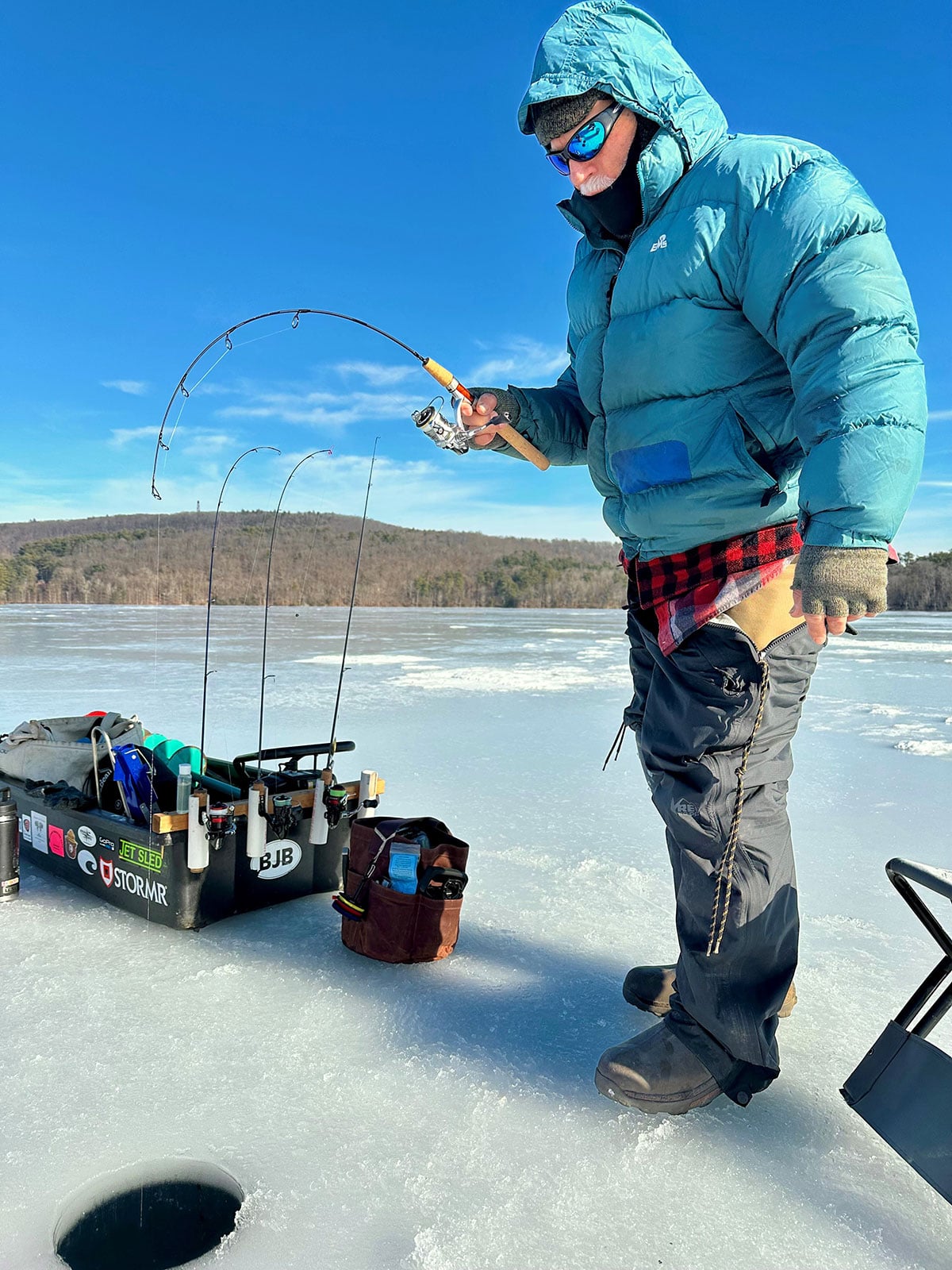
The recent return of colder winters has spawned an army of new ice anglers!
Jigging is skill that is as old as fishing itself for anglers across the centuries. Dropping a baited hook down and imparting it with action has been a timeless technique, proven throughout an ever-evolving world. In present times, jigging remains a staple for catching everything from pelagic predators to panfish.
There is one style of fishing though that this presentation is inseparable from and that is ice fishing. Jigging up a fish through a hole cut in the ice is unique from the practice in other forms and, at times, there is no better way to produce results in the frozen winter than with a rod and reel presenting a bait vertically.
If you’re new to ice fishing, the concept of using a relatively small rod to tangle with your catch may seem novel. Yet, some of the most accomplished and knowledgeable anglers have spent their fishing lives continuing to work within the nuance of evolving gear and techniques to make jigging one of the most effective methods in the sport. There is no shortage of rod lengths, actions, styles and manufacturers available to the modern ice fisherman and if you’re just setting out on your jigging journey, it can be a bit overwhelming to figure out where to begin.
A Changing Landscape
When examining the ice gear our parents and grandparents used, one thing becomes immediately clear about the jigging rods of the past – there weren’t a whole lot of choices. Most of the rods looked the same, came in just a couple of actions, were of standard lengths and had very big guides. Even just 20 years ago, although there were more options available, there were still little more than a handful of regular manufactures producing rods designed for ice fishing. Staple brands like St. Croix, Ugly Stik, Eagle Claw and HT offered some variety but if you wanted a custom rod not built by a local shop, your main option was to get something made by Thorne Brothers or a similar outfit in the Midwest.
To say much has changed in the last 10 to 15 years in terms of the availability and variety of ice fishing rods would be a major understatement. Advancements in the materials used to build rods, lines, electronics, portable shelters, heaters and the baits and lures we fish with have exploded in recent years, pushing the envelope of how an angler can use a jig rod to find fish.
A quick search across a few websites of large ice fishing dealers revealed dozens of manufactures and that doesn’t even include anyone with a decent YouTube following selling their custom line. Where rods used to come in lengths generally in the 30-inch range or less, it’s now common to see them anywhere from 28 to 42 inches and beyond. These lengths span actions that range from ultralight noodle rods to heavy power and fast action meant for taming the largest gamefish swimming beneath the frozen surface.
Components too, have changed, allowing for an array of grips, handles, reel seats and guides. When you add it all up, you’re likely to find an ice rod built for just about every application imaginable. So, which one is right for you?
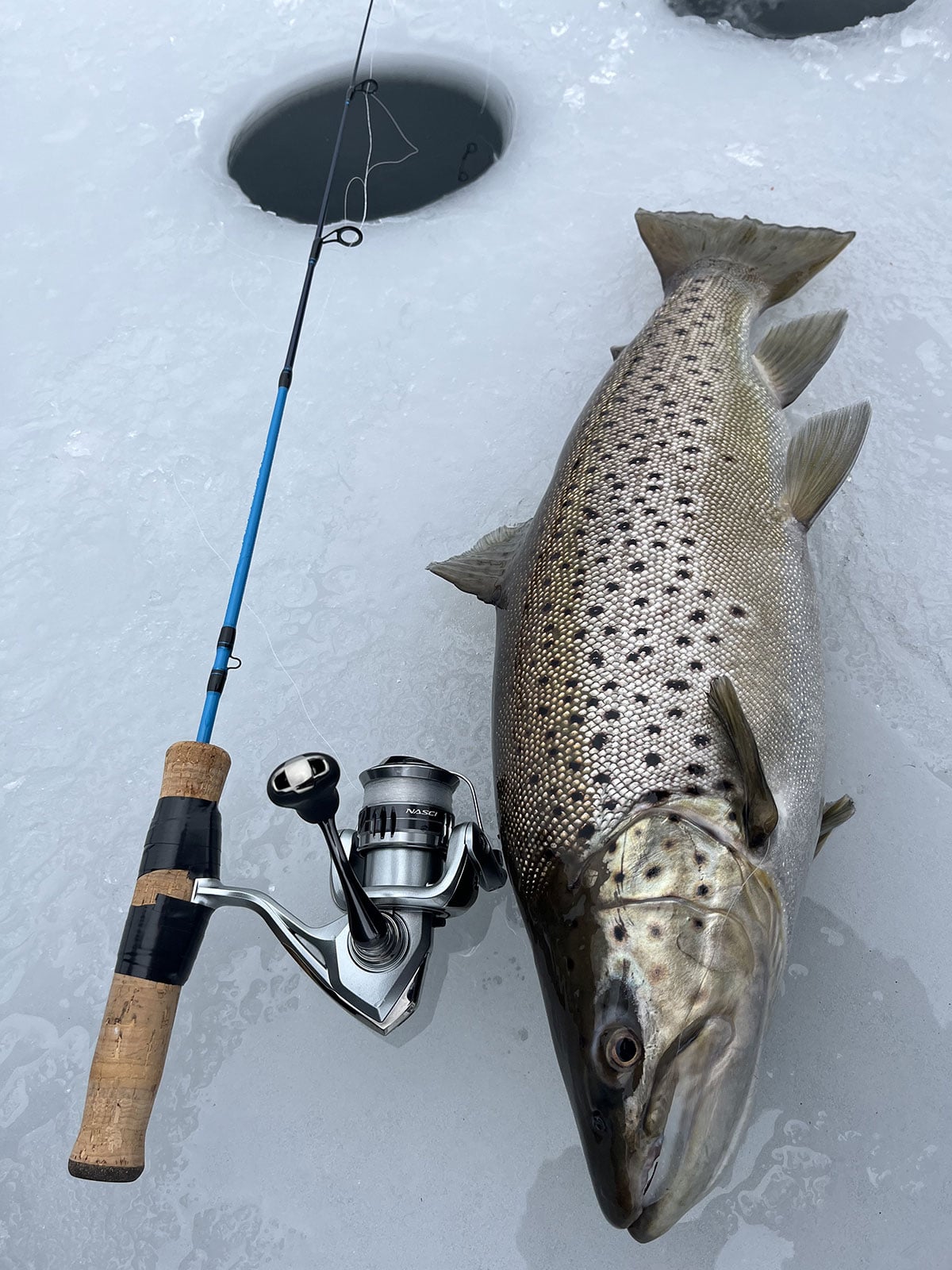
Choosing A Rod
In a world with so many options it can be a little intimidating to figure out where to start. Like most things in fishing, rather than just ordering up some new gear ‘sight unseen’, it’s usually best to visit your local tackle shop and have a conversation with the owner or staff so they can get you pointed in the right direction. With that said, taking the time to do some reading and research is a good idea, as is thinking about what it is you want to do.
Considering where you’re most likely to be fishing and the species you’ll most often be targeting is top priority. It’s also important to think about your style of fishing, will you be cozied up in a shelter all day or hopping holes in shallow water looking for panfish? Maybe you plan to be running and gunning in deep water looking for lake trout or walleye? You don’t necessarily have to get too technical right from the jump, but going through a checklist of what you’re most likely going to be doing while walking on water will make the difference in getting a rod (or rods) that suits your needs.
While there are some all-around actions that will cover many of the species we chase through the ice hear in the Northeast, there’s not necessarily a one-size-fits-all rod that would cover everything from panfish to pike.

All-around vs. Species-specific
If you aren’t focused on targeting one species or class of fish, there are some good “in between” rods that will allow you to fish effectively. If you were to think of rods as golf clubs, these might be comparable to a five or seven iron. They aren’t right for every shot, but you can make them work in a wide variety of situations. A good all-around jigging rod is generally something in the 30- to 32-inch range with a medium to medium-light fast action. Rods in this range can cover everything from panfish, bass, trout and walleye as a general rule. Similarly, a good all-around option for bigger bass, large walleye, lake trout and pike would fall in the area of 32 to 40 inches with a medium, medium-heavy or heavy fast action. Between these two builds, you’re most likely covered across all scenarios you may encounter while ice fishing. Notably, the addition of a spring bobber to any rod brings increased bite detection, regardless of action.
| WHAT ABOUT THE REEL? |
| When pairing a reel with your setup there are a few things to think about. Much like when you select a rod, the most likely water types you’ll fish and what species you might be after really dictate what you need. In general, if you’re fishing in shallow water, say 15 feet or less for panfish, bass and stocked trout a smaller spinning reel in a 500 series or less will be sufficient. If you know you’ll be targeting larger fish like pike, or fishing deep for trophy trout or walleye spinning reels in the 1 to 2000-series with a good drag will be more suitable. It’s also worth noting the increase in popularity of inline reels for jigging shallow water panfish. These reels put the line on the spool with no twist. The lack of twist can be critical in getting finicky perch, calicos or bluegill to take a small jig. |
If you know you’re set out to just jig for panfish, or are only looking to target trophy-sized bass, walleye or pike, digging into more precise rod options will be worth your time and money. While there are exceptions, rods with the actions listed are a good starting point to get you in the game with some of the most common species ice anglers target here in the Northeast.
For panfish, rods in the 28- to 32-inch range are fairly common. You’ll be looking for ultra-light and light power rods with actions ranging from medium to fast. Many rods in this class sport a sensitive tip with a bend that you can feel into the butt of the rod for detecting light bites. Some models also have a bright orange tip section that acts as a visual aid.
If you’re targeting stocked trout, bass and walleye, a rod in the 28- to 36-inch range is a good place to start. Look for rods with a medium-light or medium power and fast action. This will give good sensitivity in the tip section with a bit more power as you taper down the handle.
If you’re hunting for trophy bass, walleye, lake trout or northern pike, it’s a good idea to look for a rod with a beefier build; 30- to 42-inch rods with fast action and heavy power. These rods have the strength to lift a big fish up to the hole.

The Finer Points
One other thing you’ll notice about the wide range of rods on the market today is the differing price points. Much like buying a rod for any other type of fishing, there is a price for every budget. There is value to be had for sure, but rather than focus on price first, take a look at the components and materials that make up the rod itself.
Just as it is with the full-sized rods you’d use for open water fishing, the number of grips and butt sections available from builders has rapidly expanded in recent years. Trends seem to be that lighter is better for many applications so there are now options to buy handles and grips not just made of foam or cork, but also of carbon fiber. Traditionally, lower grade foam handles will come stock on less expensive rods while cork and other materials like carbon fiber will be the mark of higher-end options.
| A LITTLE OF BOTH |
| One other use for jigging rods that continues to gain popularity is as part of automatic fishing systems like the Jaw Jacker or iFish Pro. These devices essentially convert your rod into a tip-up. Some set the hook on-contact while others allow the reel to free spool until you engage it. It’s worth noting that these devices require a specific rod action to be most effective. If you’re looking to buy a rod to pair with one of these “rod-incorporated” traps, look at rods in the 36- to 42-inch range. The action should be slower in the tip with more power in the butt. Some of the newer rod manufacturers market and sell rods built for this specific purpose and they are definitely worth checking out if you want to use your rod as part of one of these systems. For more information on this style trap, scan the QR code or reference Kierran Broatch’s article in the March 2023 edition of The Fisherman Magazine. |
Reel seats are also worth paying attention to. Some rods come with no seat, others with rings to affix your reel in while others have a full seat for a spinning or conventional reel. Some rods are built with seats meant to accommodate straight line reels, often popular with panfishermen. Guides are another important component of today’s jigging rods. Most ice fishing is done in the cold which tends to freeze guides up. While rods used to be built with large guides to solve for this problem, some of today’s rods use recoil guides which make snapping the ice off a breeze without adding extra weight.
Wherever you land in your search for choosing a rod to fish with through the ice, actually getting out and using it is by far the best way to learn what your needs are and how it can make you a better angler. Once you get your first, chances are, you’ll already be thinking about what you’ll want to be able to do with your next one.