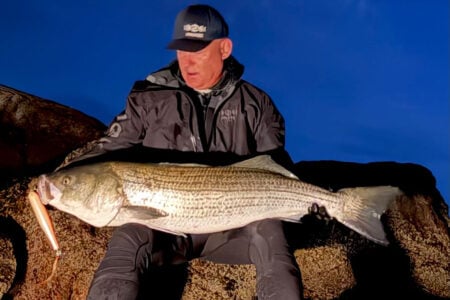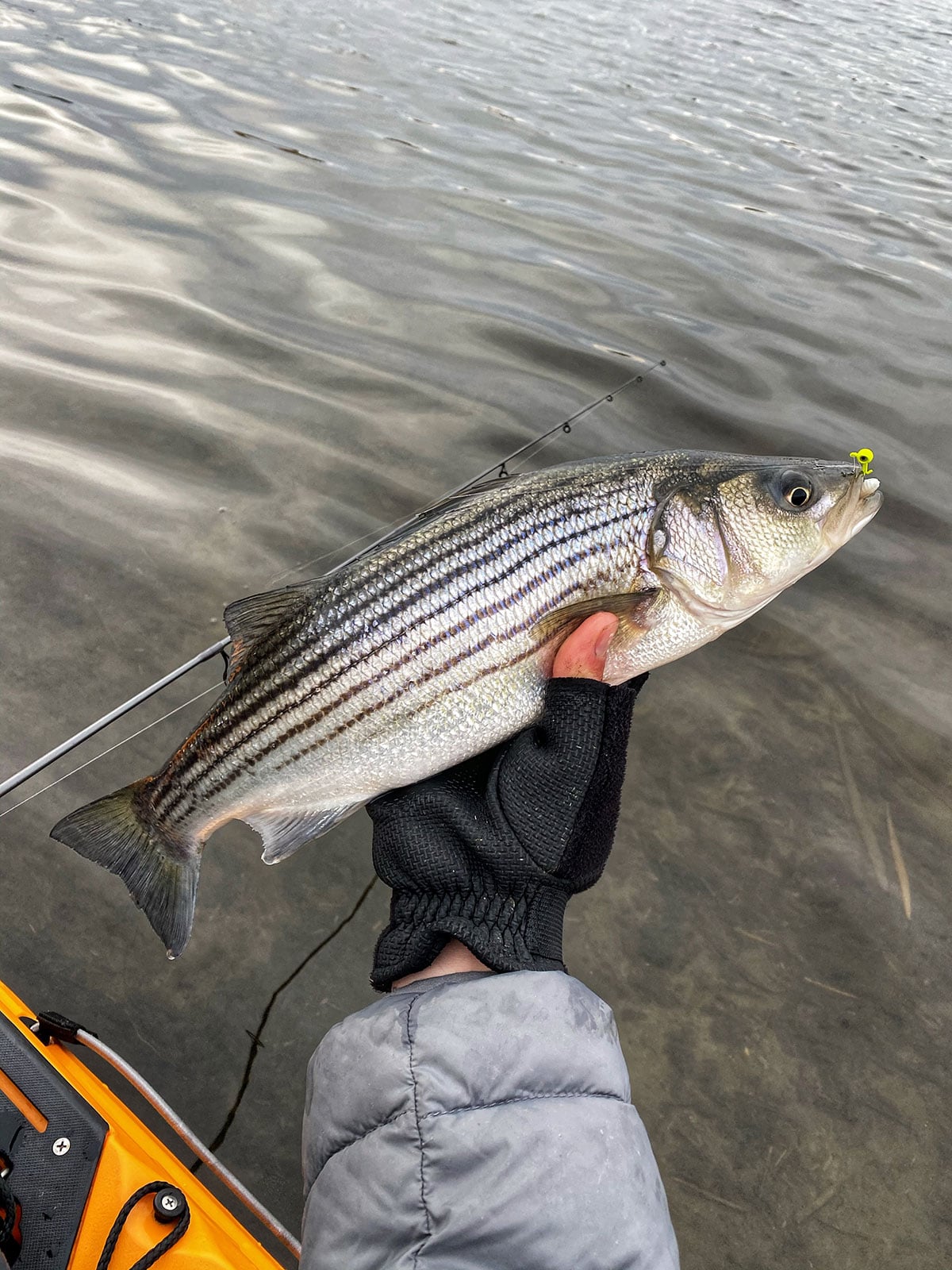
This fishery will get you out of the house and let you catch some holdover stripers.
Winters can be torturous to us Northeast fishermen. After a busy season with a multitude of species to target from snappers and blowfish to fluke and tuna, most of us are thrust into a dead season. Gone are the days of guaranteed cod and flounder, and relatively few of us take advantage of the winter freshwater fishery, which is actually pretty good on Long Island as long as the lakes, ponds, and streams are free from ice.
A lot of Long Island anglers will spend time going into fishing shows, flea markets, watching fishing TV shows, and tinkering with tackle or building rods – anything to pass the time. For the majority of the striper community, you will probably be waiting until the end of April or early May to start your quest for bass.
The March Secret
There is a secret that not too many fishermen know: as long as the creeks and rivers are free from ice, there are bass to be caught all winter long. I have caught bass here locally on Long Island every month of the season, and I’m not talking about the warm water power plant discharges from the days of yesteryear. I’m talking about the local natural features. Most of these fish were originally caught while in pursuit of white perch, and were welcomed bycatch.
Eventually they became the main target. A lot of these fish were not much bigger than the perch themselves, a few might’ve been smaller, but I have caught bass into the low 20-pound range at some of my spots on the eastern South Shore of Long Island in January and February. As long as there is free water to cast to, you can have a shot at them. There are also many mid 20-inch fish to be caught. I have caught fish in tidal ponds that were half-covered in ice. They were still hitting well in water that had to be in the low 30-degree temperature range.

What Triggers The Bite?
There is a reason I find bass with the perch because they are both finding the grass shrimp and baitfish that they both like to feed on. What is more important, let me repeat that, more important, is that almost all of my spots for bass have a freshwater source. Why this is important is because spring water coming from the ground has a constant year-round temperature of between 50 and 55 degrees regardless of the season. If you can access a tidal spot close to where the springs are, you’re almost guaranteed to catch fish, period. Even if you’re a distance away from the warmer water source. The temperature will still be warmer than the surrounding water, and fish will gravitate to that area as will the baitfish and shrimp. Being cold blooded, a temperature difference of only a few degrees means a lot to a fish, and they will take advantage of that warmer water.
Even though it’s in the middle of the winter and the striper’s metabolism has slowed down, they still need to eat, not as often as in the warmer months, but they still need to eat, and will take advantage of anything in their favor to help them. The warmer water allows them to move quicker and makes them a little bit more efficient at catching baitfish.

Another thing to consider is that most of these creeks are shallow with the dark bottom, which, with the ever-increasing higher sun angle and longer days, allows a quicker warm-up than deeper areas.
In the late-winter and early-spring backwater creeks also bring in one of the striped bass’s favorite foods of all time, the alewife. These anadromous herrings come into our local creeks in March and April to spawn. Sometimes in some rather large and constant schools, which will, at times, bring in bass of all sizes.
Low & Slow
These preseason fish are in relatively cold water. They are somewhat lethargic, although, not as much as you would expect. Something you’ll find out after hooking one. In any event, slow and deep presentations are the key. For the most part, you are not going to catch a lot of fish. There are times when you can find a school and get a couple dozen, but most of the time, it’s going to be a lot of work for one or two. But the good news is, even if you don’t hook up with stripers, there are still going to be some perch and possibly sea trout around to make the day interesting.

Those of you who follow me know my love of marabou jigs. In my humble opinion, these are the best overall artificial fish catchers that exist – having caught over 150 species of fish on marabou jigs alone. Small plastics would also be a good option in this fishery as well as small bucktails from 1/8 to 3/8 ounces. Being as lethargic as they are, getting a fish to hit a topwater would probably be very difficult, and I don’t even attempt it in this pre-season. Although I don’t use them, suspending stick baits such as the Rapala X-Rap would probably work, although you will miss out on the perch and all but the biggest sea run trout.
The tackle I usually use is a 5 to 6-foot ultralight St. Croix rod with an appropriately sized reel filled with 3 to 4-pound nano braid and a 6-pound test fluorocarbon leader. This is a catch and release fishery, and you might as well make the most out of every hookup and enjoy the fight that the ultralight tackle gives you. This tackle also allows you to give the right presentation easily. I’m not saying you can’t use heavier tackle. I just believe you would do better and have more fun with light tackle.
Target Locations
The South Shore has plenty of spots that hold stripers through most – if not all – of the winter months. From big rivers like the Carmens and Connetquot, to the dozens of smaller creeks. Access to these areas can be a bit tricky, with some having very easy access and some requiring a little innovation. The Carmens and Connetquot are best fished by boat unless you can gain permission to fish from shore. I have had some very good days with a couple dozen fish in a few hours from shore on the Connetquot River. Shore access for the Carmens River is almost nonexistent, except at the end of Beaverdam Road. The spot is usually worth a visit as access is quick and easy, and at times there are fish here.

There are some spots on the North Shore of Long Island where I’ve caught winter bass, but these areas are usually later in the season, as in late March early April. Last, but not least, I have caught them, “wink wink,” in between these two shores.
This fishery will get you out of the house and let you catch some holdover stripers to dull the winter doldrums and sharpen your light tackle skills for the spring. In addition to the big three previously mentioned species, I have also caught carp, largemouth, chain pickerel, grass pickerel, yellow perch, and shad while going for bass. Couple this with no other anglers crowding you, and it’s a no-brainer for me.