
FORT WETHERIL, RI
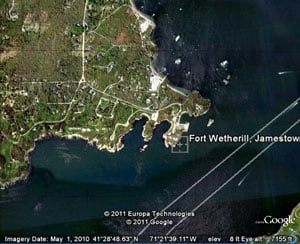
This old fort located in Jamestown in Rhode Island was built to be hidden from the eyes of seagoing enemy ships. Nestled behind towering cliffs, the fort is invisible from the ocean and it’s pretty cool to explore the area, especially if you’re a graffiti fanatic. But why would you be looking at that? Cliffs almost always belie deep water and when the scalding heat of summer cools the striper bite down, deep water is often the only remedy. This is what you should be wanting to gawk at!
I stumbled upon this rare shot at super deep water from the surf back in 2003 and when I laid eyes on it, I was immediately excited. Walking down to the right of the fort, you’ll find a twisty trail that turns scarily steep in a hurry. At the bottom, there is only one comfortable spot to stand, a large boulder situated right in front of you. Beware of the spikes of reef that reach up from the depths bookending the slot you have to cast into. But before you cast, let the sun penetrate the water directly in front of you and note its amazing blue color. Wondering why you’ve rarely seen this color before? It’s because you don’t often get to look into water of this depth from the rocks.
If you’re looking for another foothold to cast from, walk back up the hill and around to the other side of the fort, there you will find a trail that leads past a secondary fortress, past a cul-de-sac and then down to a towering spike that has been sheared away from the main cliff. Proceed with extreme caution, and if you are afraid of heights, you may want to skip this spot. The walk to the bottom skirts the very edge of a massive crack in the rock that is big enough to drive a bus into and deep enough to hide a Fall River three-decker. At the bottom, there is a small rock platform that will fit two casters, tops. There is some reefy structure to the left and the right and stepped shelves of granite can be seen disappearing into the deep water in front of you.
Fishing this kind of water requires specialized tactics and patience. Once you have the lay of the land, I would recommend fishing here at night, especially on bright moon nights when shallower summer hotspots often go cold. To pack a bag for this spot requires some thought. Because the rocks are not shear, you do have some shallow water to prospect up tight to the stones, but you have to bring plenty of baits that are capable of penetrating the water column. My strategy has been to fish shallow swimmers in tight, Atom Juniors, Red Fins and the Afterhours Jointed Eel—as well as the trusty live eel. Then I switch over to plastics on leadheads.
My preference is to use large plastics because I want my bait to stand out in all this water. One and a half to three-ounce heads are my usual call here and the plastics I like are 9-inch Slug-Go’s, Hogy Paddletails and 7-inch Tsunami Swim Shads. I try and hit the deep structure hard, but don’t be afraid to fish mid-column and also make a lot of fanned-out casts parallel to the shore, as they rocks fall off into deeper water, there are juts and shelves that can hold fish.
I also know from my spearfishing and boat fishing friends that this place holds some nice togs and has given up some massive fluke. They have also passed on warnings that I will pass on to you. Be smart about fishing here, because the water is so deep it can be hard to detect large swells until it’s too late. If the marine forecast is calling for big seas at the entrance to Narragansett Bay, go somewhere else. Also be mindful of the tide, if the swells are borderline manageable on the incoming, they may get scary when the tide flips and starts to scream. If you pay attention to the dangers and pack a diverse bag to cover all water depths, Fort Wetherill has the guts to save a tough summer night of fishing and it has all the makings of a big fish producer. You’ll see.