
HAMBURG COVE, CT
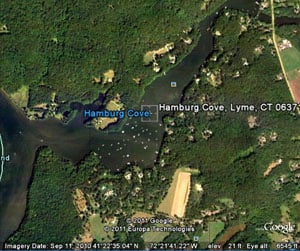
Need spring schoolies? Try Hamburg Cove in the lower Connecticut River. Found several miles north of the I-95 bridge, it is home to some of the first schoolie stripers anywhere in New England.
“The cove is a beautiful spot to fish,” says Capt. Dixon Merkt, who operates the Surf Scoter and runs early-season charters on the Connecticut. “At the head of the cove, you’d think you were in Maine or New Hampshire not just a couple of miles off I-95. It seems much more remote than it really is because it’s so quiet and peaceful. And there are lots of fish. But you can only fish it by boat because all the land around it is privately owned.”
The precise start of the cove’s season depends on the freshwater runoff from Vermont and New Hampshire. Heavy spring rain and snowmelt brings a lot of mud and debris down the Connecticut River, decreases salinity and makes fishing difficult. This year, it’s no surprise that the river has had a slow start due to the long, snowy winter.
“In some years, the runoff is light, so we can start catching fish around March 15th,” says Merkt. “But on normal years, the fish are there from the last week of March to mid April. This year, it seems like it will be even later. When the bite is on, your catch can be almost unlimited. But you’re not targeting individual fish; you’re looking for a school. When you find them, you can anchor and catch bass on almost every cast. They’re small, ‘cookie-cutter’ fish and numbers are your objective, not size. Days with 50 to 100 fish are not uncommon.”
Hamburg Cove is an easy four-mile run north from the Old Saybrook state launch, which is located on the west side of the river under the I-95 bridge. The cove is easy to fish because there aren’t any rocks to hit, and all but the back end of the cove is deep enough at low tide. The channel, however, is well marked and as long as you stay near it, you can easily cast into shallower water. But the biggest challenge is finding a bunch of fish. They are eager feeders, and once you locate a school, they’ll readily pounce on your lure or fly.
“The exact location of the fish varies from day to day,” says Merkt. “It doesn’t mean they’ve moved a couple of miles away or into another cove, it just means they’re schooling in another area in the cove.”
Rarely will you see these fish on the surface. Other than using a depthfinder, there are several other ways to find them. The quickest may be to join a congregation of boats having action, but they aren’t always present. The second is to blind cast while drifting or idling along the shoreline; and the third is to troll.
“The best way to find them,” says Merkt, “is to slow-troll a small lure behind the boat. I always troll with two lines, so if I get two hits, I know I’m close to where the school is. Then I usually anchor the boat and start to cast. It’s also helpful to have a sunny, warm day. The action can be non-stop.”
Light spin and fly-casting are the two most productive ways to fish the cove. But if you’re a spin fisherman and not having much success, Merkt suggests dropping a short leader and fly off of the lure. “It may increase your productivity dramatically,” he says. “That’s what I found, and it was very clear, particularly in early spring. We did a lot of that fishing style even when the bass moved out into the main river, and the fly would always out-produce the lure. And sometimes we get doubles.”
Merkt has success with various lures, including Deadly Dicks, Swedish Pimples, and Berkley Power Grubs. For flies off his droppers he likes chartreuse or olive/gray Clouser Minnows. Only light spin gear is needed for success.