
HART ISLAND
40 51.000’ / 73 46.200’
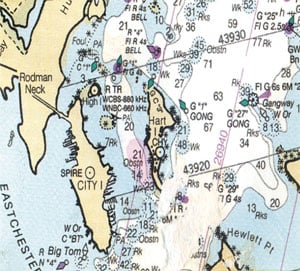
It’s a diverse place structurally. There are flats on the south side of the island that offer some decent current, but on the west end is a rocky point and slightly off that point the bottom drops off significantly. On the east end of the south side there’s another drop-off with a steeper angle. Along the northwest shore there are clusters of boulders, where we’ve enjoyed chunking for stripers and blues. Beyond this point is a more rugged bottom including a minefield of rocks, rock clusters and boulders. These waters are dangerous and should only be approached with extreme caution.
The waters around the island are prime territory for late summer fluke, with some of the best action found along the south shore of the island. The southeast corner is a flat that sports good current and drops off sharply from 10 to 32 feet near a green buoy. At times the fishing can be very good here, but fishing it properly requires short drifts, because once your baits are on the flat bottom of the drop-off, bites stop. Similarly, there’s a point on the southwest corner with a prominent jetty and current. Here, the bottom drops off more gradually from 10 to 35 feet in several directions and longer drifts are possible and productive.
Between these two ends is a gentle cove that embraces a large flat. You can make long drifts in this cove because fluke schools spread out at different depths throughout the breath of the cove as they follow bait schools. The typical drift depths are from 6 to 20 feet. Years ago it was difficult to drift through some parts of the flat because of all the lobster pots, but in recent years the decline in lobsters has also seen a decline in the pots. However beware, there are still a few unmarked ghost pots scattered about, and they represent formidable snags.
Although a persistent fluke fan can catch fluke from May into autumn around Hart Island, my friends and I prefer to invest our spring and summer fishing hours chasing stripers, blues, porgy and sea bass. However, a solid August run still occurs with regularity thanks to a combo of some peanuts, young of the year snappers, weakfish and porgies that begin to leave the safety of the harbors and move into the Sound. As a result, nowadays we do most of our fluking around the August full moon. We concentrate our efforts at the western and eastern drop-off areas that often produce larger fish.
Bucktails are the way to go here, and I use the lightest bucktail possible. Typically we drift in water that’s 8 to 25 feet deep and a 1-ounce white bucktail is my usual choice. With a light bucktail, I can produce a much subtler presentation that often makes a difference. If the fish stack up in slightly deeper water I move up to an 1-1/2-ounce bucktail. Unless I can get hold of some fresh spearing or peanut bunker and keep them on ice, I prefer to tip my bucktails with 4- or 5-inch Gulp! Swimming Mullet, Gulp! Sand Eel or Uncle Josh Meat. Just be sure that once you thread these baits on the hook, it lies straight on the hook shaft and points straight out the back of the bucktail.
There’s no doubt that the August full moon offers western Sound anglers a great chance for a doormat, and I can’t think of a better place to try for that big fluke than in the waters around Hart Island.