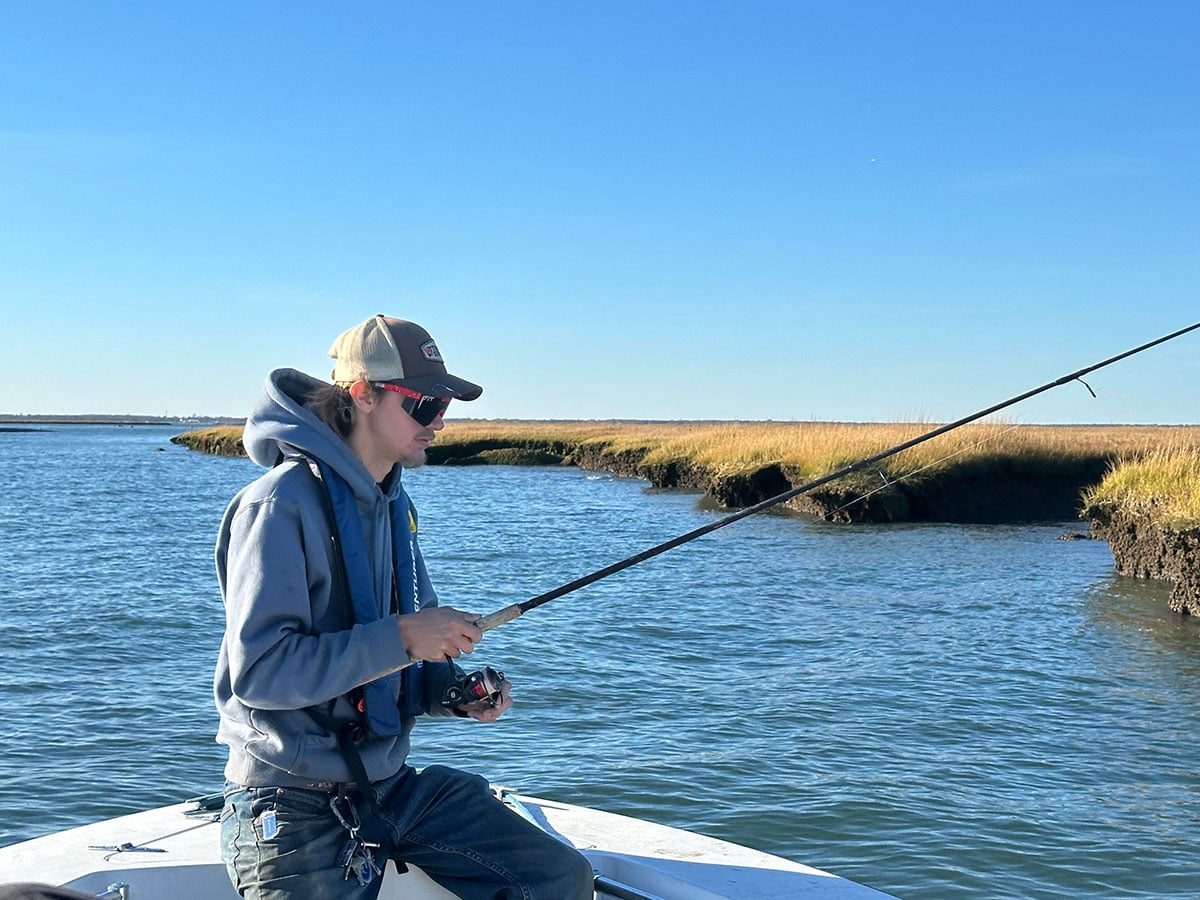
“It’s not the size of the dog in the fight, it’s the size of the fight in the dog.”
As autumn approaches and the cooler northerlies blow in place of the sticky, moist southerlies, the angling community shifts its target species mindset. I’m not unique in any way here, and while I love my summer flounder I’m as predictable as the leaves on the trees changing shades, shifting focus from fluke to striped bass.
Many skippers wait in anticipation of the big bass biomass that gradually trek down from New England on their own timetable, which in recent years puts them in South Jersey waters by mid to late November. The ocean run is a terrific fishery that provides tremendous outings when everything clicks. Other anglers, however, prefer to enjoy what nature offers up far earlier – even while waiting for the ocean bite.
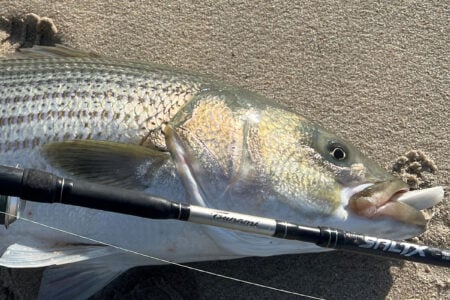
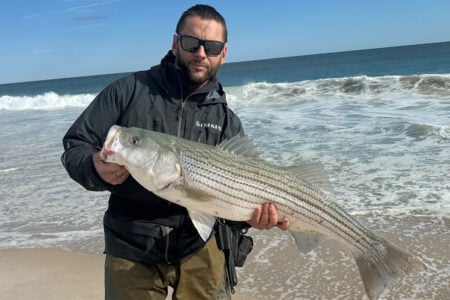
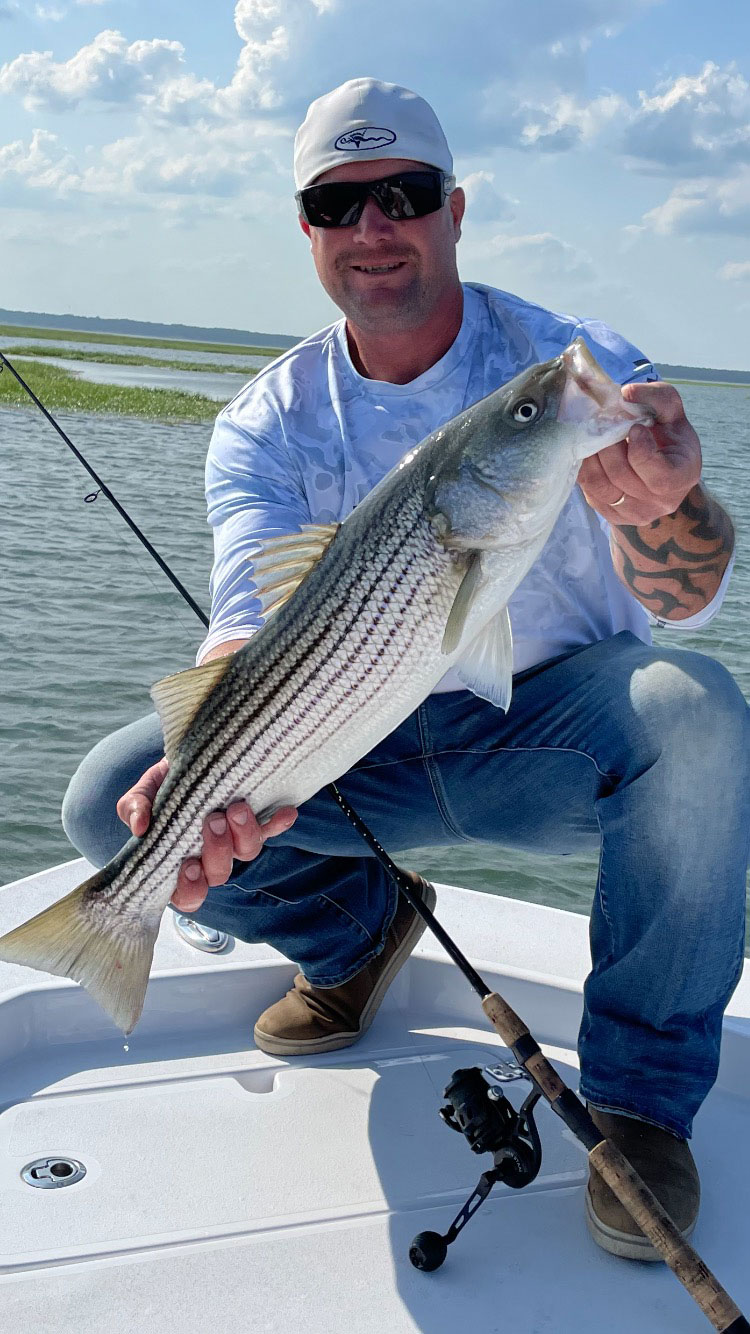
School striped bass can be found eager to play in the back bays of South Jersey throughout September and October. Numbers peak in November, and if temperatures are mild, the fish may remain for a short stint of December. These fish average 20 to 30 inches with plenty reaching into the mid-30-inch class. What the fishery lacks in 20- to 40-pounders, it more than makes up for in skinny water fun.
Marsh Madness
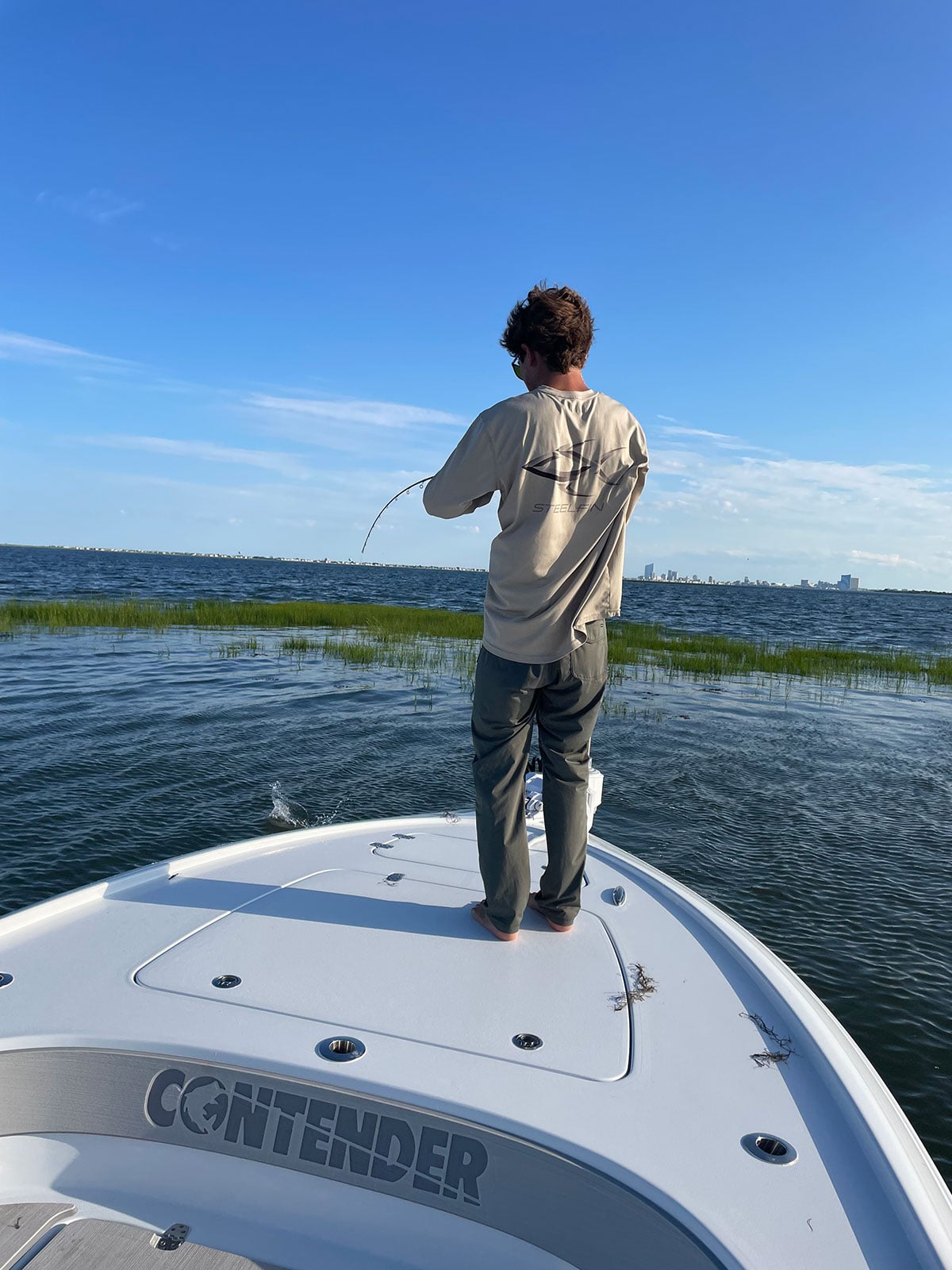
Those who relish light tackle angling love the underrated ecosystems in the southern portion of the Garden State, primarily from Barnegat to Cape May along thousands of square miles of watery flats, creeks, channels and inlets provide the habitat. The omnipresent marshes overlooked by ospreys, egrets, herons, gulls and cormorants are not what out-of-towners associate with New Jersey. It’s a light tackle nirvana that is often more reliable than the ocean run that follows later. Consider the obstructionist seas emitted by nor’easters, tropical events and nasty weather fronts have no bearing on back bay boaters. Flat waters have led to an influx of flats vessels. Decades ago, it would have been peculiar to see Florida-style flats boats creeping around the backwaters, but now they are the norm and their numbers are steadily rising due to the reliability of South Jersey’s backwater bass.
The biggest adversary to quality fishing isn’t swells on the ocean; rather it’s dirty water. Each estuary that lies behind their adjacent inlet functions in its own way. Therefore, the prevailing wind might be better from some directions than others. A light west, northwest, north or northeast are favorites among the experts. Emphasis added to light winds as opposed to blustery.
I recently spoke with a young, local expert named Mike DeMari, a man who spends a lot of his time fishing and winning local striper tournaments in his 227 Sportsman Masters bay boat that he specifically purchased for this fishery. “I prefer west and northwest because it favors cleaner water in the Brigantine and Absecon area,” he said, while adding “The key is not to overthink things and just go because they’ll bite on any wind if you know where to go.” It’s important to learn the best spots on each tide stage and each wind direction.
Successful anglers mentally log what weather works and what does not. It’s safe to say, most fishermen despise heavy rains that park over an area for days. Run-off from the streets, hard surfaces and outflow pipes are not good for any body of water let alone our sensitive back bays. Dirty water makes fishing difficult until the clarity clears up. That’s clarity, not color. Slightly tinted water color is common in many of the bays of South Jersey and that’s acceptable. But if the water has abnormally stirred and suspended sediment that’s littered with mats or broken bits of weed, fishing can be far more challenging.
Generally speaking if you place the tip of the rod in the water and can’t see past one or two guide lengths, the water isn’t as clean as it needs to be for the most robust outings.
Where To Cast
When the water covers the brown mud wall below the marsh grass it’s typically the right time and tidal stage for casting artificial lures on top. The mud gets covered a couple hours before and after peak flood tide. Obviously if there is a full moon or strong easterly flow pushing water into the estuary, then that length of opportunity may be extended. These areas may have deep drops that often contain broken sod or muddy clusters that are like moguls on the ski mountain. In turn, current breaks are formed that striped bass use as stations to wait for food to be carried in their direction. Sod banks are loaded with life such as crabs and fish. When the high tide occurs, there are less places for the forage to hide. The stripers are adept hunters and can either wait for unwary food to get pushed down current past their nose or they can pluck food off the sod features and surface just like a surgeon.
Points where waterways meet are fantastic casting targets. The periphery any point in the lee of the wind often holds fish better than the side that is windblown. Nonetheless, presenting offering should take placed on all three sides of the tip and up to 30 yards up their banks. Most points exist on the edges and ends of islands, but some peninsulas extend from standard marshes. They are striper havens are receive a lot of pressure from the skinny water specialists hence anglers should hit their favorites first on a high-traffic Saturday.
Long sod banks with modest to deep drops are excellent places to prospect. They are lengthy and can be approached best with a trolling motor that will hold the vessel in the perfect perches. Casts that land close to the bank will score the most strikes. When I say close, I mean a few inches, not a few feet. Although stripers will chase outward, they are used to their forage being swept their way tight to the marsh. Their diet is primarily grass shrimp, mantis shrimp, an assortment of crabs and small baitfish.
Creek mouths and indentations that act like miniature bays connecting to small waterways make the list of striper hot spots. In these instances, the casts should be fanned everywhere. The deeper water and the neighboring flats are chocked with food that the bass are hunting. South Jersey’s bays are loaded with erratic contours create obscure points and indentations where a topwater will catch. Furthermore, any shallow flat that is near potholes, grooves or channels stands a chance to hold stripers. The flats near major travel corridors are good prospects. Stripers aren’t the spookiest fish by any means, but on the flats, the situation is different and they are more likely to scatter if stealth is not successful.
Creek mouths, large or small, flush bait out on mid to low falling water. The stripers will set up with their noses facing the push of water coming out of the creek so they can intercept the small organisms and fish coming their way. Presentations that imitate, or are similar in size to the food, will yield results.
Luring Them In
The Storm Rattlin’ Chug Bug, Rapala Skitterwalk, Stillwater Smack It Junior, Heddon Super Spook and Berkley Cane Walker are proven surface presentations, as are the Tsunami Tidal Pro IPOP, and Yo-Zuri’s 3D Inshore series. These types of smaller surface lures draw ravenous attacks from backcountry bass. Subsurface lures with a paddle tail work very well. Mike DeMari told me he is a fan of the Z-Man minnow or plain white bucktail with a white curly tail. It’s been about 20 years, but I fished with the angler’s grandfather in the Absecon’s backcountry and he proceeded to put on a clinic with a single ounce Andrus bucktail with a white Mister Twister grub. It’s safe to say some methods get successfully passed on generation to generation.
Three feet of 30-pound fluorocarbon is ideal when attached the braid with an inline knot or small, unobtrusive barrel swivel. Some anglers go as light as 20 pound test on the leader, which works 99% of the time until the leader gets chafed on the dorsal fin or a bottom feature. When the tide stage is fairly low or blown out, captains that like tossing artificial lures dig into their play book for the next location to fish. “When the tide gets really low on the flats and the sod banks, I’ll move off to the closest channel or any deeper hole nearby,” DeMari insisted. “That’s where the fish slide off to when they leave the flats,” said DeMari, describing when and where subsurface presentations will yield more fish than topwater.
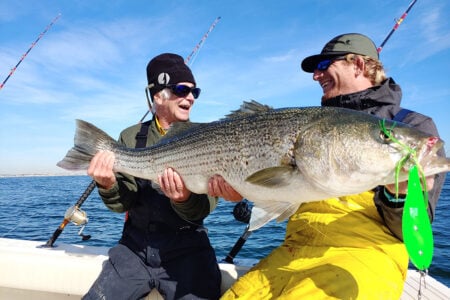
Dave Showell from Absecon Bay Sportsman runs charters out of his tackle shop and uses Berkley Gulp Nemesis presentations with impressive results. Attached to a half- to 1-ounce jighead, the Nemesis can be bounced along the sod banks lining islands that are so prevalent in South Jersey’s backcountry. White is right, but it sure seems like when I see Captain Showell’s on-the-water photos taken in the moment, there’s often a chartreuse Nemesis hanging out of a stripers mouth!
It does seem of course like there are two factions of experts in the backwaters, those tossing lures and the ones who prefer bait. Once upon a time, eels were the go-to for all live bait anglers, but after the striper resurgence in the 90s, live spot became the bait of choice. Whether captured locally or imported from below the Mason Dixon Line, one cannot deny their fish-catching ability. Depending on the size of the spot, anglers can use circle hooks that range from 5/0 to 7/0 with their “pieces.” A variety of rigs work, but a simple three-way special is more than adequate.
Live spot drifted on the bottom just like fluke fishing is the name of the game, though drifts should be more calculated rather than casual. Drifting the deep sod banks is a surefire way to score, but boat control is important; anglers with trolling motors have a better chance of keeping the bait in the zone.
After anglers catch a pile of bass in one place and the bite dries up, it’s important to seek out the next spot. It’s not that there’s no more fish, it’s that they swam on to another place that’s more favorable to feed. As anglers become proficient, they’ll learn to fish a pattern based on the tide and conditions. They’ll know when it’s time to move from spot to spot as each feed dissipates. This is what separates mediocrity from expert level fishing, knowing when to move and understanding the logic of sticking your next fish.
Rips are formed where there are dramatic depth changes with fast flowing water over top. The turbulence on the surface makes identifying these places easy. Spots drifted through back bay and inlet rips have an outstanding chance at catching because stripers stage in these locations looking for forage to be swept their way.
Bridges too are fish magnets. Live spots or eels drifted around the bridge stanchions or in their lee are likely to catch. The bridge supplies the structure and its own biological ecosystem. Every tiny organism lives there and the predators follow. Moreover, a bridge is like putting a reef in the inlet or back bay. The structure and current sweeping past scours the bottom and creates depth changes and dimples that become encrusted with additional muscles and barnacles.
Ask an expert live bait angler what tide stage they’d like to fish most and you’ll most likely hear the top of the falling toward the middle. Since live bait anglers fish the bottom, they have more opportunities on the low water stages than those fishing surface lures. And if you were wondering about chunking clam or bunker in the bays, I haven’t seen it performed nearly as often as I did in the 2000s. It’s not to say it won’t work, but it’s not a method being used like it was 20 years ago either.
New Jersey’s skinny water bass fishing is strategic angling that requires a tactical approach. Fished properly, large numbers of releases, well into the double-digits can take place during each outing. The fishery is more than a gap-filler before the ocean cows, it’s a gem that sometimes doesn’t get the notice it deserves from the masses.