A step-by-step beginner’s guide to catching your first striped bass on the fly.
It’s certainly an exciting thing to do. Maybe it’s even one of your goals. All in all, catching your first striper on fly really isn’t a hard thing to put together. If you’re an experienced striper fisherman, all you need is some advice on tackle and how to use it. If you’re an experienced fly fisherman, but not a striper or saltwater fisherman, you need to learn where to go, a little bit about the habits of your quarry, and how to use heavier fly gear. If you’re a novice fisherman, you need a little more, and if you’re a beginner, well then, you have to learn all your “A, B, C’s.” But no matter where you stand, there’s a systematic way to accomplish your goal. All you need is some concentrated attention, some perseverance, and then a little accumulation of experience—in other words, going out and doing it—and your goal is very achievable.
I’m writing this article from the perspective of the wading angler, the fisherman casting from shore, as I think most “beginners” will be doing. Also, I’m assuming that you will be learning and doing this fishing on your own. That’s not to say you can’t take the shortcut by hiring a guide, or perhaps taking a course in saltwater fly fishing at a fly shop or college. This will accelerate your learning. But you can succeed wonderfully simply by reading along and then putting words into practice. I must say that May and June are wonderful times to start, as stripers will be in the shallows in many places, and close to shore throughout the Northeast.
Essential Fly Tackle
Before we discuss where and how, let’s talk about tackle.
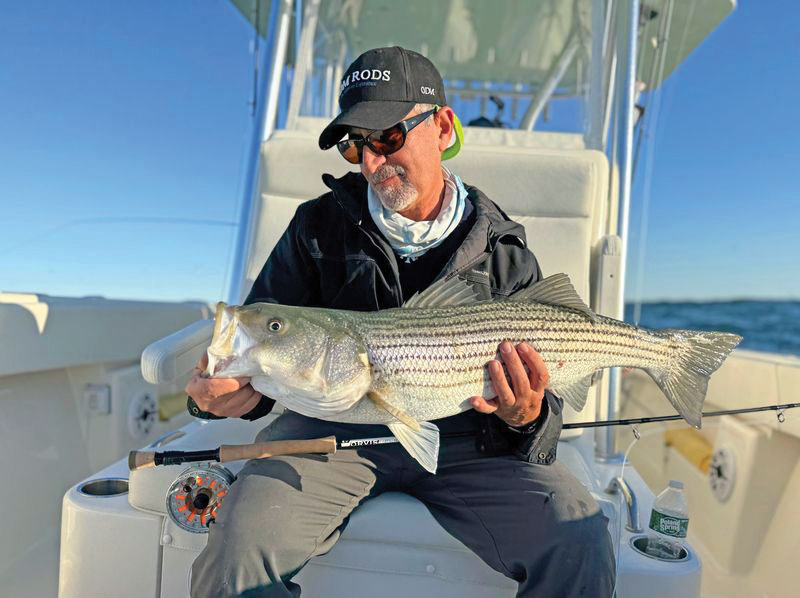
I would recommend using or acquiring a fly rod designed to cast an 8-, 9-, or 10-weight fly line. Most striper anglers use a 9-foot rod for a 9-weight line. You’ll be using a weight-forward floating fly line or a weight-forward intermediate (slow-sinking) fly line with this. Get either.
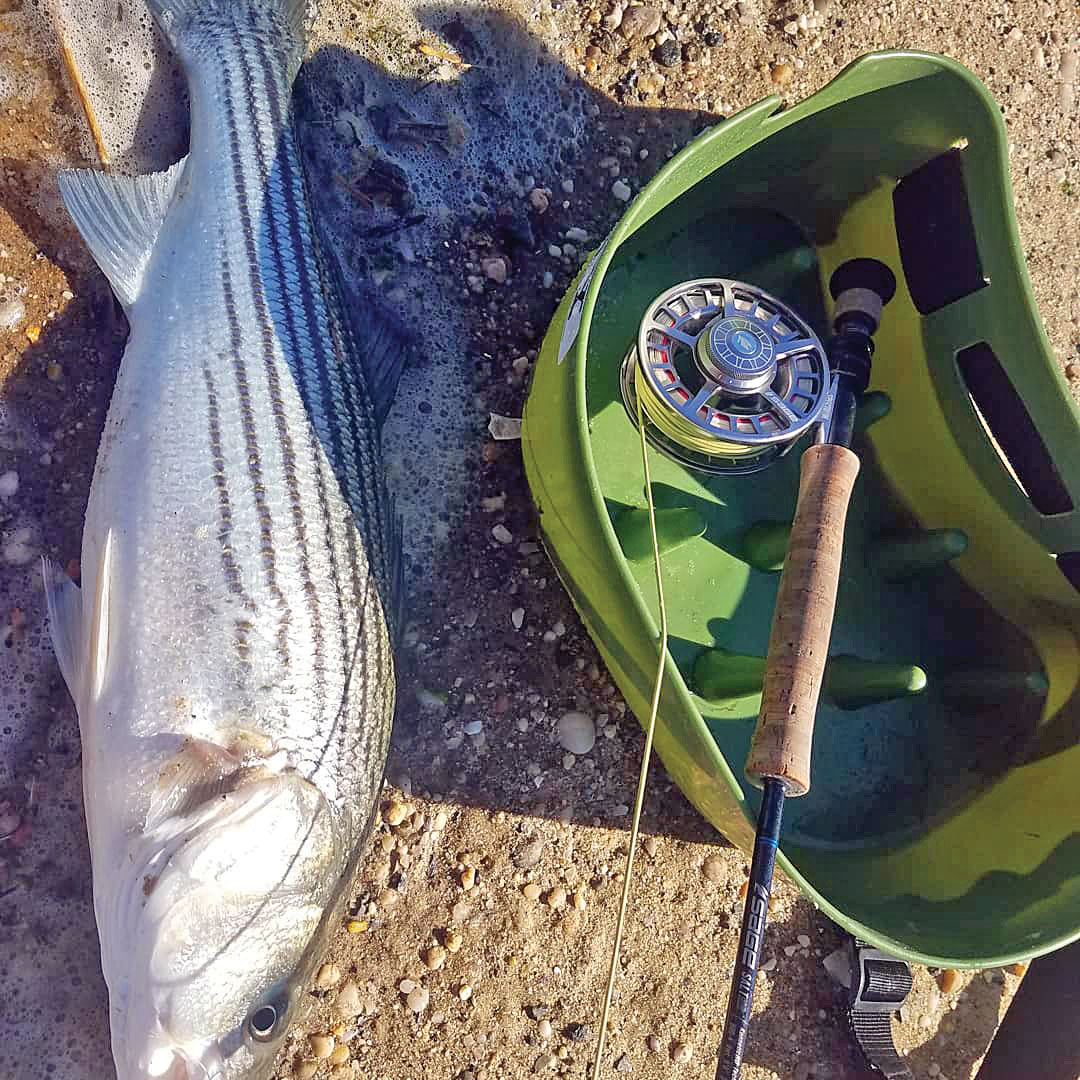
I would also recommend buying a shooting or stripping basket, especially for the intermediate line. You’ll wear this line receptacle around your waist as you fish and strip the fly line into this container as you manipulate your fly. It will keep your line under control and out of trouble, helping you have a pleasant experience.
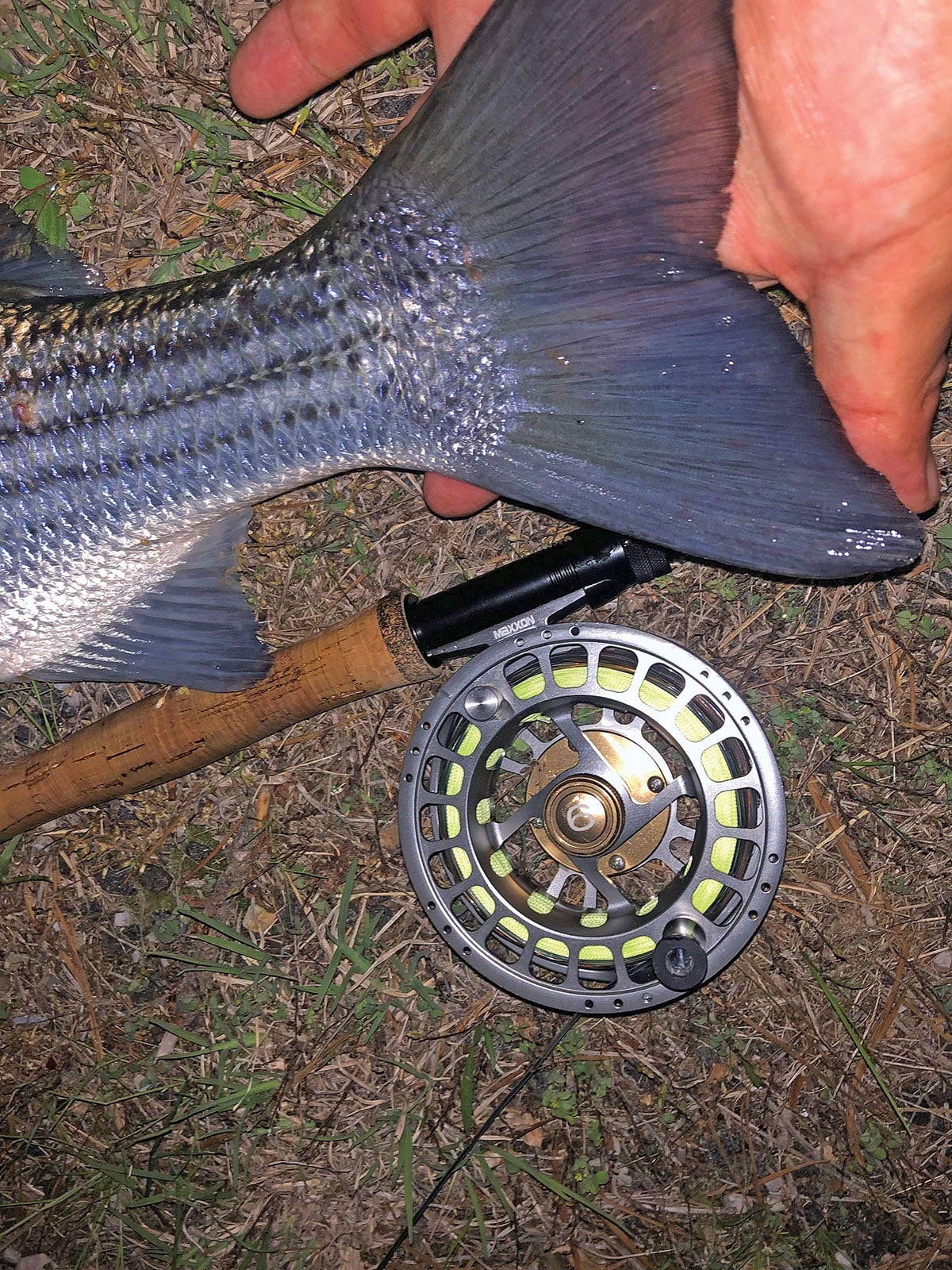
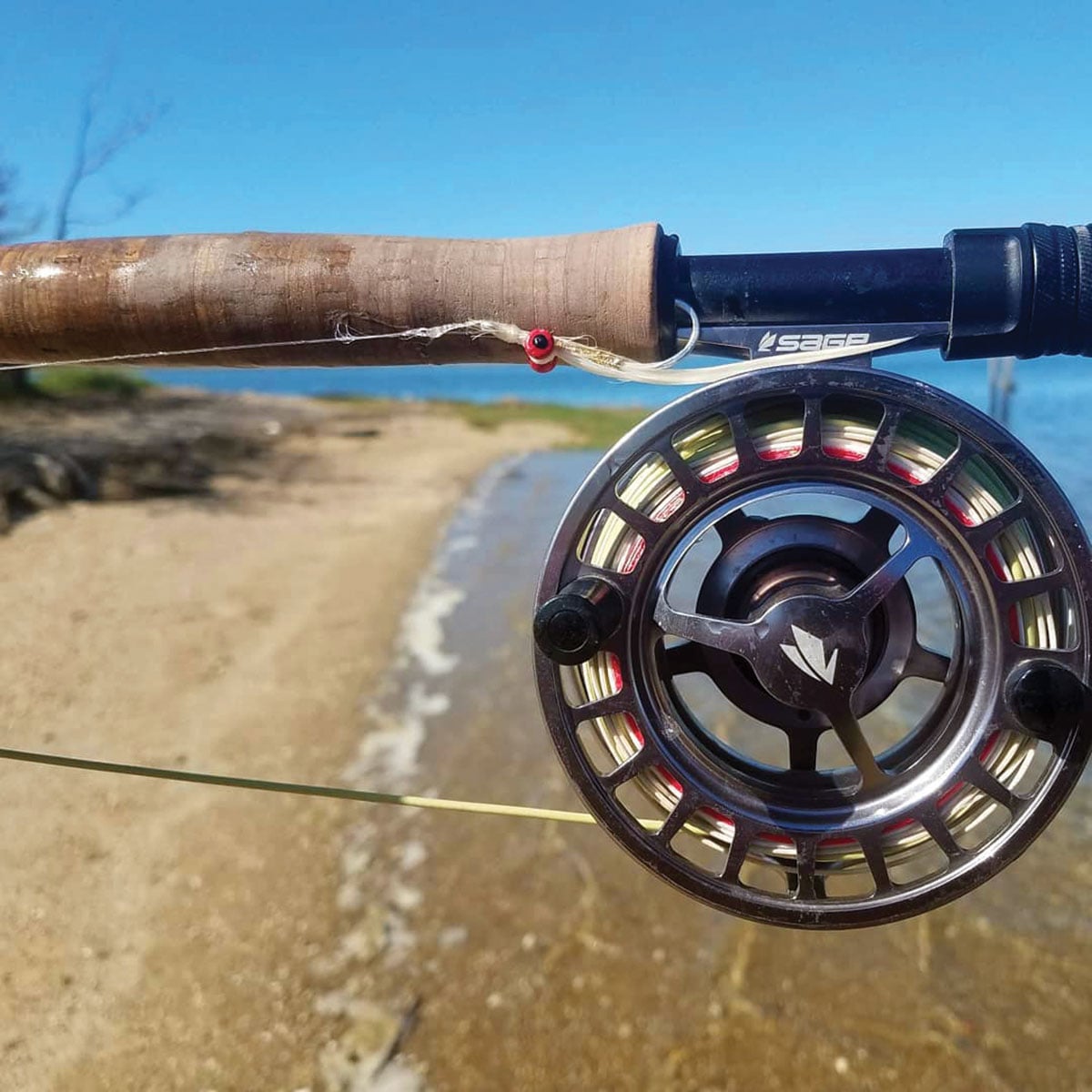
You don’t have to spend thousands of dollars on beginning fly gear. Just get some practical stuff that works. Fly shop owners and YouTube can help you here. Buy an inexpensive fly reel designed for saltwater fly fishing—meaning corrosion resistant—and one that will hold at least 50 yards of backing, usually 20- or 30-pound dacron.
If you’re an experienced fly fisherman and all you have is a 6- or 7-weight rod and line, you can start with this. I’m not expecting anyone to go out and cast long distances, and the fish you will be concentrating on will generally be small—say 15- to 26-inch striped bass. These will be easier to catch than bigger bass, and as a beginner, catching any bass is a prize and worthy accomplishment. I speak from personal experience. Lighter gear will handle these fish just fine. A 9-weight simply puts you in the game for all size bass for years to come.
Leader Setup & Accessories
The leader is tied in front of the fly line and connects the fly line to the fly. I recommend using an 8-foot leader—an 8-footer tangles way less than a 9- or 10-footer—and making it two pieces of mono. Use 4 or 5 feet of 30-pound mono as the butt, knotted to 3 or 4 feet of 15-pound tippet. Keep that leader simple.
You don’t need many other items. Waders—make sure they fit you—sunglasses and safety glasses, a couple spools of mono tippet material, a fishing tool or pliers to cut leader material, help tie knots, and unhook fish, and perhaps a hook file to keep hooks sharp, is about all you need. Maybe a tape measure and fly box or pouch too.
Learning To Cast
Learn to fly cast and practice it some! The easiest thing to do is go to YouTube. Study some videos. Then go out and try it with your outfit. I have some fly casting videos out on YouTube myself—Mark Sedotti. If you can get a fly casting lesson at a fly shop or take a casting class, so much the better. I give private fly casting lessons. Do the best you can, but don’t skip the videos. Consulting YouTube is such an advantage compared to years past.
A note: You won’t have to cast far to catch at least some fish. You want to be able to make casts of at least 30 feet. I could go on and on about fly casting, but I won’t—go to the visuals.
Working The Fly
Your retrieve is going to be different than using a spinning rod. You strip the fly in, or rather, strip the fly line in like you’re hand-lining. Best thing for you to do is look at this on YouTube or online. A visual explanation is more helpful than me telling you.
You hold the outfit with one hand—the rod hand—then, after the cast, make strips of the line with the other, line hand, from behind that rod hand. You can strip different lengths and speeds to affect the fly’s retrieve, putting action and life into the fly.
Best Starter Flies
Start out with a couple patterns out of the many you might see. They are:
Clouser Minnow – about 3 to 3-1/2 inches long in white or chartreuse
Lefty’s Deceiver – 4 or 5 inches in white with a dark top, or yellow
These are all you need to start. Buy a few of each. You will need spares. It’s easy for any angler, let alone a beginner, to bend hook points, wreck flies, and lose flies. Be prepared.
Hooksets & Knots
Setting the hook—again, go to a visual for this. You simply strip tight quickly into the fish, then with a quick twist of the body, pull the butt of the rod away from the fish on a tight line. It’s a lot easier to get a good hookset on a short line than a long one. You’ll see what I mean and will get it with practice.
If you know the following knots, you’re in business:
Clinch Knot – for tying on the fly
Blood Knot – for connecting leader sections
100% Loop Knot – can be used for almost everything
Practice tying your knots too.
Where To Go & When
| TWO-HAND RETRIEVE |
| This gives the fly a different look in the water and also allows for a faster retrieve if needed. After the cast, put the rod butt under your armpit, which allows you to retrieve the line with both hands, hand-over-hand. Retrieve until the leader is at the rod tip, then make another cast. Retrieving will require a little practice, but the learning curve is quick.
|
Got your tackle? Is it all rigged up? Have an idea how to use it? Ok, let’s go get a bass.
Striper patterns have changed compared to years ago, and they’re not quite as available from shore as they once were. But you can find them. There are still plenty out there just waiting for you.
Many fine anglers have told me, “You can’t catch them unless they’re there,” so I pass this on to you.
Your best chance of finding bass is to go into a fly shop or tackle store, tell them you want to catch your first striper on fly, and ask exactly where you can do this from shore. You don’t care about size—a small fish is fine. You simply want to hook a bass. Any size.
They’ll probably tell you exactly where to go. Smaller fish are easier to find than larger ones, especially from shore, so much is in your favor.
Also ask about the best time of day and tide to fish that spot. This is critical and often makes the difference between catching and not catching. It will most likely be sunrise, sunset, cloudy days, and around high tide. Bass often work closest to shore on high water. Nighttime can be excellent too—stripers are nocturnal feeders.
Boat docks in rivers and harbors can be incredible places to catch your first striper. Many small bass—and not-so-small bass—hang around these places. Bass may be active during the day, but they’ll be even more active late and especially in the dark. You’ll often see and hear them feeding in dock lights. You may even watch them eat your fly. It’s a peak experience for the first timer.
Lighted bridges with moving water below are another top option. I caught my first striper under a small lighted bridge at 4:00 a.m. one summer morning in Rowayton, Connecticut. It remains a vivid, cherished memory.
Fighting & Releasing Fish
| POTENTIAL FIRST FLY STRIPER LOCATIONS |
|
You can strip a small striper in. If it’s bigger, play it off the reel, meaning get all the fly line onto the reel and fight the fish by reeling it in. Don’t take too long during the fight. You don’t want the fish exhausted. You want it to live to fight another day—and perhaps make another angler as happy as you.
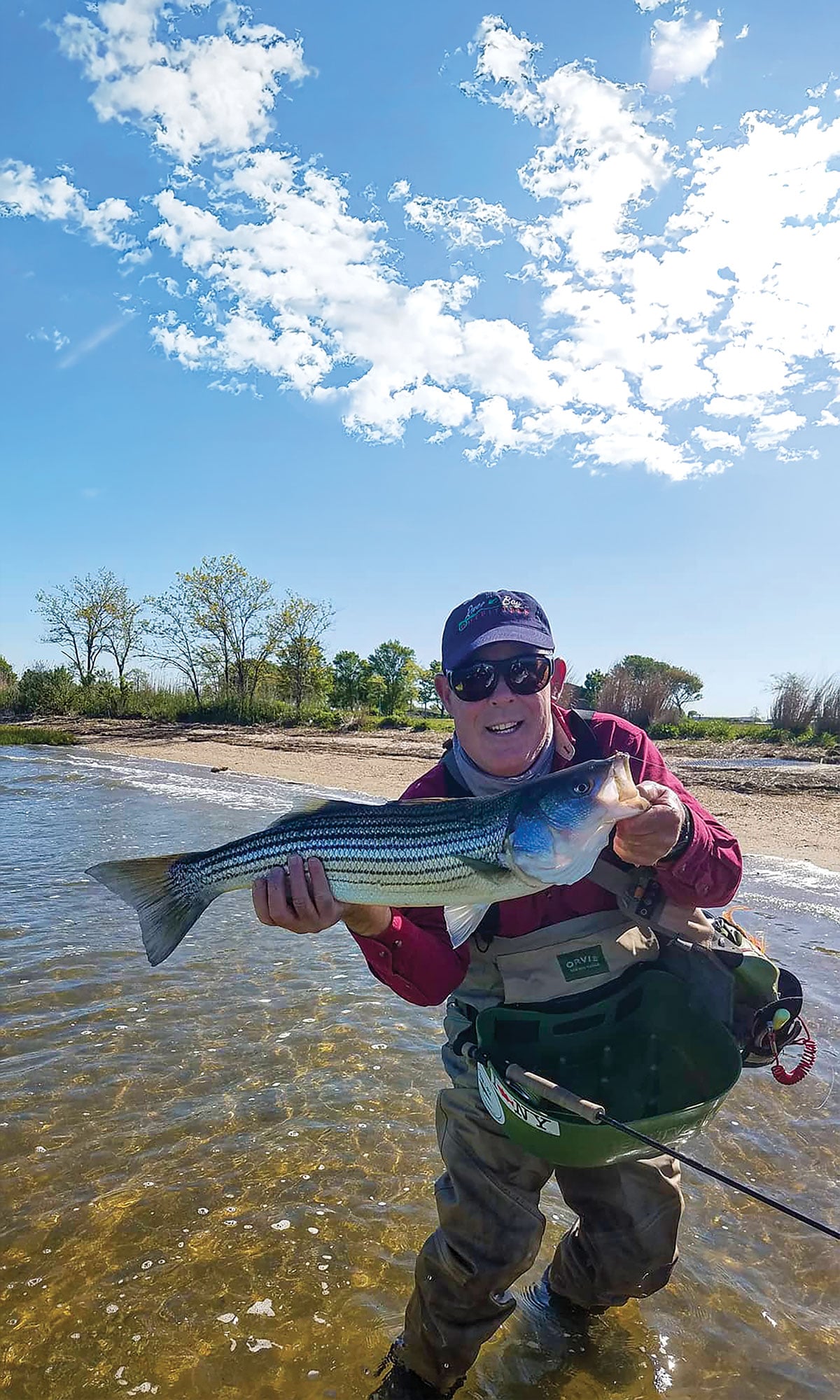
Don’t overhandle the fish, keep it in the water as much as you can, take a quick photo, and then watch it swim away with strength. This is an exciting, joyful, and satisfying moment—your first striper on fly. I know, I’ve been there!
Experience pays. As you, the beginner, fish, you’ll get better. It may happen quickly, or it may take time. It doesn’t matter. It’s really the road that’s fun. So be perseverant. You will get that bass—then more of them.
Good luck pursuing and catching that first striped bass on fly. I’m all behind you.