With the ugliness of ‘25 in the rearview mirror, a rosier outlook look on bluefin in ‘26
Now that the news has hit social media and the airwaves with a wide array of opinions this article will hopefully provide clarity behind what’s up with the 300 metric tons of United States (U.S.) recreational bluefin tuna quota.
But first, let’s talk about how we got here.
The International Commission for the Conservation of Atlantic Tunas (ICCAT) manages bluefin tuna and other select pelagics that migrate across international boundaries. The U.S. and other ICCAT contracting parties are required to comply with ICCAT fishery-management measures. Specifically, the U.S. is required to abide by the decisions of ICCAT consistent with the Atlantic Tunas Convention Act.
Measures adopted by ICCAT are then implemented by the National Marine Fisheries Service’s (NMFS) Highly Migratory Species (HMS) Management Division.
There was an increase in bluefin quota allocated at the ICCAT annual meeting in Seville, Spain, in November 2025. The Western Atlantic bluefin quota (west of the 45th longitude line) increased to 3,081.6 metric tons (mt), whereas the Eastern Atlantic/Mediterranean bluefin quota increased to 48,403 mt.
The Western Atlantic bluefin quota is allocated to the US, Canada, Japan, Mexico, United Kingdom (Bermuda) and France (St. Pierre and Miquelon). The U.S. portion of the quota for 2026 through 2028 is 1,572 mt. That U.S. share of the total quota is further separated and managed by NMFS into sub-quotas for recreational and commercial-size fish that can be legally landed utilizing various means and methods (hook and line, longline, trap, harpoon, etc.).

Close Kin Science
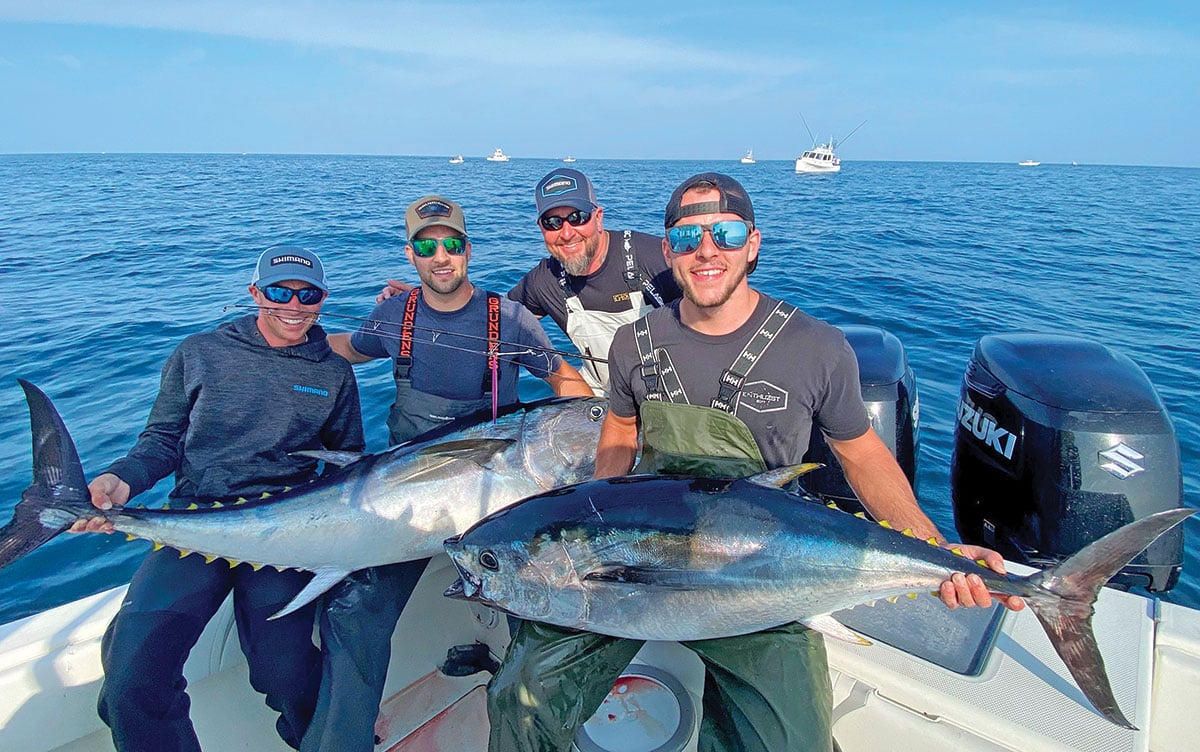
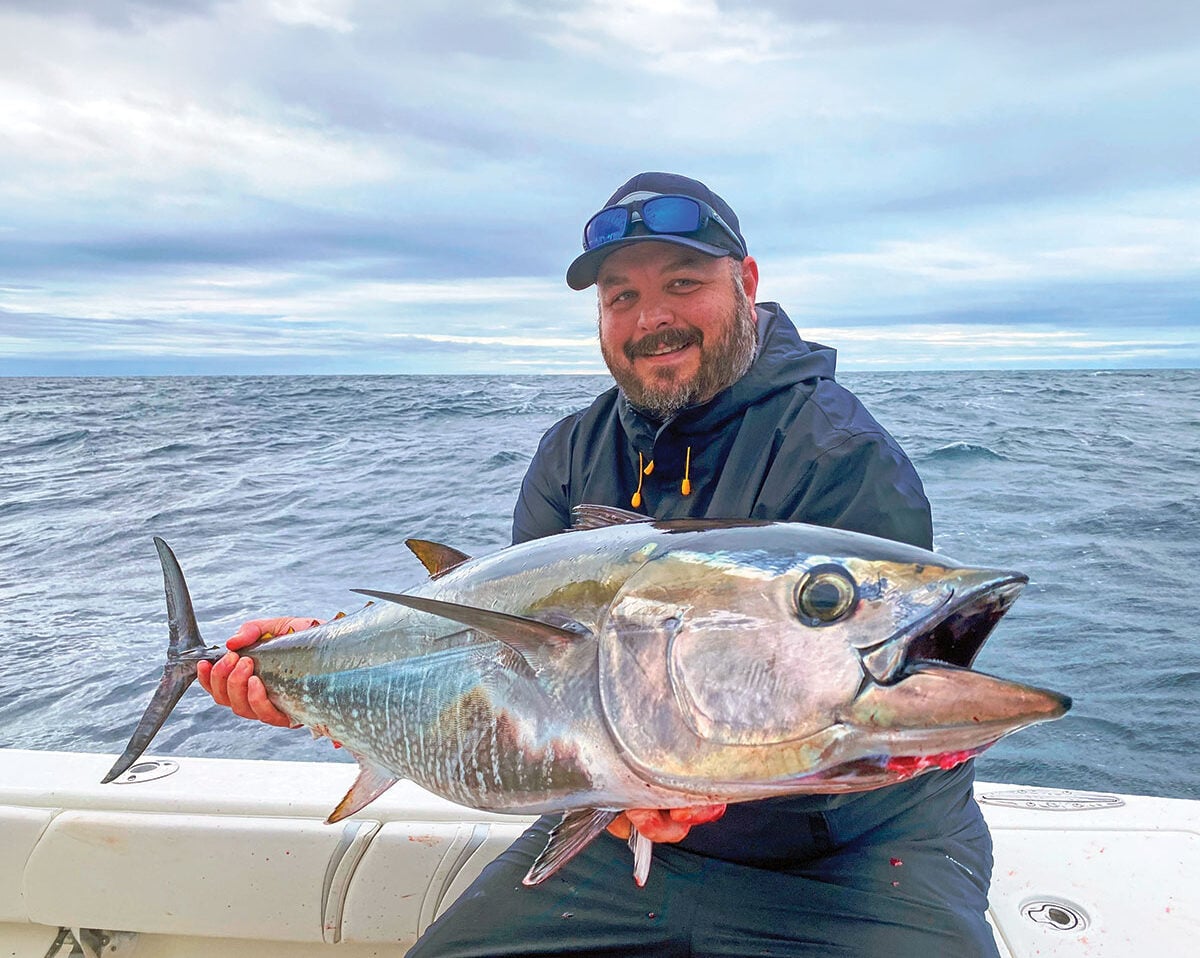
We don’t need to be convinced there is an abundant bluefin fishery in our waters. Ten plus years ago one would need to 30 to 50 miles or more offshore or to the Hauge Line for a chance to land a recreational or commercial size bluefin. With the availability of select forage fish and favorable water temperatures our bluefin are nearshore; in some instances they’re being caught right off the beach, and now easily accessible to the public.

For years we have indicated that the area known as the Slope Sea is a separate and distinct bluefin spawning area independent of the Gulf of America (Mexico) spawning area. Recent studies conducted of the Slope Sea observed abundant bluefin larva throughout. Pending close-kin mark recapture bluefin science should provide additional lines of evidence of an additional bluefin spawning area contributing to the increased abundance in our waters.
The eastern Atlantic/Mediterranean quota noted above is shared among many ICCAT contracting parties. ICCAT recognizes that the Western and Eastern Atlantic/Mediterranean stocks mix. The ongoing bluefin “close kin mark recapture” science spearheaded by Dr. Walt Golet at the University of Maine, and derived from fin clips provided by the recreational and commercial bluefin fishermen. The “close kin” science helped facilitate the 17% ICCAT Western Atlantic bluefin quota increase at the November ICCAT meeting in Spain.
The “close kin” science provided to date indicates approximately 60% of our Western bluefin originate from the Eastern Atlantic/Mediterranean. This facilitated a change in allocation percentages associated with the U.S. Atlantic bluefin quota. This “close kin” science could well be the future of bluefin recreational management, where if adopted, management of the fishery would be based on abundance.
Recreational Reporting
For many years the U.S. has been one of the few contracting parties that reports recreational catch from our allocated quota. Contracting parties that have Eastern Atlantic/Mediterranean bluefin quota are required to report their recreational catch as well, but for many years have only sporadically and partially reported landings. There is no doubt that there is a booming recreational and for-hire fishery in the Mediterranean and Eastern Atlantic waters with little catch data reporting being submitted for too many years now. Earlier this year the EU implemented new, mandatory, daily electronic reporting requirements for marine recreational fisheries targeting certain species, including bluefin. However, other nations that are not part of the EU but are part of European and African continents are reporting little if any recreational catch, despite landings occurring. There is still a glaring disconnect.
We are yet to see the details of the EU plan to ascertain whether it is even close to the U.S. data requirements and management of recreational bluefin or other pelagics. One apparent omission is that recreational does not include for-hire and as a result it appears the for-hire catch is largely not being recorded and reflected in one’s annual quota allocation.
The ICCAT Eastern Atlantic/Mediterranean management requires that recreational catch be recorded and assigned to one’s quota. The U.S. has argued that a parallel requirement does not exist for the Western Atlantic contracting parties in Western bluefin management Recommendation 22-10. As a result – and because of the lack of recreational catch recording for many years now by the Eastern Atlantic/Mediterranean contracting parties – the U.S. notified ICCAT in January 2026 that it is exploring continuing to meet its requirement to report our recreational catch but not count it against the US quota.
Regardless of the determination regarding counting recreational fish against quota, the US will continue to collect, compile and submit recreational catch data to ICCAT.
Not surprisingly, this proposal has been heavily criticized by our friends across the pond. It should be noted that our recreational quota is negligible in comparison to the Western and Eastern Atlantic/Mediterranean bluefin quotas that are dominated by commercial quota allocations.
Seasonal Management
So, what happens to the 300 metric tons? As noted, measures adopted by ICCAT are then implemented by NMFS/HMS. Although specific ICCAT recommendations supersede U.S. domestic management in most instances, management is still impacted by the Magnuson Stevens Fisheries Conservation and Management Act and its 10 National Standards. NMFS, therefore, continues to collect, compile, and submit recreational data to ICCAT and will continue to manage and closely monitor the recreational and commercial catch of bluefin while using the best available science. In that regard, the HMS Division will set catch quotas for 2026 for its recreational catch consistent with ICCAT recommendations, and NMFS will continue to responsibly manage the recreational bluefin fishery. As a result, NMFS is presently reviewing domestic management of bluefin consistent with the Magnuson Stevens Act, with a decision pending soon with what will occur with the 300 mt of recreational quota.
| HMS PERMITS & MANDATORY REPORTING |
| In order to target Atlantic bluefin and other pelagic species (yellowfin, longfin, billfish) you’ll need a Highly Migratory Species (HMS) permit assigned to your vessel. The $24 Angling category permit or Charter/Headboat permit authorizes vessels to recreationally fish for and retain Atlantic HMS species using specific gears, and must be renewed annually.
All anglers must report all recreational billfish, swordfish, and bluefin tuna landings and all bluefin dead discards within 24 hours either online or via the HMS Catch Reporting App. Vessel owners/operators can also report by calling customer service at 888-USA-TUNA (888-872-8862), Monday through Friday from 8 am to 5 pm. Additionally, the Large Pelagics Survey (LPS) or Marine Recreational Information Program (MRIP) may survey anglers at the dock, by phone, or by mail regarding all recreational HMS. If contacted, HMS permitted anglers are required to participate in these surveys. Get your $24 vessel permit by visiting hmspermits.noaa.gov |
Aside from the pending decision let’s look at what happened in 2024 and 2025. In late 2024 the recreational bluefin quota was exceeded for the first time since approximately 2010. The Harpoon and General Category (GC) commercial bluefin quotas were exceeded in 2024 and then reserve quota was applied. Yet both exceeded their revised quota and left no reserve for the end of the year to apply to the recreational quota. NMFS also concluded that the recreational fishery exceeded its quota for 2024. The fact that reserve quota need not be applied to the recreational quota since 2010 was a surprise and left no reserve quota available for use at the end of 2024. It’s a testament really to an abundant bluefin fishery, nearshore and accessible to recreational anglers up and down the Atlantic Coast.
Ultimately, the U.S. bluefin quota for the General, Harpoon, and Recreational sectors was exceeded in 2024 requiring, as concluded by NMFS, that a 2025 payback or reduction – equal to the overage from 2024 – get applied in 2025. But it doesn’t end there; with the change in the White House administration in 2025, the transition, as is often the case, caused delayed action by the HMS Division resulting in the trophy and GC quota being exceeded in early 2025. This put the U.S. fishery in a terrible position, because if our bluefin quota was exceeded again in 2025 there would be a 125% payback the following year, which of course is 2026.
As a result, cuts to the commercial and recreational quotas were applied with changes to seasons and bag limits for the recreational fishery and a recreational closure in late August of 2025. That was devastating to bluefin anglers, our for-hire fleet, and the tackle shops, marinas, boat dealers and the entire bluefin economy that relies on such to make a living. The early recreational closure severely impacted Mid-Atlantic states to New England, thereby denying historic access to the recreational fishery.
As of now, the 2026 bluefin fishery is being managed based on the prior U.S. quota. With no exceedance of the bluefin quota in 2025, there is no payback. Moreover, the U.S. quota does not include the recent ICCAT 17% quota increase approved during the annual meeting November in Seville, Spain. That will likely not be available for use until late summer.
As I write this in late March, there continues to be a hot nearshore bluefin bite with tuna accessible to the angling community from Maryland to South Carolina. Mindful of those landings, at all costs, we cannot have another recreational closure that would be devastating to the entire industry.
| CLOSE-KIN MARK RECAPTURE (CKMR) |
| To help with the scientific efforts to better understand the spawning and migratory patterns of Atlantic bluefin tuna, order your bluefin fin clip kits to support the close kin mark recapture (CKMR) science. This is the wave of the future; management based on abundance independent of reporting. Order your kit now, and make sure to get your bluefin fin clips to Dr. Walt Golet and his research team at the University of Maine.
Point your cellphone at the QR code to visit the University of Maine website for all the details from their Pelagics Fisheries Lab or email pelagicfisherieslab@gmail.com. For 2026, the focus from researchers will be on anglers sampling smaller, school bluefin where science is currently less robust. |
Last year the bluefin bite just got underway in southern New England when it was closed in August, resulting in many anglers from southern New England to Maine to not get an opportunity to catch recreational bluefin through the rest of the 2025 season. This was devastating for the for-hire fleet with 30 to 40% trip cancelations. Bluefin tuna rules the day north of the Cape Cod to Maine with few other options as a result to cuts to seasons and bag limits for cod, and wide array of other species recreational angler’s target.
The importance to the entire blue economy from the Mid-Atlantic to New England cannot be denied. The tackle industry suffered with significant orders of rods, reels and equipment being cancelled due to the closure. The same can be said of boat sales, they were canceled after the closure.
Ultimately what lies ahead for the rest of 2026 will be determined soon as we wait on the final regulations from NMFS/HMS. Clearly, we have an abundant and accessible bluefin fishery, and catch is not likely to go down. Some tried a catch and release fishery last year after the shutdown, but such was not the preferred order.
There is no lack of bluefin based on our ongoing observations and catch up and down the east coasts and Gulf states, recent Slope Sea bluefin larval and DNA study, as well as the close kin recapture science. Much is at stake and we hope that the NMFS puts the 17% bluefin quota increase to good use, hopefully with a reserve category set aside for the recreational quota in the event it needs to be applied to keep the recreational fishery open the rest of the year.
We anxiously await a decision of the 300 metric tons of recreational quota and hope that relief is on its way.
The author is president of the Stellwagen Bank Charter Boat Association and an active member of International Commission for the Conservation of Atlantic Tunas Advisory Committee and HMS Advisory Panel.