The image shows me walking along a Cape Cod beach with an intense aurora exploding from the horizon. It was no accident that I was there when this phenomenon occurred. I have been fascinated by the northern lights ever since I first saw them in 2003. But, try as I might, in the 20-plus years since that first sighting, I have only seen the northern lights a small handful times, and most of my hopeful excursions, with conditions that were supposedly ‘right’ for seeing them in New England, resulted in me looking at a black sky. I imagine that many of you have had similar experiences, seeing a news report or Facebook post about the conditions being favorable, going outside… and seeing nothing.
While it is a relative rarity to see the northern lights from our little corner of the world, it’s more common than you might think, I have seen them seven times in the last year, which far eclipses all of my varied efforts in the 21 years prior. You would think, being a dedicated surfcaster with thousands of nights logged in the surf, I’d have seen them more often, even by chance. And it’s true, one of the best displays of the northern lights I saw (before 2024) was on a random night fishing the beach, and I had no idea the conditions were right. I just happened to look north and saw an eerie green glow swelling up from the horizon with a fan of towering white pillars stretching skyward. Awestruck, I watched until the glow descended. I remember feeling supercharged for the rest of the night, but I have no recollection of what I caught.
There are several factors that have led to my recent spike in aurora successes. The first one is opportunity. I have recently learned that the sun works in an 11-year cycle, the pinnacle of that cycle is called ‘solar maximum’ and scientists declared that this level was reached this past October. This peak level of solar activity lasts a couple years as the pinnacle builds and recedes, meaning we have, at least, the rest of this year to look forward to.
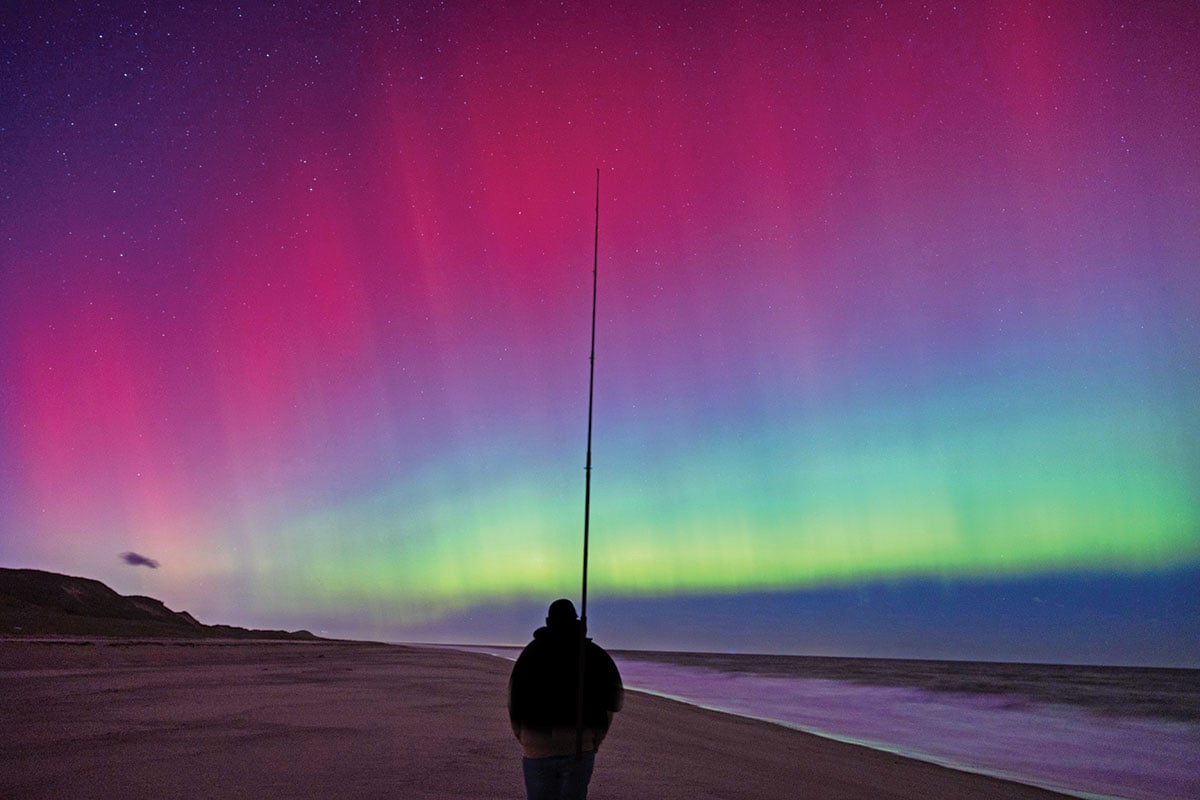
The second factor is a better understanding of what the aurora really looks like. Those wild photos we see online are seldom even close to what can actually be seen with the naked eye. Photos taken with a longer exposure can capture more light which results in these stunning images. The accompanying photo is pretty close to what we could actually see, more vivid, but that was also a three-headed-monster of a geomagnetic event. In most cases, the aurora looks more like a tinted fog. And taking a photo with your phone, especially if you can lengthen the exposure to at least 5 seconds, will reveal whether or not you’re seeing the aurora or just light pollution.
The other thing that’s important to understand is that, just because conditions are ‘right’ for seeing the aurora, it doesn’t mean that the lights will be in full view all night long. The aurora is caused by a solar flare, originating on the surface of the sun that results in a coronal mass ejection (CME). This plume of magnetically-charged particles, when directed at earth, collides with our atmosphere and ignites the aurora. This journey from the sun to the earth, results in the CME stretching out which means it won’t hit all at once and it won’t hit with uniform intensity. These intermittent flare-ups are called ‘substorms’ and they are the real key to seeing the lights. So when conditions are favorable, you should plan to be out at night and just keep an eye on it for several hours. This is why aurora hunting and fishing for stripers, brown trout or largemouth bass are such a perfect pairing.
If you want to increase your odds, I would suggest downloading the ‘Aurora Alerts’ app for your iOS or Android device. This will provide tools to make informed decisions about when to go out and look. The main factor is the Kp Index, this is an imperfect indicator, but valuable nonetheless. The Kp Index is numbered 1 through 9, we typically need at least a 7 to see them in New England. But paying attention to other factors has led me to sightings with a Kp as low as 5. The Bz factor, the z-component of the sun’s magnetic field, is a huge part of aurora hunting, you want to see a negative number, -10 is where I start to look, the best viewing I’ve seen came with -39. Then there’s Bt, this measures the strength of the magnetic field between the earth and the CME, higher the Bt, the greater the attraction, with that negative Bz and high Bt, opposites attract, and the aurora is likely to be strong. The final component is density, which – as I understand it – measures the potency of the CME in real time as it collides with earth, the higher the density, the more vivid the visuals will be.
I also use the Space Weather app because it offers free alerts that tell me when solar flares and increased auroral activity are happening. And I would highly recommend signing up for Tony Bendele’s Real-Time Aurora channel on Facebook, he is dedicated to providing and deciphering all of the data and broadcasting it to his thousands of subscribers; this is also free and you can learn a lot by reading his content.
I would estimate that about 80 to 90% of my fishing is done under the cover of darkness and I love everything about being out at night, immersed in the quiet of the wee hours. But it’s things like meteor showers, fire balls, comets and aurora sightings that can make an otherwise ordinary trip into a night you’ll never forget.