This summer I wrote of “the irony of 21st century fisheries management” when referring to bluefin tuna management; too many fish and not enough allowable quota. The problem with black sea bass is quite similar, but far more incomprehensively stupid.
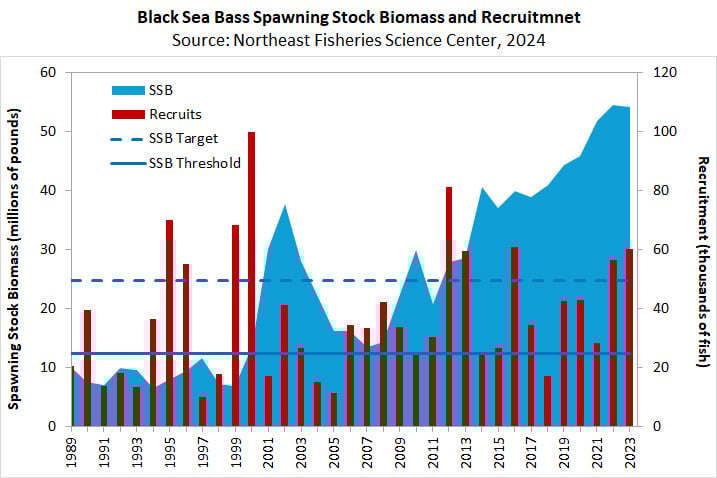 I’ve included this chart to prove my point. Pay no attention to the typo, ‘Black Sea Bass Spawning Stock Biomass and Recruitmnet’ – the chart was produced by the Northeast Fisheries Science Center, and we commoners know not to question the data coming out of that office! When you hear folks say “black sea bass is double the biomass target,” that’s shown by the dark blue mass of total spawning stock biomass (SSB). The dotted horizontal blue line is the SSB target; when SSB was below that line, we were considered on a rebuilding track, the goal to get the blue mass above the dotted line. Mission accomplished!
In 2008, New Jersey sea bass anglers had a 12-inch minimum size limit and 25 fish bag with 365-day access to the fishery. In the fall of 2009, NOAA Fisheries took unprecedented action in shutting down black sea bass midseason, and by 2010 our January/February fishery was gone forever. We then found ourselves with a 2010 bag limit of 25 fish at 12-1/2 inches running May 22 to September 12, and still the biomass continued to grow…and grow, and grow.
The fishery was officially rebuilt (a third time) 13 years ago, and we’ve since gone from overfished to overstocked. In fact, there are now so many black sea bass that anglers can’t help but catch one, often inadvertently. The more we catch, keep and/or release, the more restrictive the regulations to preserve the biomass, which only promotes more discards; in turn each reported sea bass caught, kept and/or released is fed back into the assessment model to prove that yes, indeed, the stock is robust. I think the only thing this chart needs is a graphic of a dog chasing its tail!
Non-government environmental organizations with deep pockets – and their activist mouthpieces lining their own pockets – often criticize those who dare ask for more fish. “Short-term sacrifices needed to rebuild fish populations are worthwhile investments,” is what they throw around in meetings and blogs, their hypocrisy as clear as the giant blue mass of sea bass in the chart! “Maintaining long-term abundance often involves short-term sacrifice,” they preach, as if someday anglers will reap the rewards. And yet, someday never comes.
Simply put, black sea bass management has become far more complicated and complex than it should be, and I’d ask NOAA Fisheries staffers to look at their own chart as intently as you and I are doing right now. Socioeconomically speaking, the current management regime is counter-productive to the goals of conservation; preservation maybe, but certainly not conservation. Regulations may be working for the fish, but not for the fishermen.
The point anglers should be making with fisheries managers is this – reduce the minimum size limit and you’ll also reduce discard mortality rates while lowering the overall poundage, which historically speaking would maintain biomass and potentially give anglers more days to sustainably fish for sea bass. It’s time to look back at 20 years of science and history, to when our sacrifices first began, and before assurances of future rewards would be proven to be nothing more than false promises.