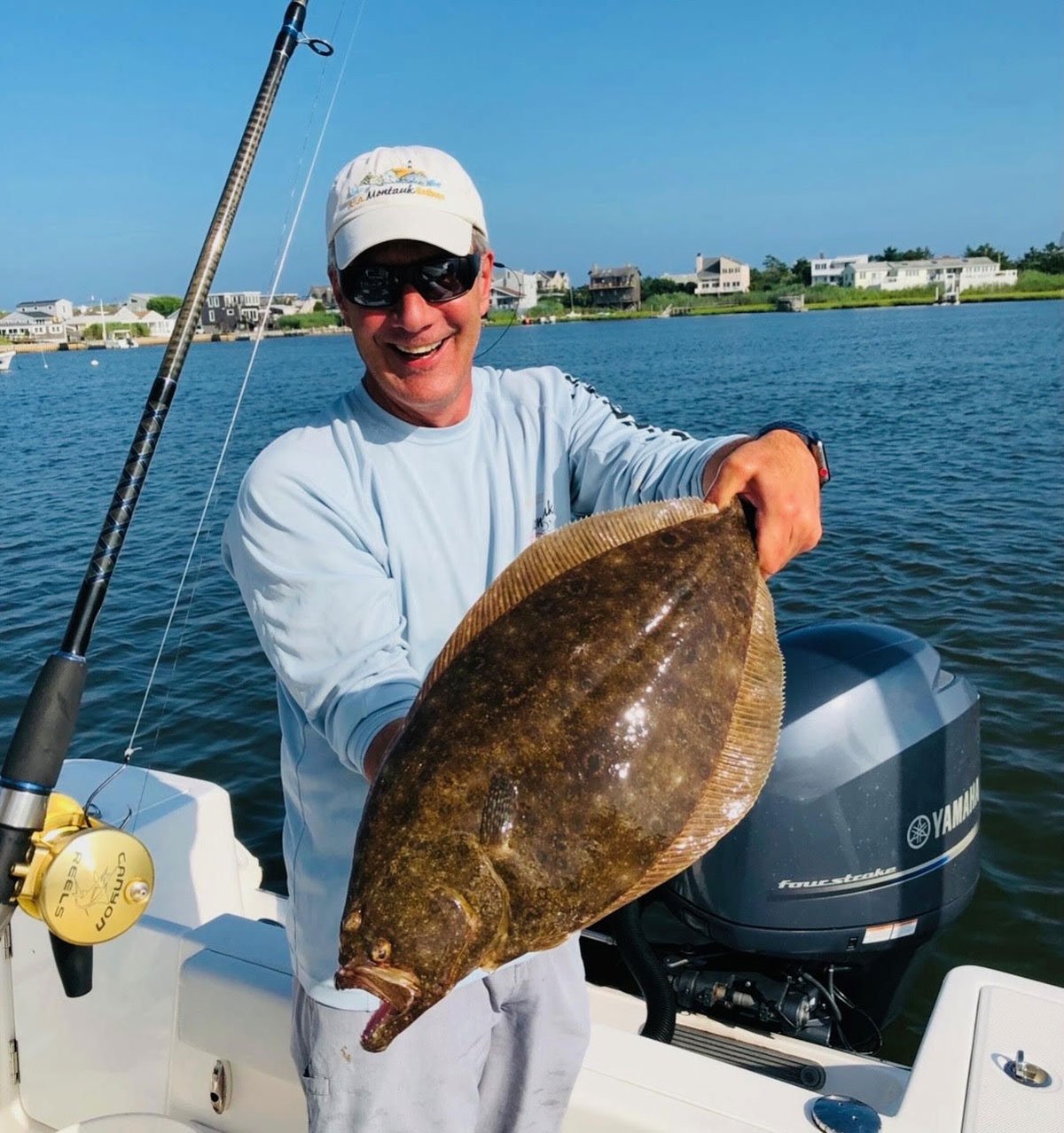
With live spot, you now have an added live bait, which are guaranteed will put more fish in the live well.
From the time Capt. Tom Cornicelli of Ocean Merchant in Moriches began offering live spot (2005, and the largest distributor on Long Island) to anglers, the key target had been striped bass for the most part. However, for the last five years or so, more and more anglers started expanding the targeted fish. In fact, several anglers I know use them for fluke regularly in Moriches and Fire Island. For the offshore angler, bluefin tuna and even sharks of various species have been all over this old, but “newfound” bait.
The live spot exploration into new species was not that these fish just began eating spot, anglers started catching more and more fish as a bycatch while bass fishing. As I compile the South Shore report weekly, I hear, firsthand, about large fluke, blues, sharks and tunas caught as a bycatch while bass fishing in the inlet and ocean alike. I always felt anglers looked for that added advantage while fishing, whether it be that new “hot” lure, a new “color” soft plastic, or just something others anglers are using to catch more fish! This is why we have thousands of dollars tied up in rigs, soft plastics and other gear in our basements, boats and garages. With live spot, you now have an added live bait, which are guaranteed will put more fish in the live well.

Spot?
Before we get into fishing a spot, let us take a quick lesson on what they actually are, and what they look like. A spot is really just another name for lafayette. The name spot came from a round brown dot/blotch near the root of the pectoral fin. Live spot are a species that thrives in the spring and throughout summer months and are caught using a small piece of worm fished on the bottom in our bays. However, the effort needed to put them in your live well may be a bit overwhelming and slow. However, if you are bottom bouncing for flounder, sea bass, kingfish etc. and catch a spot, you might want to make a quick drift on fluke/striper grounds inside the bays. For most however, stopping at Ocean Merchant, Cow Harbor, Live Bait Long Island or one of the other smaller suppliers is a much easier task.
The one nice thing about a spot is they are a hearty bait, and very easy to keep alive. You do not need some high-end live well. I have picked up spot at Ocean Merchant and drove to Fire Island to fish. All I used to keep them frisky was a five-gallon spackle bucket and inexpensive battery operated air stone. Capt. Tom said a live well on the boat is great, but if you do not have one, just make sure you have some form of air, and it is an insulated container to keep the water temperature stable.

Not Only Bass
I hear all the time from anglers this question. “Are spot only good for stripers?” Absolutely not! Not only will live spot put bass in your live well on virtually every trip, sometimes every drift, you can catch some of your largest fluke, sea bass, blues, weakfish, and offshore species – tuna and shark! Heck, with the Dream Boat Contest having a category for sea robins, several years ago I could have been one of the top dogs, if not top, with a 6-plus pound sea robin that jumped all over a spot in Fire Island Inlet.
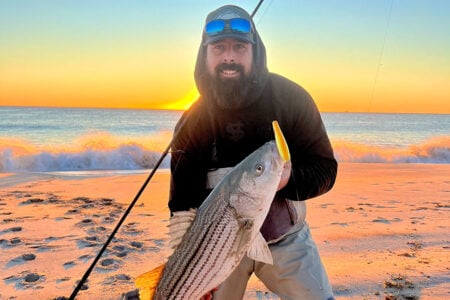
Already this year (late May/June) I have heard of outsized fluke landed on live spot in Moriches and Fire Island. Some anglers will tell you spot only catch smaller bass, but that is the farthest thing from the truth. And, with today’s regulations, that may not be a bad thing if it were case as “slot” fish are we want anyway. I remember talking with one of the great striper anglers I knew – Capt. Scott Leonard (R.I.P. buddy) before his passing. Capt. Scott won many events using spot, and in fact had a bass of 51.9 pounds on one.

Catch ‘Em Up
As for rigging and using live spot, it is really no different and then any other live bait where areas are concerned. In today’s world, they must be on an inline circle hook in size 6/0 to 7/0. Don’t worry, big sea bass and fluke, as well as others, can easily engulf a bait with a 7/0.
From Capt. Tom, he suggests you hook spot up from the chin and exit out through the hard cartilage near the nose. On the rig, Tom uses an 8-foot leader of 50-pound fluorocarbon fished on a standard fish-finder rig. What you need to know is spot will always swim to the bottom, regardless of the depth. The longer leader allows the fish to swim freely and look more appealing to predators.

Rod And Reel
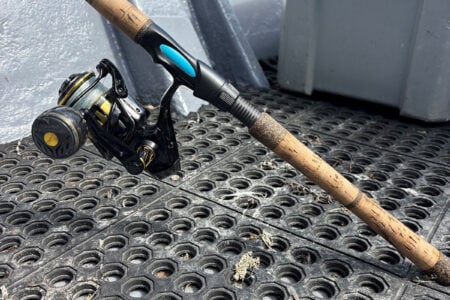
For the rod and reel, (inshore species) any well-made 6 foot 8 inch to 7 foot 6 inch rod will suffice. I have been using the Penn Legion (LEGIN1530C70) matched to an Abu Garcia 7000C for years. Until this combo fails me, there is no need to change. There are others, so let this be a guideline, then pick your poison and hit the water with whatever you choose in the same specs. On the line end, I spool up with 30-pound braid – fish-finder rig, and Capt. Tom’s advice of an 8-foot fluorocarbon leader.
When moving to the offshore grounds, I sought out the advice of our own offshore aficionado, Capt. John Raguso of the MarCeeJay. Capt. John has been plying the offshore grounds for over 50 years, and if anyone knows what it takes to live line spot for pelagics, Capt. John is the man.
Capt. John said live spot would work great for bluefin when chunking/live lining the inshore grounds. Moving farther offshore in search of yellowfins or mahi mahi, live spot is also a solid option. Casting free lined spot to lobster pots or floating debris is a gold mine where dorado are concerned.
As for tackle on the offshore grounds, Capt. John prefers several reel options. First up would be size 12/16 Penn VSX OR VISX reels for the tuna and the Penn Slammer IV DX 5500 for live lining dorado and tuna under 50 pounds. Another solid performer would be the Shimano Talica 16IIA and 12IIA, and the more economical Shimano Speedmaster. For spooling, John said, “Your best bet would be 65-pound braid on 12s, and 80-pound braid on the 16s. For the Slammer, use 40-pound braid and hope you don’t get a 100-pound tuna that will spool you!”
On the business end, Mustad or Gamakatsu short-shank 2X to 4X strong J hooks in sizes 3/0 to 7/0 are best. For leader, Capt. John recommends a 6 to 7 foot length of pink fluorocarbon in your choice of manufacturers. John feels this is the perfect length to be able to reel the swivel to the rod tip and not have to handle the leader, using a 6-foot gaff.
Moving to fluke, Capt. Tom Cornicelli would make a few changes from typical striper set ups. For fluke, Capt. Tom would opt for a three-way with one leg of 30-pound test fluorocarbon, 3 feet long to a VMC O‘Shaughnessy hook, size 3/0 to 5/0. This is wide gap hook, which is great for fluking. Another hook option would be a Gamakatsu 5/0. The bottom leg of the three-way for the sinker should be 18 inches and have a loop knot to make changing weights easier.
This year, before heading out, stop down at one of the many shops and grab a dozen or so. I guarantee that you will at least put a fish on the scale, or maybe even drop the biggest sea bass, striper or fluke on the deck of the boat. For the offshore guys, a nice paycheck from a tourney always sits well at the end of the day and a live spot could put you in the winner’s circle.