
When I say one small, simple streamer is among the most productive I’ve ever used, I mean it.
I’m a streamer guy. A big streamer guy. When I started fly fishing for trout in 1978, I used nothing but streamers. I wanted big trout from the start, so I threw big flies. When I switched to saltwater fly fishing in 1981, streamers were again my go-to.
By 1991, I was tying my own flies and became known for my giant menhaden imitations—up to 13-1/2 inches long—called Sedotti’s Slammers. What made them unique was their castability. You could throw these massive flies nearly as far as any standard fly. The secret was “weight balancing”—countering the drag of wind-resistant materials with the right amount of weight. Big flies create serious air resistance, and balancing that with enough mass allowed them to cut through the wind. Before this, most anglers believed anything over 8 inches was un-castable. They were wrong.
I took my saltwater bunker patterns to Northern Michigan in the early 2000s. These were scaled down to 7 inches—still huge by trout standards, where 4- to 4-1/2-inch streamers were the norm, even among the big-name Michigan anglers. But those 7-inch patterns drove big trout wild. Soon, the use of oversized streamers—up to 11 inches—exploded in popularity across Michigan. The trend spread to Arkansas, then back up to the Northeast, out West, and eventually Europe. The global “big streamers = big trout” movement started the moment I clipped one of my Feather Slammers onto a tippet in Michigan’s Manistee River around the turn of the millennium.
So, when I say one small, simple streamer is among the most productive I’ve ever used, I don’t say that lightly.

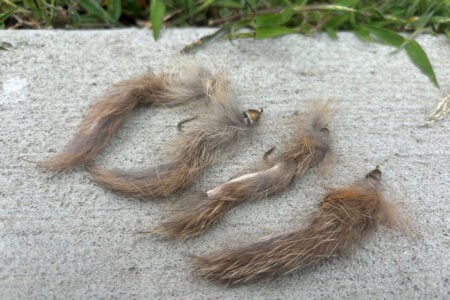
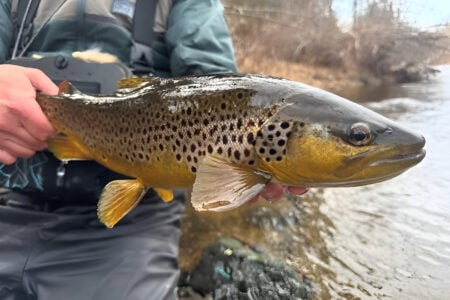
That fly is the Rabbit Strip Jiggy. It’s dynamite for trout, smallmouth and largemouth bass, crappie, bluegill, white perch, carp—even Great Lakes brown trout and steelhead. A Bob Popovics pattern, it’s the picture of simplicity: a short strip of rabbit (Zonker) lashed to a hook with a tungsten head. That’s it.
I use two sizes: 2-1/2 and 3-3/4 inches. After much trial and error, I found these lengths deliver the best action, which is absolutely key to this fly’s effectiveness.
For the 2-1/2-inch version, I use a size 8 nymph hook and a 3/16-inch tungsten bead. The body is just a 2-1/2-inch strip of thin rabbit Zonker.
To Tie It
Slide the bead onto the hook and wrap it snug against the hook eye. Pierce the hide side of the rabbit strip with the hook so the strip lies tight along the shank and extends out the rear. Lash the rabbit in just behind the bead. The hair will lie along the bend and hook point, forcing the fly to ride hook-point-up like a jig. You don’t need a jig hook—this setup handles it.
For the 3-3/4-inch fly, I build it the same way but use a size 4 medium nymph hook and two tungsten cones placed back-to-back behind the eye to resemble an egg. The rabbit strip measures about 3-1/2 inches, bringing the total fly length to 3-3/4 inches.
Color Selection
My top color is white—it’s highly visible in the water, allowing me to monitor the fly’s position and detect strikes more easily. Other productive options include brown, fluorescent pink, purple, chartreuse, and olive.
My go-to colors by species:
Trout: White, Fluorescent Pink
Bass, panfish, carp: Brown
Crappie: Chartreuse, White
White perch: White
Where To Fish It
For trout, fish it just like you would any other streamer—through pools, runs, riffles, around wood or boulders, and even in frog water and deep holes.
For bass and panfish in lakes, fish it around structure: rocks, wood, points, drop-offs, and weed beds. Essentially, wherever you’d cast a conventional lure.
Crappie gravitate toward bridges, downed trees, docks, and backwaters. White perch like bridge pilings too, so target those areas for these panfish.
How To Fish It
This fly is incredibly easy to fish and is meant to be worked near the bottom—where most fish are. The tungsten head makes it sink fast, and the sparse design reduces resistance, helping it get down, and stay down.
What makes this fly deadly is its action. Its design allows for dramatic, strike-triggering motion. Even slight rod twitches or sharp, rapid jigs will make the rabbit strip dance, mimicking an injured baitfish. With a short line—of say 3 to 20 feet—you can use only the leader or a short bit of fly line. You don’t need to be a great caster; the Rabbit Strip Jiggy is most effective when fished close.
Try to get as many jigs per foot of retrieve as possible. The more lifelike and frantic the movement, the better.
When casting longer distances (which I rarely do with this pattern), I wait for the fly to touch bottom, then work 1- to 2-inch strips with lightning-quick repetition, adding short but distinct pauses in between. The strip makes the head dart upward; the pause lets the tungsten nose it back down, giving the rabbit strip an irresistible motion. Even if your fly line bows in the current, this retrieve still works. Just stay disciplined, and keep your strips short and snappy.