As ‘finder fees drop, private anglers are able to up their tech game, just like the pros.
Several years ago when forward facing sonar (FFS) came out, every professional bass angler in the country had to have it. It was called a game-changer, as anglers could now not only find fish, but actually watch their baits float down and the fish swim over to it. There was controversy from the very beginning. It was called video fishing, cheating, and on and on. In my opinion, the bottom line was it was another “tool” that anglers could use to up their game. If that is what you want, and you felt it was worth the $2K and more outlay, you did it.
After several years of watching anglers use it, I still felt it was just not the way I wanted to fish. I like the hunt, the challenge, the aura of “finding” fish on my own. However, as I am getting older, I wanted to fish more efficiently. And this is where an FFS unit comes into play. And somehow, someway, I was going to have to bridge the financial gap.
Before we explore the unit, let’s see what I wanted it for, and how I believe a lot of anglers would benefit from it. At this point the new FFS has been installed on my Javelin. What I wanted from this unit was to eliminate areas where I thought fish should be, yet after countless casts I’d never get a touch. Were there really no fish here, or to put it bluntly, did I just “suck?” I consider myself a pretty decent angler so I don’t believe it was the latter.
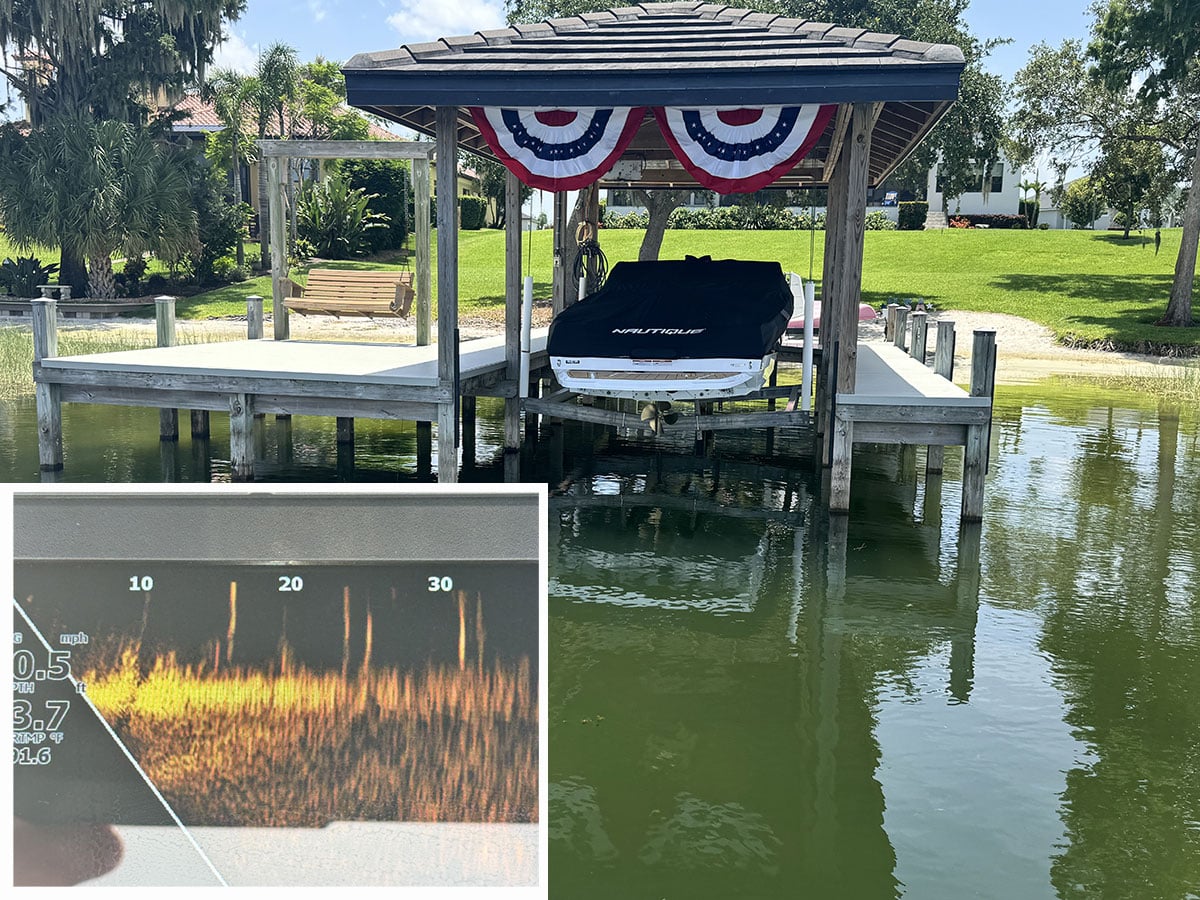
To help know what is or isn’t there, maybe I could just point the FFS transducer towards the structure and take a look. Recently I was fishing docks. I had caught fish on most, but some were barren. I fished an entire 6-hour shift, hitting dock after dock. After installing the unit, I went to these same docks. I had twice as many fish, and on less docks. I was able to pull up to a dock, scan quick and if there were fish, cast, if not, move on.
The best part about the FFS is it can be mounted to your trolling motor, or on a stationary pole, making for direction of the transducer a breeze. Other areas where it comes into play are ledges and drop-offs. If you know where there is a ledge, knowing where the fish are lying will make what you throw, and where you throw it a lot easier; again, eliminating the dead zone
The second half of why I decided to get the unit was to find bait and structure without spooking fish. We all know that sliding up onto a point too close to structure could spook fish. Fish relate to noise, and hence, will become skittery if detected. Now, I can now approach a point from 50 feet or more, scan the area and detect activity before I even make a cast. Bass will hold at certain depths, and if you do not cast to that area, chances are, you will spook them with your very first cast. On the other hand, if I see fish for at the very tip of the point, at the drop-off, I can cast past, working my lure right into the strike zone.
Finding bait is critical for finding fish most of the time. Sure, there are always those times when bait is not prevalent and you catch, but for the most part, no bait presence, means no fish. Finding bait on “new” waters at times can be a challenge. We all know what to look for on the surface, but seeing a pod of crappie or white perch – that bass, especially big ones, feed on – is tough. With an FFS unit, I can easily see bait balls well ahead of where I am heading, long before a get close and break the school up.
In terms of bridging the financial gap, which may affect a lot of anglers looking to get into forward-facing sonar, there are now more affordable options that still deliver impressive performance. The unit I went with is a stand-alone setup with its own transducer, and while a guide I know runs a much higher-end system with a larger screen and a wider field of view, fishing side-by-side showed me that I was still getting a very similar picture. For what I wanted out of the technology, and considering the price point, it has been more than enough. If you want to eliminate dead zones, locate fish faster and take advantage of forward-facing sonar without spending top-dollar, going with a more budget-friendly system can still get the job done.
PHOTO CAPTION
MAIN w/ INSET – By scanning an area, anglers can now find bait, rule out dead water, and fish more efficiently.