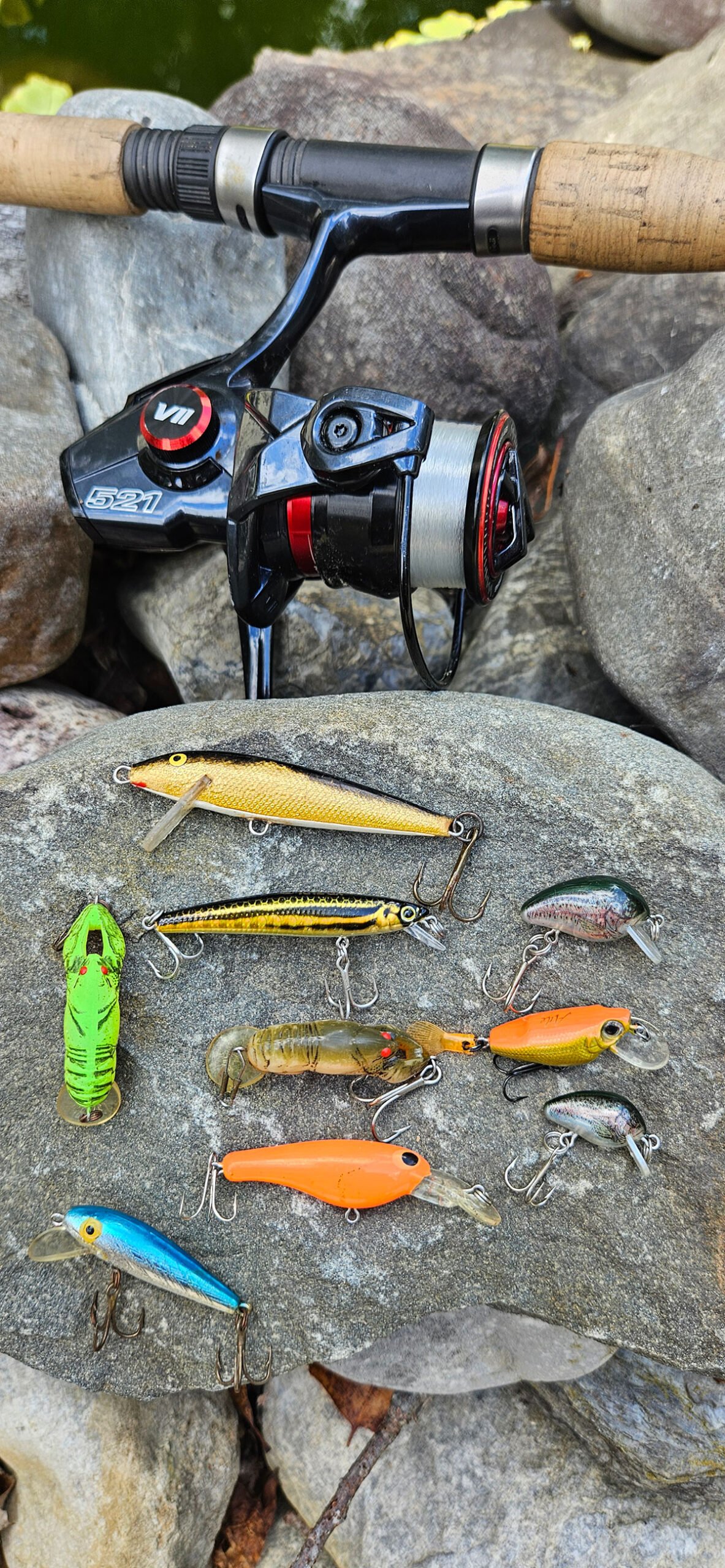
Browns, rainbows or brookies, light ‘em up on a plug!
Predators of the salmonid family – rainbow, brown, brook and even wild tigers – exist on an apex level, even on the narrowest of swims. From aquatic insect larvae to minnows, small suckers and chubs, crayfish and meaty terrestrials such as grasshoppers, ants and crickets, and ground escapee garden worms or nightcrawlers, yeah, trout are on the top of the flowing food chain.
By the advent of the Thanksgiving holiday, figure the ants, hoppers, crickets and annelids, for all intents and purposes, only an occasional pick on the trout pecking menu.
And that’s what makes the mid-October through November period a prime time for the meat of the matter on moving waters: minnows and crayfish.
Enter the plug in.
Unlike a spinner and/or spoon, plugs range from floating/swimming to diving to suspending thus allowing a twitching to jerking to straight retrieve. Suffice to say, it’s easy enough to get a grasp as per which action will get a trout to make a play. In deeper pools and runs the plug still has an advantage. Models designed to track deeper can be worked on a steady retrieve and then stopped for a second or two before resuming its swimming motion without sinking to the bottom. Sometimes this stop and go is enough to draw a trout to strike that would oftentimes ignore a spinner or spoon that would otherwise bottom out when forward motion ceases.
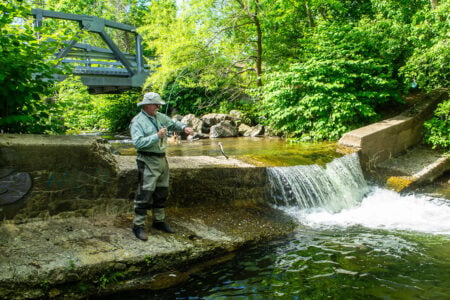
This was the case on a 30-something long yard pool on a northern New Jersey trout river that was running in the vicinity of 3-1/2 feet at its deepest right through the middle. The switch was made from the Yo-Zuri Pin’s Minnow that had caught several rainbows in shallower areas above, to a trout and smallmouth-worn orange Snap Shad. During the second stop and go a ‘bow came out from a pocket below a half sunken boulder, blew by it, did a quick 180 and waxed it as the retrieve was momentarily paused. Away it went to fight another day after a brief exchange.
Match the hatch, and fish the profile. Baitfish (minnows, chubs, baby suckers and sunfish, et al), and crayfish have distinct profiles that identify them as forage. The movement imparted via the retrieve adds to the realism, be it a healthy victim on its way or one that is distressed and can be an easier target. Either way, the shape serves as the primary trigger followed by movement.
And of course, size matters. Predicated on the venue and the forage inhabitants, tailor the size of the imposter to the real thing and the size of the flow. Our selections run from the Yo-Zuri Snap Bean, Rapala Ultra-Light Minnow, Rebel Wee Crawfish and F2 to F4 Flatfish, and up, depending on width, flow rates, depth and structure. Don’t discount the crayfish imitations. Crays are surprisingly active even during the chilling waters, especially along shallows where rocks heat from sunshine.
As with bass, trout will stick close to cover for both protection and ambush. Laydowns across the swim or along the bank bordered by a deeper edge are prime locations. The same goes for the slack water behind a boulder with current pulsing to either side or an eddy under an overhanging bank. There will be occasions where the choice of a single hook lure or one with a treble removed, or the barbs mashed, might be a better move as snags will be inevitable when retrieving tight to cover.
Does color matter? From this corner it’s about perception and what has worked. The adage “Ain’t no use if it ain’t chartreuse” came to mind when knotting the aforementioned Snap Shad. Decades of experience had shown that rainbows in particular, even if launched from a hatchery truck, like things bright. Browns seem to prefer more somber tones. We’ve caught wild brookies on bright and black.
As for the strikingly realistic lifelike patterns (body colors, gill covers, etched scale finish, 3D eyes, etc.)? We’ve enjoyed success and more than a few times these have proved a difference between commitment and refusal. We pack a limited selection of both.
Indian summer is prime trout time, so plug it in.