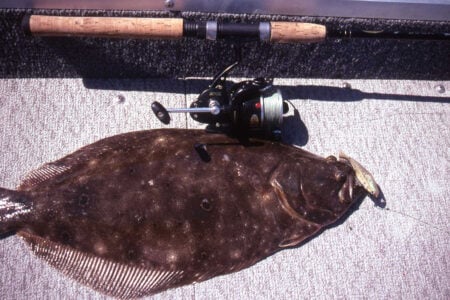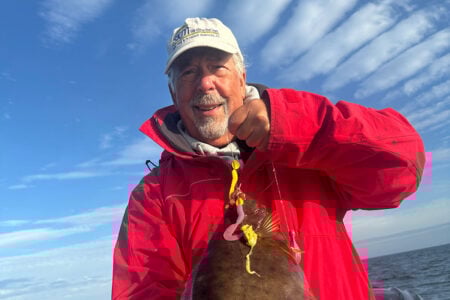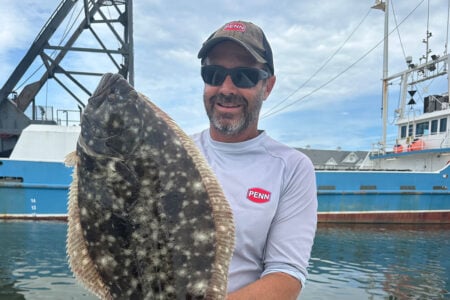
For the saltwater angler, waiting for spring is a feeling of hopeful anticipation.
Every spring, as I watch and wait for the ice to melt and Mother Nature to provide a few sunny days, I still get nostalgic about the days when a few hours of worm soaking would yield some winter flounder for the dinner table.
Winter flounder once were a favorite target of anglers along the Northeast coast and as a harbinger of spring, the winter flounder holds a unique place in the hearts of many fishermen. The mention of winter flounder causes old timers like me to wax nostalgic about the days of painted sinkers, a plumbers’ helper plunger attached to a broom handle, frozen chum logs, and light tackle outings on Barnegat Bay or the Manasquan River.
When I was younger, my flounder fishing was guided by weekly recon provided by installments of The Fisherman Magazine and John Geiser’s Sunday Outdoor column in the Asbury Park Press. Heck, in those days, Geiser even included maps of hot bite locations from the past week in local rivers and estuaries!
However, the ‘bible’ for all things winter flounder was William Muller’s 1980’s installment in The Fisherman Library’s Fishing for Winter Flounder. Loaded with tips, tricks, and illustrations, this book covered all of the tools and techniques needed to make winter flounder fishing fun and productive.
The Local Scene
Living in northern Ocean County, back in the day winter flounder could be found throughout upper Barnegat Bay and the Manasquan River every spring. If you had a boat, it actually was fairly easy to find good winter flounder fishing. I got my first boat back in 1984, a 12-foor fiberglass Sears Gamefisher with a 9-horse motor. On a typical spring day, I would find myself anchored up in the midst of the flounder armada, which consisted of small boats with names like Flounder Pounder and Flappin’ Flatties, as well as an assortment of other skiffs and rowboats clustered around hot spots. In those days, even party boats like the Miss Point Pleasant and Norma K II got into the flounder action sailing two half-day trips.
Familiar winter flounder grounds in upper Barnegat Bay included Long Point in Island Heights, the channels and flats around the Route 37, Pelican Island and Mantoloking bridges, the Mantoloking Hole, Gunner’s Ditch, and Dale’s Point. In the Manasquan River there was the Route 70 Bridge, Kings Grant Inn hole, Treasure Island hole, Point Pleasant Hospital, and the Clark’s Landing area.
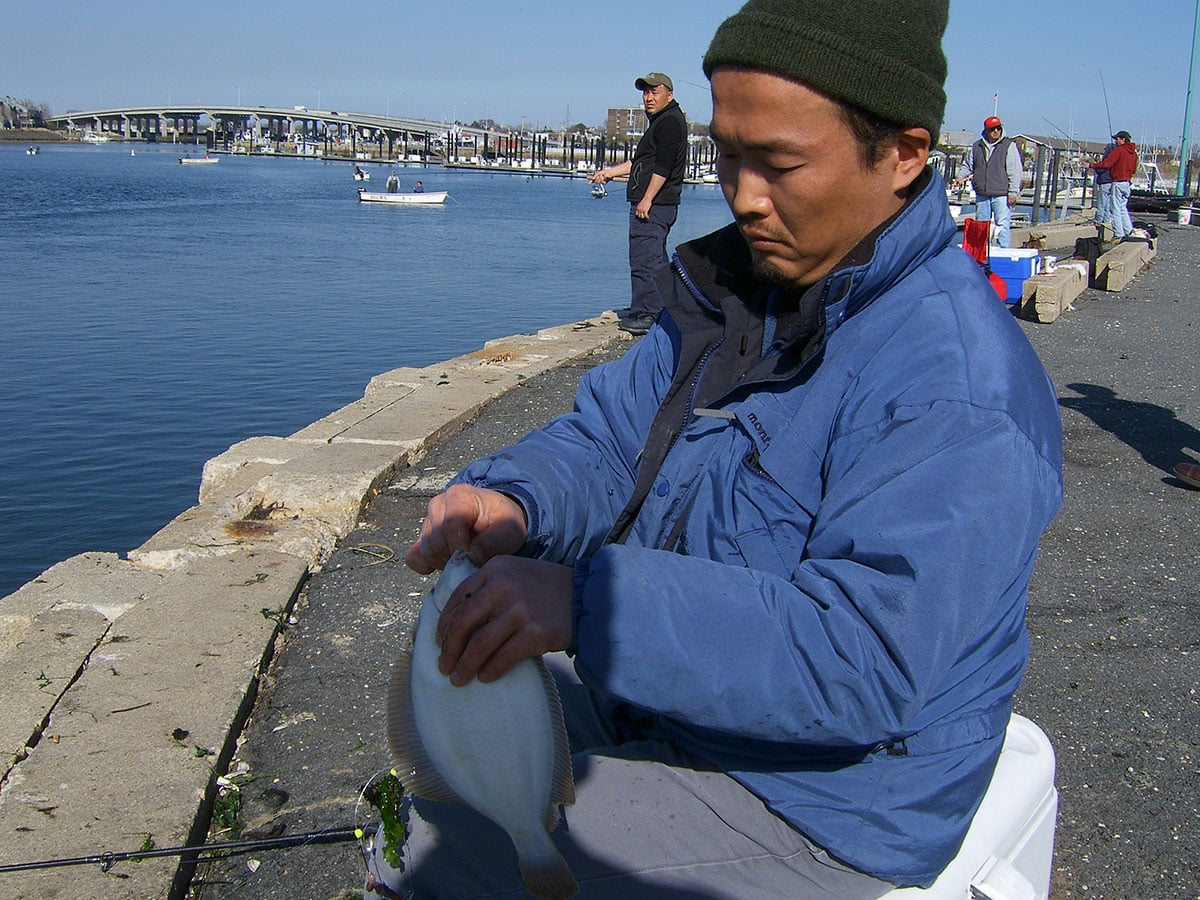
Flounder were also readily catchable from shoreside docks, bulkheads, banks, and beaches in the Bay from Island Heights to the Point Pleasant Canal, in the Canal itself from the bulkhead, and various accessible spots along the banks of the Manasquan River. Folks enjoyed this fishery all the way down through Southern Ocean County in those days, from Oyster Creek down into Beach Haven on LBI.
Some days, these places would seem like the bottom was stacked with flounder, and, on a sunny day on the right tide, it was possible to fill a cooler with blackbacks in a few hours. Reflecting back on those days always makes me think of Louis Van Doren’s 1884 exclamation that the winter flounder “has one virtue not possessed by its prouder relations, he is always ready to be caught.”
Although, as John Geiser noted in his book The Shore Catch, published by the Asbury Park Press in 1984, while it doesn’t take special talent to catch winter flounder, some knowledge of their habits will increase catches.

Habits And Habitats
The winter flounder gets its name from the fact that it was initially encountered by early settlers in coastal rivers and estuaries during the coldest months of the year when many other familiar species had migrated offshore or to the south. The winter flounder’s range is usually stated as the Gulf of St. Lawrence, Canada south to North Carolina although historically they were less abundant south of Delaware Bay.
The majority of adult winter flounder are inshore-offshore migrators; however, in some larger northern estuaries an inshore contingent is present year-round. Typically, they spend summers in offshore ocean waters, migrating inshore sometime in fall prior to spawning in coastal rivers, bays, and nearshore coastal waters. Inshore, they prefer soft bottoms of mud, sand, or even gravel as well as areas supporting submerged aquatic vegetation and macroalgal beds.
Peak spawning time in southern portions of their range like New Jersey occurs near the end of winter into early spring. Females lay clusters of eggs that adhere to the bottom to facilitate retention within spawning grounds. Once fertilized by males, eggs remain negatively buoyant and stick to the bottom or grass beds. After spawning, adults begin to actively feed prior to eventually moving out of these habitats to cooler, deeper water of estuaries or returning to offshore areas of the continental shelf.
Nursery habitats consist of calm waters of coves, salt ponds, and protected embayments. Young-of-the-year and juveniles reside in estuaries, preferring eelgrass and macroalgal beds as nursery habitats. Larval and juvenile survival and growth are affected by a number of factors including water quality (temperature, salinity, and dissolved oxygen), food availability, and predation.
Where Have They Gone?
Unfortunately, for the most part, the winter flounder fishery in the northeast is a shadow of its former self. The decline of the winter flounder in our region began sometime in 1980s and by the late 80s the population had already declined significantly, and its abundance has continued to decline over the last several decades.
For example, researchers at the University of Rhode Island recently estimated that the current status of the winter flounder in Narragansett Bay is a mere 1 to 2% of past peak abundance in the early 1980’s and recent data from New York indicate that in 2022 angler landings there were estimated to be around 1% of their mid-80s landings. Recreational landings in New Jersey have seen similar declines from historical highs of the 1980s and are currently only a fraction of what they were a few decades ago. In addition, according to a New Jersey study led by Rutgers, winter flounder populations in New Jersey appear to have been contracting northward over the last several decades, resulting in significantly lower abundance, especially south of the Barnegat Bay region.
Winter flounder are managed by the Atlantic States Marine Fisheries Commission (ASMFC) under the Interstate Fishery Management Plan for Inshore Stocks of Winter Flounder. Under this plan, New Jersey is included as part of the southern New England/Middle Atlantic region (SNE/MA). Unfortunately, recent stock assessments paint a dismal outlook for the future of winter flounder in the Southern New England/Mid-Atlantic region.
While there is no doubt that overfishing resulting from past harvest pressure is a major factor for declines of the southern New England/Middle Atlantic stock, a combination of a number of other factors have contributed to this decline as well. For example, decades of coastal development and pollution have led to widespread destruction and degradation of the coastal ecosystems that winter flounder rely on.

More recently, researchers have found that, although spawning is still occurring throughout the region, poor recruitment in the late 1990s and 2000s rather than overfishing has contributed to its decline. Thus, the impacts of habitat destruction, pollution, and poor recruitment, in combination with overfishing, have resulted in historically low abundance of the once widespread and abundant winter flounder.
Recruitment (the number of fish that enter a defined portion of the stock such as young-of-the-year, the spawning stock, or the fishable stock) in particular has been singled out by researchers as a major issue. A review of the status of winter founder recruitment conducted by the University of Rhode Island Graduate School of Oceanography found that it has decreased significantly in the southern New England/Mid-Atlantic stock from its peak of 160 million in 1981 to an estimated low of 7.5 million in 2019.
A major problem associated with winter flounder experiencing poor recruitment is increased predation related to warming water temperatures. In fact, several recent studies have documented that, in years when winter and spring temperatures are warmer, the winter flounder experience a shorter spawning period and poor recruitment.

Here’s the general scenario scientists currently feel has been unraveling over the last several decades to explain why winter flounder produce fewer young in warming waters:
- When the water is cold, there are no predators around, giving larval and juvenile flounder time to develop and grow before predators show up.
- As waters in the Northeast have become warmer in spring, the population of predators like comb jellies and sand shrimp have spiked, and they arrive in estuaries earlier exposing both flounder eggs and larvae to increased predation before they have time to develop and escape predation.
- In addition, those that do survive to become juveniles face increased levels of predation from young bluefish, fluke, sea robins, windowpane flounder, gulls, blue crabs and avian predators like cormorants, herons and egrets.
The result? Despite management actions to curtail overfishing through implementation of size and bag limits, populations in the southern New England/Mid-Atlantic have not shown signs of recovery. In fact, according to the ASMFC’s Winter Flounder Technical Committee, both the spawning stock biomass and recruitment indices and model estimates all continue to indicate that the winter flounder stock in this region is in poor condition.
So, the consensus seems to be that our once flourishing winter flounder fishery will remain, for the most part, a memory. So much so that most of the older anglers I know don’t even bother fishing for winter flounder anymore and younger anglers never even give them a thought.
| SEASON, SIZE & BAG |
| Under current regulations in New Jersey, the winter flounder season runs from March 1 to December 31 each year with a minimum size of 12 inches and a bag limit of two fish per person per day. |
That said, as researchers continue to unravel the recruitment puzzle and managers continue to grapple with recovery plans, I don’t know about you, but I still think it’s worth the price of grabbing a couple high/low flounder rigs, a few dozen sandworms or bloodworms, and some mussel or clam chum logs to give it a shot at local flounder grounds on a warm sunny day every spring in hopes of tasting their delicate, tender, slightly sweet flavor once again.
After all, if you are lucky enough to find them come spring maybe, as Louis O. Van Doren noted in his American Angler 1884 publication entitled The Fishes of the East Atlantic Coast That Are Caught by Hook and Line, “just as soon as it gets mild enough for the hardiest fishermen, he has but to drop his hook over a soft mud bank and when he raises his line, lo! There is a flounder at the other end.”