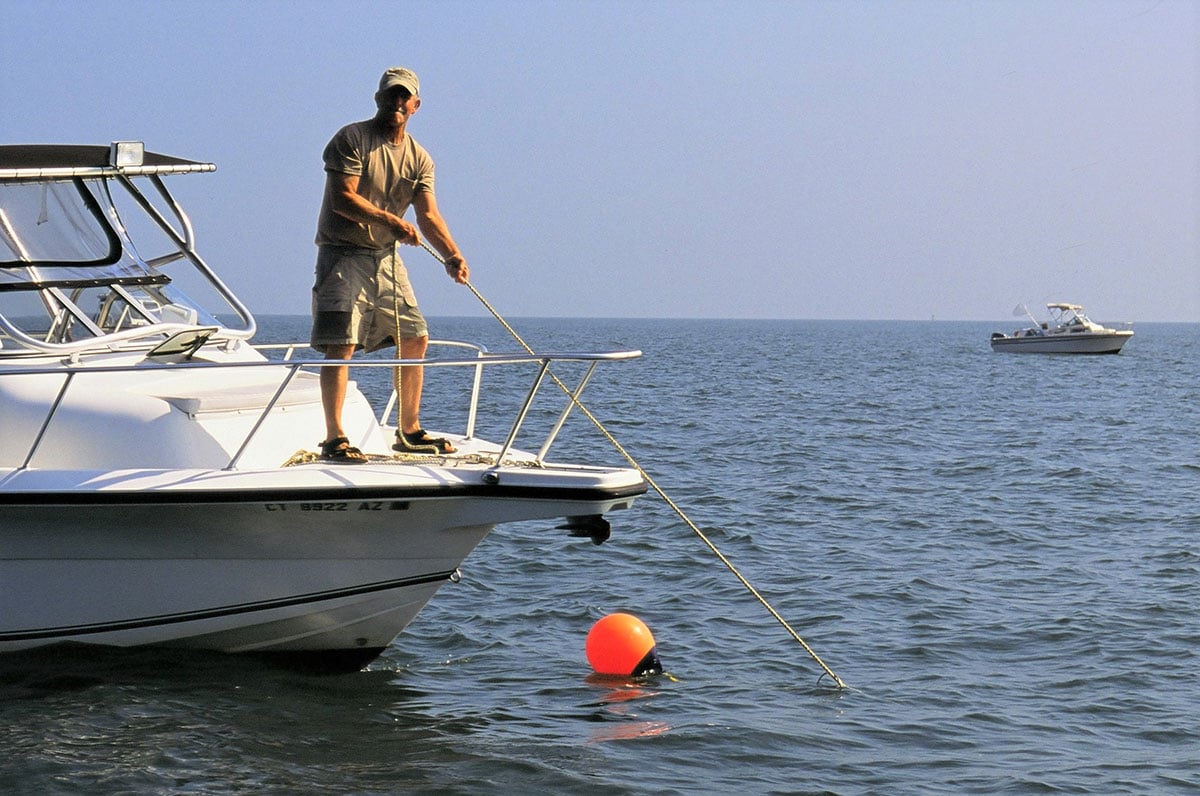
Know your essential anchoring skills for safety and fishing efficiency.
Although trolling motors with spot-lock are replacing routine anchoring for many anglers, proper anchoring is still a critical skill. Here are some basics you should know.
All anchoring gear between the anchor and the boat is collectively called the “rode.” The rode includes chain, line, and hardware. The main length of anchor rode is called “line” not “rope.” Although many types of rope exist, the best material for anchor line is nylon. Rope experts recommend 100% braided nylon for this use. It’s strong, flexible, doesn’t rot, resists sun damage, and most importantly, it stretches by 15 to 30%, which cushions your ride at anchor in rough conditions. Nylon also sinks because it can absorb up to 6% of its weight in water, which makes it better for holding bottom than other lines like polypropylene, which float.
Attach your line to at least 6-feet of medium (1/4- or 5/16-inch diameter) galvanized chain. This serves three purposes: first, it prevents line chaff over rough structure. Second, its weight lowers the angle of pull, which sets the anchor better. And third, the slack or belly created from its weight helps offset surges from waves and wakes. Connect the line to the chain using an eye splice around a thimble shackled to the chain (or buy pre-rigged anchor line).
An anchor does not hold your vessel in place by its weight—it requires proper scope. “Scope” is the ratio of the diagonal length of the anchor line to the vertical height from the bottom to the top of the bow. You must also factor the height or amplitude of a rising tide. Without sufficient anchor line angle (scope) the best anchor and chain still won’t hold you in place.

A minimum of 5:1 ratio of length to depth is required for average fishing conditions on a soft bottom. However, for heavy conditions such as a strong wind and current pushing against a vessel with a dead engine, you’ll need a 7:1 or even 10:1 ratio for safety. For maximum effectiveness, all anchors require a low angle of pull, preferably less than 8 degrees. A short scope reduces holding power because the angle of pull is too high, which breaks the anchor out of the bottom.
Bottom composition is important for firm anchoring. Mixtures of mud and clay or sandy mud make excellent holding for most anchors. Firm sand is good, too, if your anchor will bite deep into it with sufficient scope. If possible, avoid loose sand, soft mud, stones, and weed bottoms. Bottom characteristics are denoted on nautical charts.
The two most common anchor types are the Danforth or “fluke” and the plow or “scoop,” with the Danforth the best bet for smaller boats. However, the plow anchor generally performs better overall in grass, mud, and sand.
To set an anchor, lower—do not throw it overboard to the bottom and then back down (reverse) while the line is paid out—making sure you or your assistant doesn’t get a coil wrapped around an arm or foot. When you believe sufficient scope is paid out (pre-marking your anchor line in 25-foot increments helps determine line out), quickly snub the line around a bow cleat. A Danforth can be initially set with a scope as short as 3:1 on an ideal, rocky bottom such as when togging. Anglers who pursue blackfish often carry a second, smaller, cheaper “sacrificial” anchor, in case it becomes irretrievably snagged in the rocks.
After the anchor catches bottom, pay out more rode for the expected conditions, preferably of at least 5:1. Scope must be sufficient for holding, but in a crowded fishing spot you must also consider not encroaching on fellow anglers. Then make your anchor line fast by running it through a bow chock and cinch it to a cleat. To tie to a cleat properly, take a full turn around the base, then one turn around each horn, crossing diagonally over the center of the cleat. Finish with a half hitch around one horn. Never use a clove hitch because it may seize and jam, possibly necessitating cutting the line during an emergency. Last, turn off the idling engine.
If your anchor drags, the best option is to pay out more scope until it sets. When you’re done fishing and ready to weigh (pull up) anchor and move, start your motor first (to be sure it starts), then slowly run up the anchor line while taking in slack. The anchor should break free when the line becomes vertical; if not, continue past it. Be sure the anchor doesn’t strike your propeller or hull during the haul out.