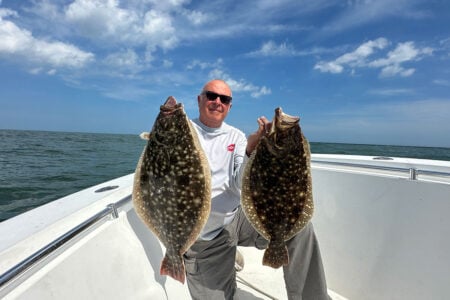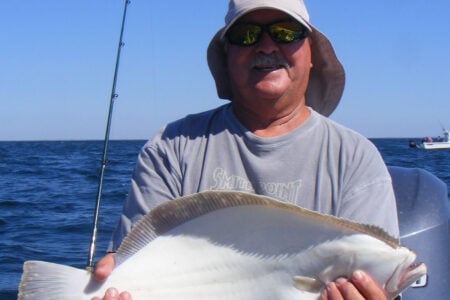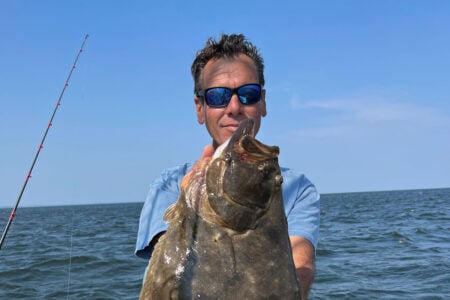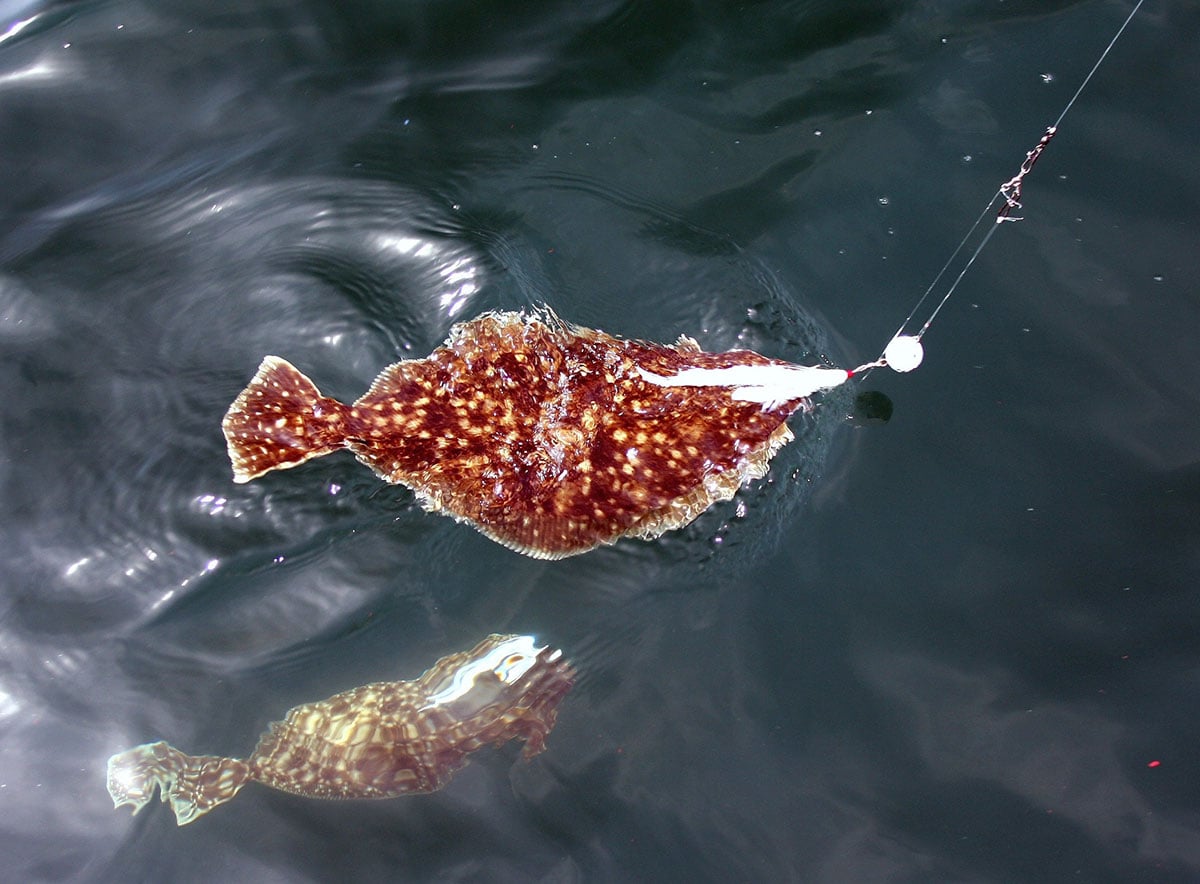
How some experts target keeper flatties each season.
Fluke pros agree that understanding how summer flounder feed is one of the keys to consistent success. Unlike winter flounder, fluke are aggressive predators that will often follow a bait or lure a considerable distance off the bottom, sometimes all the way to the surface. That’s why experienced anglers recommend retrieving rigs slowly when checking baits.
“Although cranking hard saves time,” said fluke pro Capt. Jim Kaczynski (ret.), “never reel in as fast as possible. Use a steady pace and stop several times on the way up. Even dropping the bait back a few feet near the bottom will sometimes prompt an aggressive strike. The combination of your drift speed and slow reeling will produce a bait that appears to be scurrying away and trying to escape.”
A variation of this technique is to slowly raise and lower the rod tip while drifting. This creates a squid-like pulsation or wounded baitfish action that often triggers following fish.
Another productive tactic comes after a missed strike. When a fluke misses the bait, immediately free-spool your rig for several seconds while continuing to drift. This gives the fish the impression it has stunned or injured its prey.
“It’s subtle,” said Kaczynski, “because some of these fish won’t suddenly eat and run. They inhale the dropped-back bait and just hang there with it in their mouth until you feel pressure and then set the hook.” Timing is equally important. Mike Stepski, captain of the Tartan II out of Niantic, Connecticut, believes tides are critical. “Knowing the tides is the secret to success,” said Stepski. “When fishing for fluke, the beginning of the tide always seems to be the best bite, but I also use the strength of the current for a good drift. You must know your boat and how it reacts to the conditions.”
Fluke generally face into the current to intercept bait and maintain efficient water flow through their gills. Drifting with the current helps cover ground naturally and presents baits directly to feeding fish. When wind and tide oppose each other, however, the boat may slow or stop, often resulting in fewer bites.
During slack conditions, many anglers switch to slow-trolling. A squid-and-spearing combination fished behind a spinner blade or Spin-N-Glow rig can be highly effective. In deeper water, sinkers ranging from 8 to 12 ounces may be necessary to maintain bottom contact.
Virtually any fluke rig can catch fish when the bite is strong, but experienced anglers focus on generating strikes when fish become selective.
“The trick,” said fluke pro Capt. Jim Maturo (ret.), “is to make fluke bite when they’re picky. I like to use a standard three-way rig with a Mylar fluke fly dressed with a squid strip and spearing on the top hook. For the bottom weight I use a 2- to 6-ounce fluke ball or bucktail jig dressed with fresh bait.” Maturo also stresses experimentation. “It’s more work, but we change rig colors often until we find the one that’s producing that day. We normally start with white or chartreuse. I recommend using the lightest weight possible to hold bottom. Just remember, what worked last week may not work this week.”
Some anglers favor attractors such as beads, spinner blades, and colorful tubing, while others prefer a more natural presentation. Regardless of the approach, most successful rigs combine bucktail material with natural bait such as squid strips, spearing, mummichogs, or fish belly.
One highly productive setup comes from Capt. Kerry Douton of the charter boat Dot-E-Dee. His rig features a 3- to 6-ounce Spro Blue Shad Bucktail Jig connected to a three-way swivel with 12-inches of 30-pound fluorocarbon. A second leader of approximately 3 feet carries a large blue-and-white Deceiver-style fly. “I tip both the fly and the jig with squid strips,” said Douton.
The proper rod is critical for consistently landing summer flounder. Fluke often inhale a bait with little indication, making sensitivity essential. Combined with their paper-thin mouths and violent head shakes near the boat, it’s easy to understand why so many fish are lost at the surface.
Most professionals recommend a 7-foot medium-light conventional rod with a sensitive tip and strong backbone matched to a quality conventional reel spooled with 15 to 25-pound braided line. This combination provides the sensitivity needed to detect subtle bites while maintaining enough power to drive home hooks and control larger fish.