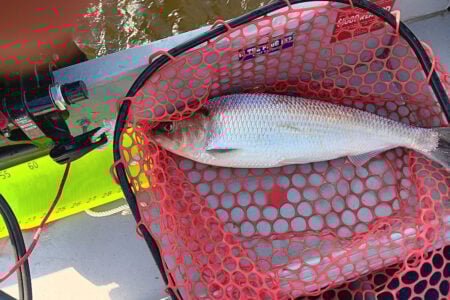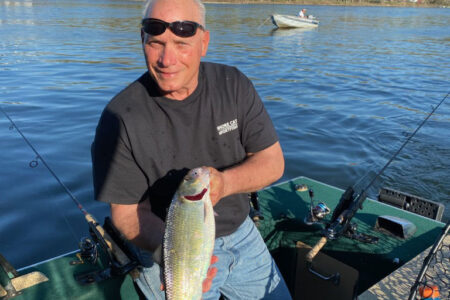
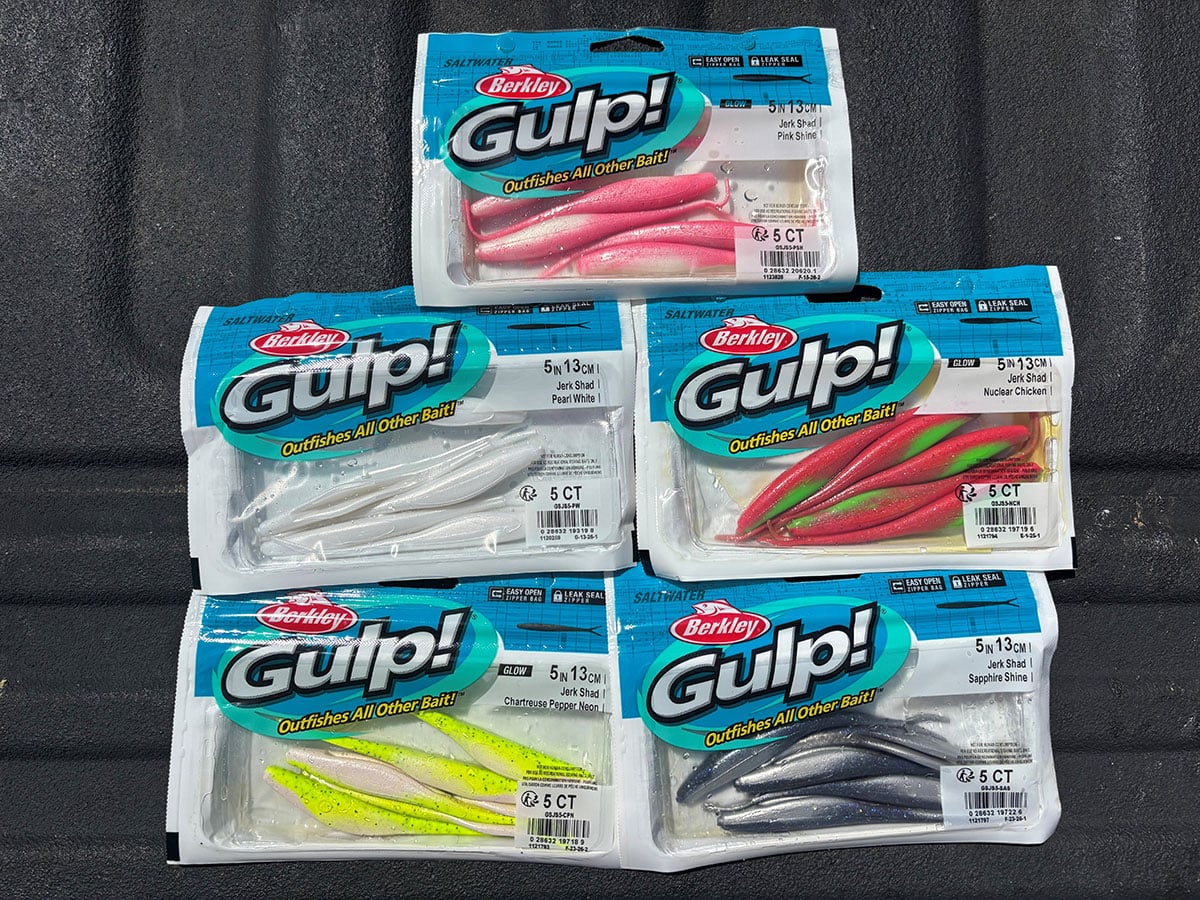
A single jerk shad on a jighead closely matches the spearing fall fluke love to feed on!
Fluke fishermen are always experimenting with different combinations of bucktails, teasers, strip baits and soft plastics… but sometimes, the most effective approach, is the simplest approach. One presentation I’ve been fishing more often lately is a single jerk shad rigged on a jighead, and this time of year it makes a lot of sense because of what it closely resembles—a spearing.
By late summer and into the early fall, spearing can be found in good numbers throughout Northeast bays, channels, inlets and inshore waters. These small, slender baitfish become an important part of the menu for everything from bluefish and striped bass to weakfish and fluke. When fluke are feeding heavily on spearing, matching that long, narrow profile can be a very effective way to get their attention.
Two soft plastics that fit this style of fishing well are the Berkley Gulp Jerk Shad and the Fishbites Brawler Jerkbait. Both provide that narrow baitfish profile I’m looking for when spearing are abundant, and both can be fished simply on a single jighead without adding a teaser or additional bait.
That simplicity is a big part of the appeal.

The jerk shad doesn’t have the exaggerated action of a large curly-tail grub. Instead, much of its movement comes from what you do with the rod. A short snap, twitch or lift sends the bait darting before it falls back toward the bottom. When worked correctly, the presentation looks a lot like a wounded or disoriented spearing struggling away from the school. To a fluke lying along the bottom waiting to ambush something, that can be a hard meal to pass up.
The rig itself couldn’t be much simpler. I’ll thread either the Gulp Jerk Shad or Fishbites Brawler Jerkbait onto a jighead heavy enough to maintain consistent bottom contact. Jig weight will depend on where you’re fishing. In shallow bay water with a slow drift, you can get away with something relatively light. Once you start fishing deeper channels, stronger current or the ocean grounds, you’ll have to increase the weight accordingly.
The idea is to use just enough weight to regularly touch bottom. Going unnecessarily heavy can take away some of the natural darting and gliding action that makes this presentation so effective.
Pay attention when putting the bait on the hook as well. A jerk shad should sit as straight as possible on the jighead. If it’s bunched up or crooked, it can spin or track strangely through the water. Rigged straight, its thin body moves cleanly and maintains that convincing spearing-like appearance.
Once the jig reaches bottom, I like to fish it more actively than I would a traditional dragging rig. I’ll use short lifts of the rod mixed with sharper twitches every few seconds. You don’t need to rip the bait several feet off the bottom. In fact, most of the time I want it staying fairly tight to the bottom where the fluke are waiting.
Think about what a small baitfish does when it becomes separated from the school. It darts forward, pauses and changes direction. You’re trying to create some of that same erratic movement.
One of the most important parts of the presentation is the drop. A fluke may notice the bait when it darts upward, follow it for a moment and then eat it as it settles back down. For that reason, maintain contact with the jig throughout the entire motion. Some strikes will be unmistakable. Others are surprisingly subtle. You might feel a tap, or the jig may simply feel heavier when you make your next lift. When something feels different, come tight and set into the fish.
Fishing one jerk shad also keeps you in contact with your presentation. There isn’t a teaser several inches above the jig or a longer rig dragging behind a sinker. It’s one bait, one jighead and one direct connection between your rod and whatever is happening on the bottom. That makes it easier to feel subtle strikes and also lets you work the bait exactly the way you want.
This approach really shines for me when spearing are present in numbers. Late summer and early fall are prime times to find them throughout inshore waters, and fluke often become keyed in on this forage. If you’re seeing spearing around the boat, coming through an inlet or packed into a bay, there’s a good chance predators are paying attention to them too.
Color can still play a role. When I’m specifically trying to imitate spearing, I generally like starting with something that maintains a natural baitfish appearance, particularly in clear water. In dirtier water or low-light conditions, brighter colors and additional contrast can be worthwhile.
Of course, there will still be days when a large curly-tail grub, teaser rig or strip bait is the better choice. Fluke can change their preferences from one tide to the next, and having several presentations available is always smart. But when the spearing are thick, there’s no need to overthink things.
Whether it’s a Berkley Gulp Jerk Shad or a Fishbites Brawler Jerkbait, the idea remains the same: present the fish with one slender soft bait that closely resembles what they’re already eating. One jighead, one jerk shad and a little action from the rod tip. Sometimes matching the hatch for fluke really can be that simple.