Explore the Miller Wreck’s late-season blackfish action, with tips on tackle, bait & rigs.
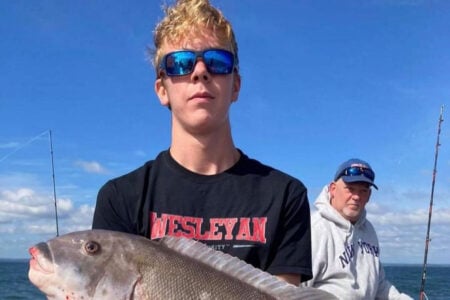
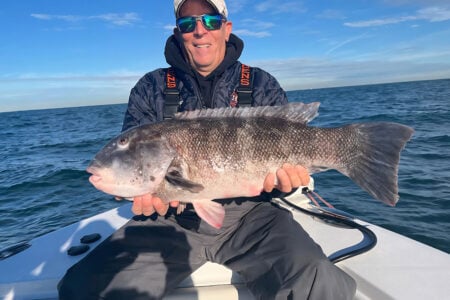
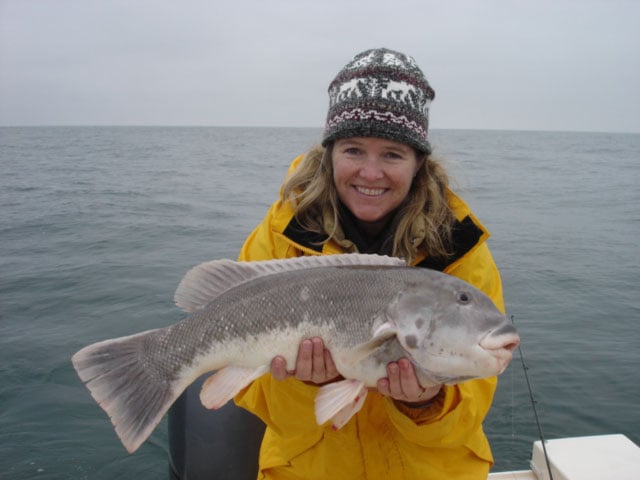
The holiday season is here, and while most people flock to shopping malls and department stores looking for gifts, diehard anglers with trailered boats head to the marina ramps of Montauk. Their destinations are the Cartwright Grounds, West Grounds, and Southwest Ledge, where exceptional blackfish action peaks each December, with plenty of double-digit white chins coming over the rails from the deep, rocky bottom.
This December, I would like to present a gift to The Fisherman readers by sharing the exact numbers of the Miller Wreck. Come December, this piece of bottom produces exceptional action with big blackfish, market-size cod, and plenty of large red hake for anglers who enjoy dining on scrod. Therefore, if you trailer your boat or keep it in the water through December in Moriches or Shinnecock bays, then it’s Miller Time!
The Miller Wreck
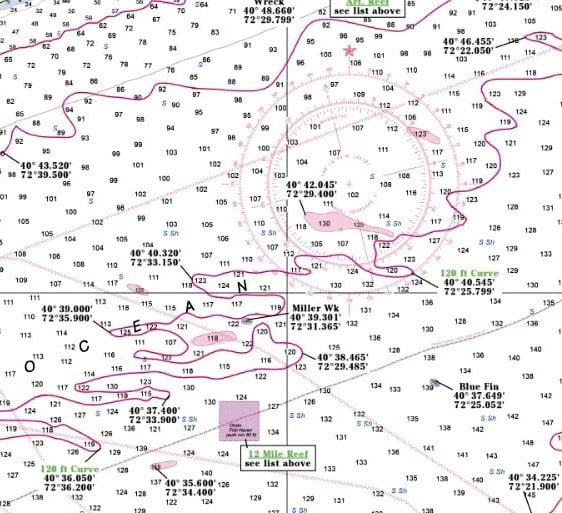
The Miller Wreck is approximately 15 miles offshore, south of the area between Moriches and Shinnecock inlets. The GPS coordinates that will put you directly over the center of the wreck are 40.39.301/72.31.365, with the structure resting in 120- to 130-feet of water. Since blackfish rarely spend their winters in depths greater than 150 feet, the Miller Wreck will likely be among their last feeding grounds before becoming largely inactive once ocean temperatures drop below 43 degrees, usually around mid-January.
In reality, the Miller Wreck should have been named the Mystery Wreck since this piece of Davy Jones’ locker was never officially identified. The navigator who discovered it reportedly wrote the Loran coordinates on a Miller beer bottle, giving this unidentified piece of history its name. Besides offering exceptional fishing throughout the year, the wreck has been a scuba diver’s treasure, yielding all types of brass and copper artifacts. Experienced divers can easily recognize the boilers, engine, and copper-clad hull. Even today, divers continue returning to the surface with souvenirs consisting of nonferrous metals.
The Miller sits along the edge of the 20-fathom curve, just north of the first set of Fingers, placing it directly in the migratory path of local and offshore species. What makes this location outstanding is its abundance of marine life throughout the year. Although different groundfish and gamefish appear seasonally, anglers can generally count on red hake most of the year, blackfish from late November through early January, and cod from December through late April.
Living Under One Roof
Come December, blackfish, cod, and red hake share the same structure. That’s rarely a problem, as each species gravitates toward its preferred section of the wreck. I’ve generally found blackfish throughout the structure, swimming over and inside the crusty, barnacle-covered boilers and hull. Cod prefer the higher portions, including the bow and upper boiler stacks, while red hake, commonly called ling, occupy the ship’s crevices and openings.
Whatever you do, stay directly over the wreck. Once you drift off the structure, you’ll likely enter dogfish country. One drawback to fishing the Miller is the abundance of dogfish circling the wreck in search of juvenile groundfish or weakened baitfish that wander into the mouths of these insatiable, green-eyed predators.
Dogfish, or sand sharks as some anglers call them, typically remain clear of the wreck’s many obstructions and instead circle the structure while searching for prey. They generally arrive in early November and remain until late January or early February, when colder water sends them toward deeper, warmer areas.
Tackle For Tackling
Late-fall tog fishing on offshore grounds like the Miller Wreck is for serious blackfish anglers. You’re dealing with big tog, deep water, and occasionally strong currents. With that in mind, you’ll need rods with backbone and reels capable of handling the pressure.
A stout 6- to 7-foot graphite rod rated for 30- to 40-pound line, featuring a fast-tapered tip, matched to a 3/0- or 4/0-class conventional reel spooled with quality braid of at least 40-pound test, is a solid combination. I recommend an 8- to 10-foot shock leader of 40-pound monofilament or fluorocarbon connected with an Albright knot. Fluorocarbon’s reduced visibility underwater can help increase your chances of fooling a big tog.
Rigs, But Definitely Not Jigs
Like most wrecks, the Miller is sticky in places, so leave the diamond jigs and heavy metals in the bag and stick with single-hook rigs. Although double-hook rigs are tempting, they can become a disadvantage when a big tog grabs one hook while the other snags the structure. The result is often a lost fish, rig, and expensive sinker.
For blackfish, I prefer a 3/0 Gamakatsu Octopus hook snelled to a 12-inch length of 40-pound fluorocarbon leader material, attached to a dropper loop 3 inches above the sinker. For cod, I’ll tie an 8-foot, 40-pound fluorocarbon leader to the main line, creating a large dropper loop 4 feet above the sinker and running a 5/0 Gamakatsu Sea Hook through it. This simple, effective rig prevents the hook from spinning by placing it directly on the leader.
For ling, a tandem-style rig positioned a couple of inches above the sinker works well. Gamakatsu 2/0 Bait Saver hooks will securely hold clams and other soft baits. Sinkers complete the terminal setup, and with depths ranging from 120 to 130 feet, 4 ounces may be the lightest you can get away with. However, 6 to 8 ounces is generally the norm.
White Versus Green
When it comes to crabs and blackfish, the menu can be extensive, as I’ve rarely experienced tautog refusing any type of crustacean. However, a couple of factors deserve consideration.
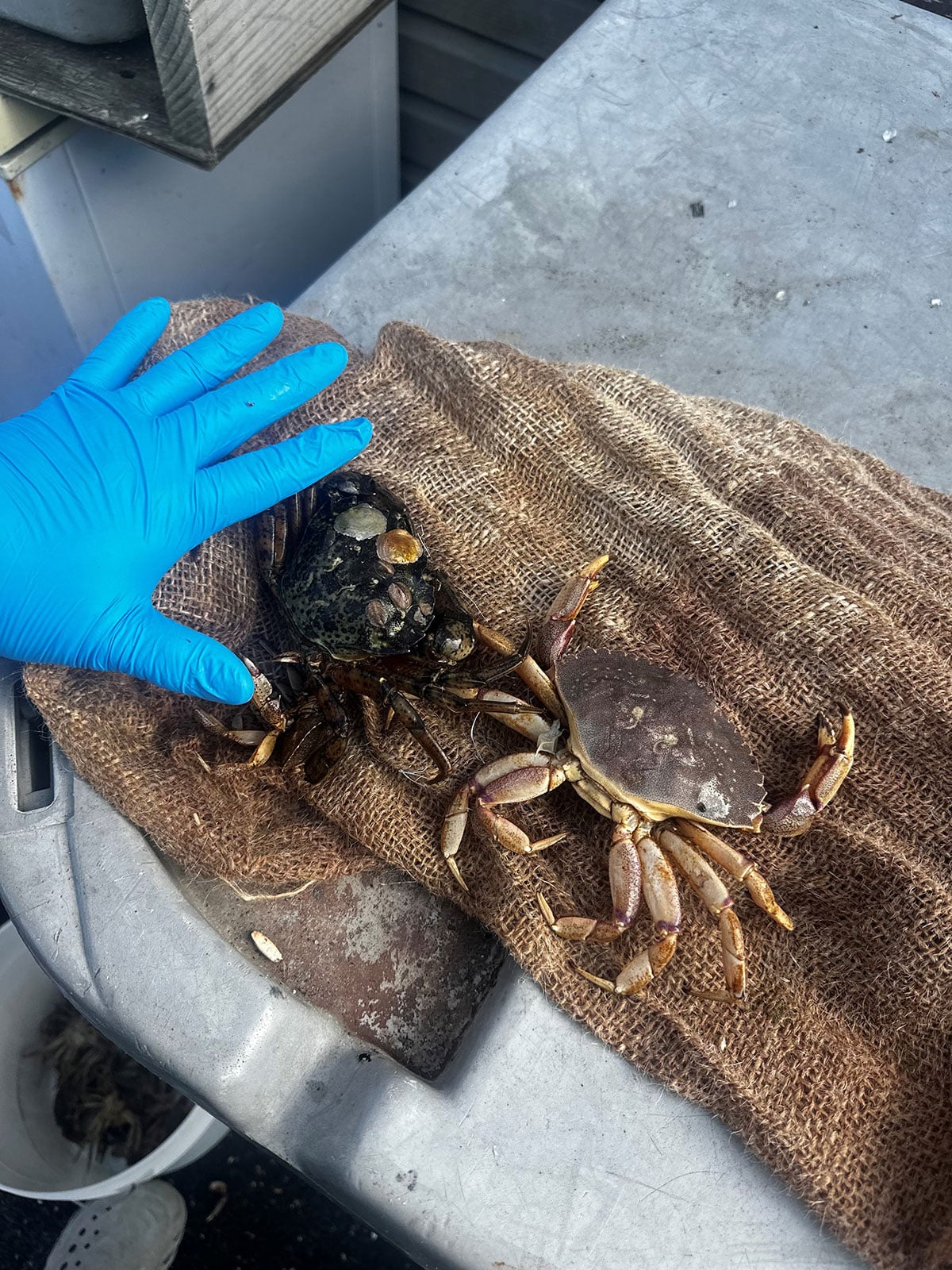
First is availability. Green crabs are the easiest to obtain and generally produce good results on most tautog grounds, despite being an invasive species from across the Atlantic. Then there’s the stone crab, also known as the white crab or white legger, which is highly effective in cold ocean waters. White crabs often must be ordered by the bushel from your favorite bait and tackle shop several days before fishing and can be pricey. Bringing both varieties is wise in case one outperforms the other.
Green crabs should be cut in half, with the outer shell, claws, and legs removed. Frankly, when big tog are around, I’ll keep the entire half crab intact to retain the innards. Smaller white crabs are best fished whole, with the outer shell cracked just enough to release their juices. Presented on a snafu rig, these baits can tempt double-digit bulldogs whenever they’re around. Both crab species also attract cod, although a nice piece of skimmer clam can catch all three groundfish species when presented on the appropriate rigs.
Anchor Away
If you’re fortunate enough to have Spot-Lock, great for you. For the rest of us, we must rely on an anchor. Anchoring over wrecks, particularly in deep water, is an art of its own. To simplify the process, ensure your anchor is large enough to grab bottom quickly. The key component is the chain, as additional chain helps the anchor set. A 12-foot length of galvanized chain matched to the anchor’s size is ideal.
Just as important is having sufficient anchor line to hold position and move around the area you intend to fish. At depths approaching 130 feet, depending on tide and wind, figure on four to seven times the water depth in anchor scope. Since an anchor can become wedged in the wreck’s structure, an extra anchor system should always be aboard as a backup. When it’s time to retrieve the anchor, an anchor ball makes life considerably easier, especially during moon tides when lifting becomes difficult.
Know Before You Go
Several important considerations come into play before heading offshore. First and foremost is the weather. After all, it’s December, and no matter how you look at it, conditions can be cold, rough, and lonely offshore. Check the marine forecast covering Montauk Point to Sandy Hook out to 60 nautical miles.
Leave the GPS coordinates of the wrecks or structures you plan to fish with a friend or family member, along with your expected return time. Should you fail to return as scheduled, they can notify the Coast Guard and provide information to assist in locating you. Don’t rely solely on a mobile phone or 25-watt VHF radio for communications 15 miles offshore. Make sure your boat carries the appropriate emergency communication equipment.
Ensure you have enough fuel for the round trip, as a faulty fuel gauge simply won’t cut it. Check that your dashboard instruments, electronics, and batteries are in proper working order. Don’t leave home without a portable jump starter in case your batteries fail. Pack extra warm clothing, including hats and gloves, along with plenty of bottled water and protein bars.
Although it’s Miller Time, make sure that means the wreck and not the beer. Your focus should always be safety first. And remember, catch and release is contagious, as today’s release is tomorrow’s catch.