This time-tested “jumbo” technique works from Sandy Hook down Cape May.
A buddy of mine has a saying, “Season ain’t ‘til fall.” He’s an avid hunter, but we get his thinking. Died in the wool striped bass fanatics feel the same way.
The fall run as big stripers head to their wintering grounds provides an opportunity to catch the bass of a lifetime at the Jersey Shore. Though jigging or casting plugs and swimbaits, as well as livelining bunker, are all popular, trolling with bunker spoons can locate big bass by covering more ground. And it’s a tactic known for catching big, personal best striped bass which will carry over up and down the Jersey Coast from Sandy Hook to Cape May as the season progresses.
Wireline has been around for decades and we were fans of it for a very long time. We don’t charter our Kathy G but often have friends aboard who lack the “educated thumb” when letting out line. With wireline this mistake can often lead to a “slinky” on the spool where the only solution is a pair of wire cutters. A close friend who has since passed away, swore by lead core and it took me a couple trips with him to see the advantages lead core offers over wire. Additionally, standard high-speed 4/0-size reels work fine, but here again, having an “educated thumb” to pack the reel when retrieving line is necessary.
Tackle Essentials
For the past few years, we’ve utilized Shimano Tekota 800 reels with lead core with excellent results. The lead core line is soft and doesn’t “bird’s nest” easily; if it does it’s quickly cleared up. The sink rate is also close to that of wireline so there’s minimal loss and at 45-pound test there’s no sacrificing line strength either. The levelwind feature also allows the angler to simply focus on turning the handle without being distracted by packing the reel. Another plus with lead core is at the end of the season – if we’re not re-spooling the reel over the winter – we strip the lead core off the reel into a large tub of fresh water, wash down the spool of the reel and easily wind the lead core back onto the reel without a tangle. This removes any salt that may have accumulated on the spool and helps reduce corrosion.
A loop-to-loop connection from the 50-pound test hi-vis backing connects the lead core which has color changes every 30 feet. The reels are packed with 300 feet of lead core and a loop- to-loop connection is utilized to attach a 25-foot, 80-pound test monofilament wind-on leader. To the leader we attach a 200-pound test ball bearing snap swivel with a clinch knot to which the bunker spoon is attached. Once spooled up we stretch the lead core out on our dock where at 150 feet the color is noted.
Since we have three pairs of trolling rods for striped bass with various action, our reels are numbered one though six and a label is affixed to the reel. A label noting the rod number and lead core color at 150 feet is also at the helm where we can quickly note and relay to the crew where each set-up needs to be placed when at 150 feet is desired. A buddy of mine has a set of the Tekota 800 reels with the line counter and it is indeed a nice feature but at this point we’re not thinking about a capital outlay to replace all six of our Tekota 800’s to add line counters!
As noted we have several set-ups we use when trolling striped bass and each have their pros and cons. Our favorites when pulling spoons are a pair of 9-1/2-footers custom built by my buddy who passed away and given to us by his daughter. Besides the sentimental aspect, these are our favorites for bunker spoons. They have a soft tip but still have enough backbone to turn a 40-plus pound bass. We also have a set of Star DLX 8/0 WL and a set of Daiwa Seagate SGT 80HR-W which are both eight-footers. The Star rods are good back-ups for bunker spoons and the Daiwa set are lighter so we use them later in the fall with shad and umbrella rigs when the smaller bass show up.
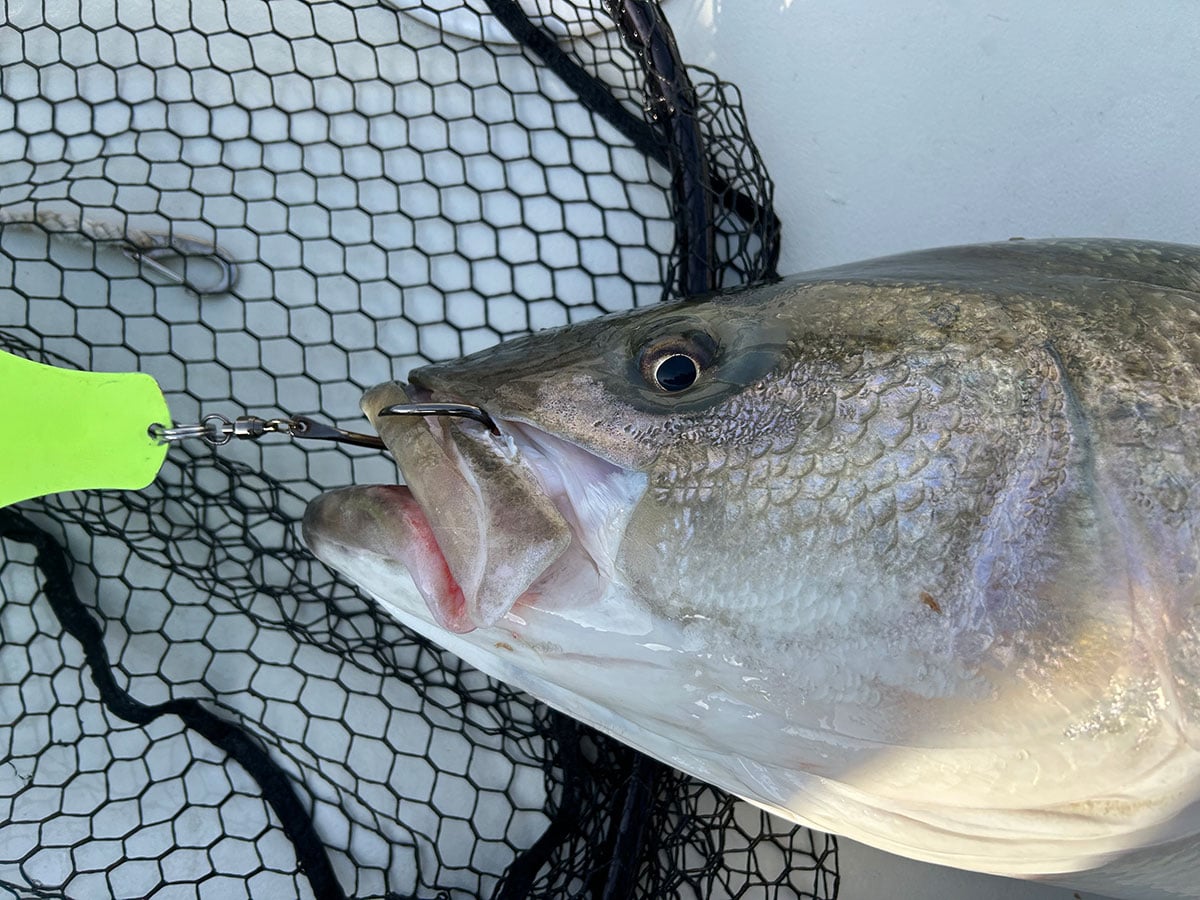
There are plenty of bunker spoons on the market to choose from and designs vary with some having fixed weights while others offer features to reposition the weight or change its size. There are fixed hook versions too but we prefer those with swinging hooks. With a fixed hook a big bass can utilize the spoon as leverage when shaking its head to free itself. A free-swinging hook allows a bass to shake its head from side to side though the angler can keep the spoon tight to the boat preventing the fish from leveraging the spoon with resistance from the water.
Another change we make on our spoons is removing J-hook and replacing it with a 10/0 or 11/0 inline circle hook. The QuickRig Charlie Brown rig features an inline circle hook attached to a ball bearing swivel and has worked well for us and nearly every bass we catch is hooked where it can easily be removed; it’s also less likely to get snagged on sticky bottom or foul hook a bunker should you happen to troll through or near a school. We also stay away from spoons rigged with single hooks and a treble hook trailer attached for obvious reasons.
The last adjustment we make is removing the screws that hold the weight in place and adding a drop of Permatex Medium Strength Threadlocker Blue before reattaching the weight to ensure it stays in place from the erratic motion a bunker spoon makes when trolled. Spoons made by Spoon Fed and Tony Maja have worked best for us over the years and are the only models we use. We carry numerous bunker spoons in a variety of colors but for the most part solid white, solid chartreuse and green and chartreuse combination account for 90% of the bass we catch. We also carry solid bronze, silver and a few of multiple colors but they rarely see water.
A shipping carton with 4-inch by 4-inch PVC squares cut to the level of the top of the carton makes an ideal carrying box for bunker spoons that easily fits two large spoons in each square.
On The Move
While opinions vary, we typically look at the moon phase and will make our first trips on the back side of the full moon or new moon in October. Our logbook shows the earliest catch of big bass for us occurred on October 7th one year where six fish from 40 to 46 inches were caught; it should be noted that the first good reports on jumbo migratory striped bass in 2026 occurred just following the late September nor’easter.
While a good logbook can be a guide, a network of dependable friends willing to share information is priceless. We keep good records and are fortunate to have the latter as well. High tide can also have an influence on the fishery too since for the most part we’re trolling within two miles of the coast. Water temperature can also influence bass and typically in the fall we see the bite start when sea temperatures reach the lower sixties.
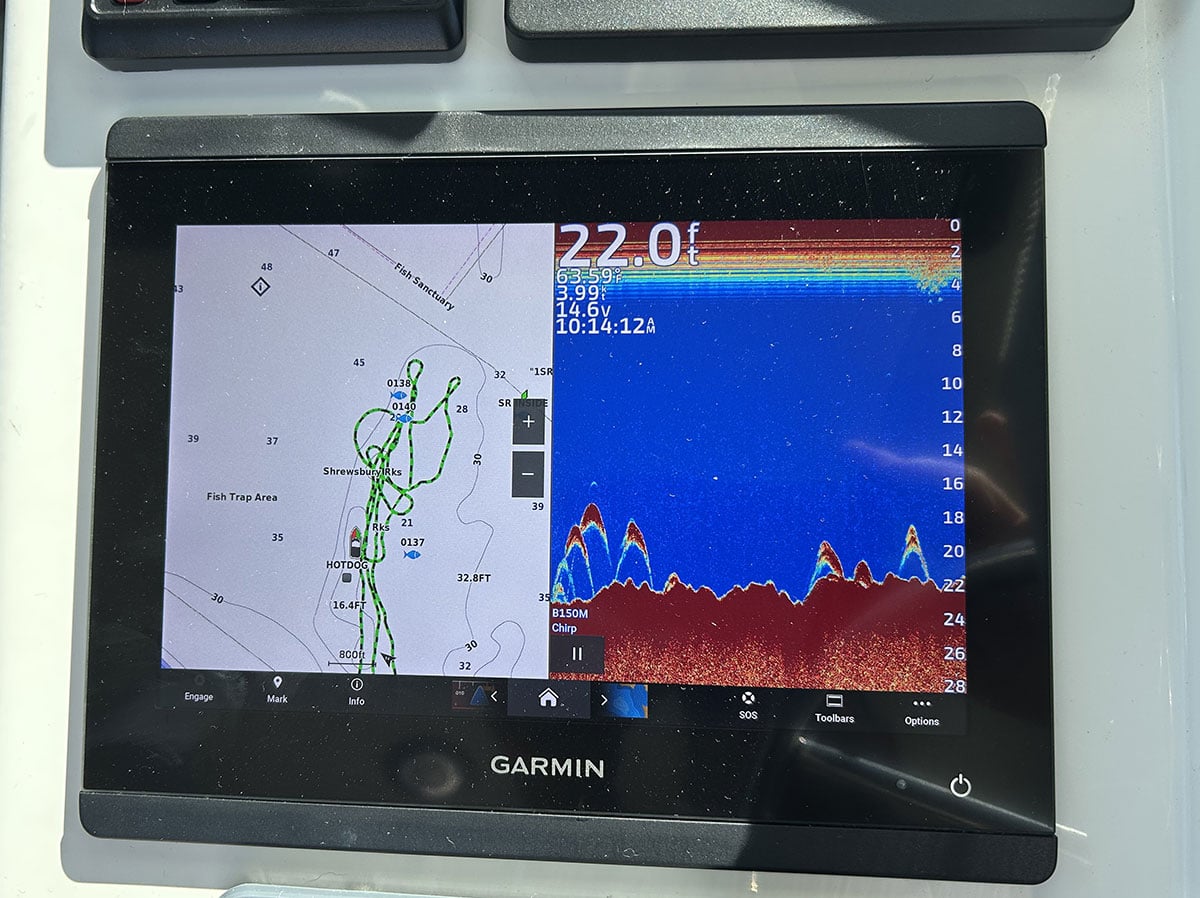
As with most “spoonheads” our pattern consists of two rods, each in an outrodder on either side of the boat. A safety line long enough to reach the opposite side of the cockpit is attached to the reel for ease of movement around the cockpit. Depending on depth we’ll set out anywhere from 150 to 300 feet of lead core as each 100 feet of lead core out will get the bunker spoon down about eight to 10 feet in the water column. Fishing irregular bottom, especially areas such as the Shrewsbury Rocks, requires strict attention to the bottom machine to prevent a snag. Though getting caught on the hook is less likely, there’s still the chance of the spoon getting hung up.
We don’t add any additional weight when trolling spoons but if desired in deeper water a 4-ounce drail can be attached to the swivel but then a 25-foot leader must be added. This creates an issue as once the drail reaches the rod tip the fish now must be pulled to the net increasing the risk of pulling the hook. With a wind-on leader we crank the fish right to the boat within easy range of the net. Trolling speeds/RPM’s vary based on wind speed, direction and sea conditions.
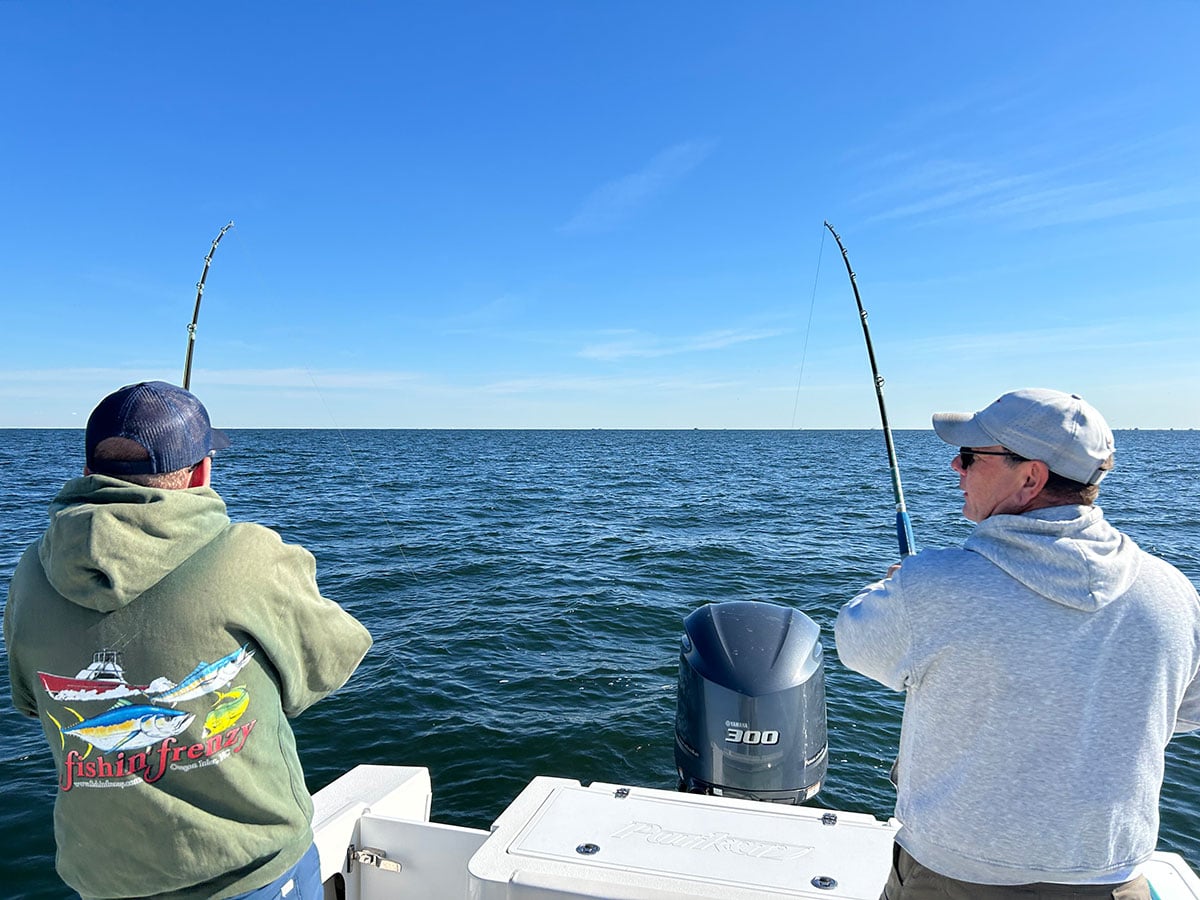
Generally, 3-1/2 to 4-1/2 knots will get you in the proper presentation zone though rod tip action is more important as it should bounce every second or so as the bunker spoon swims from side to side. Think of one one-thousand, two one-thousand, three one-thousand, etc.
Once a runoff occurs we’ll stay trolling briefly before clearing the other line with hope of a second fish. Out of gear we simply let the angler fight the fish from a dead boat just moving in and out of gear as needed to keep the fish off the transom. Keep the rod tip up and just crank; no need to pump the fish. Lead core and wire line have no stretch so pumping the fish could cause slack in the line and a lost trophy.
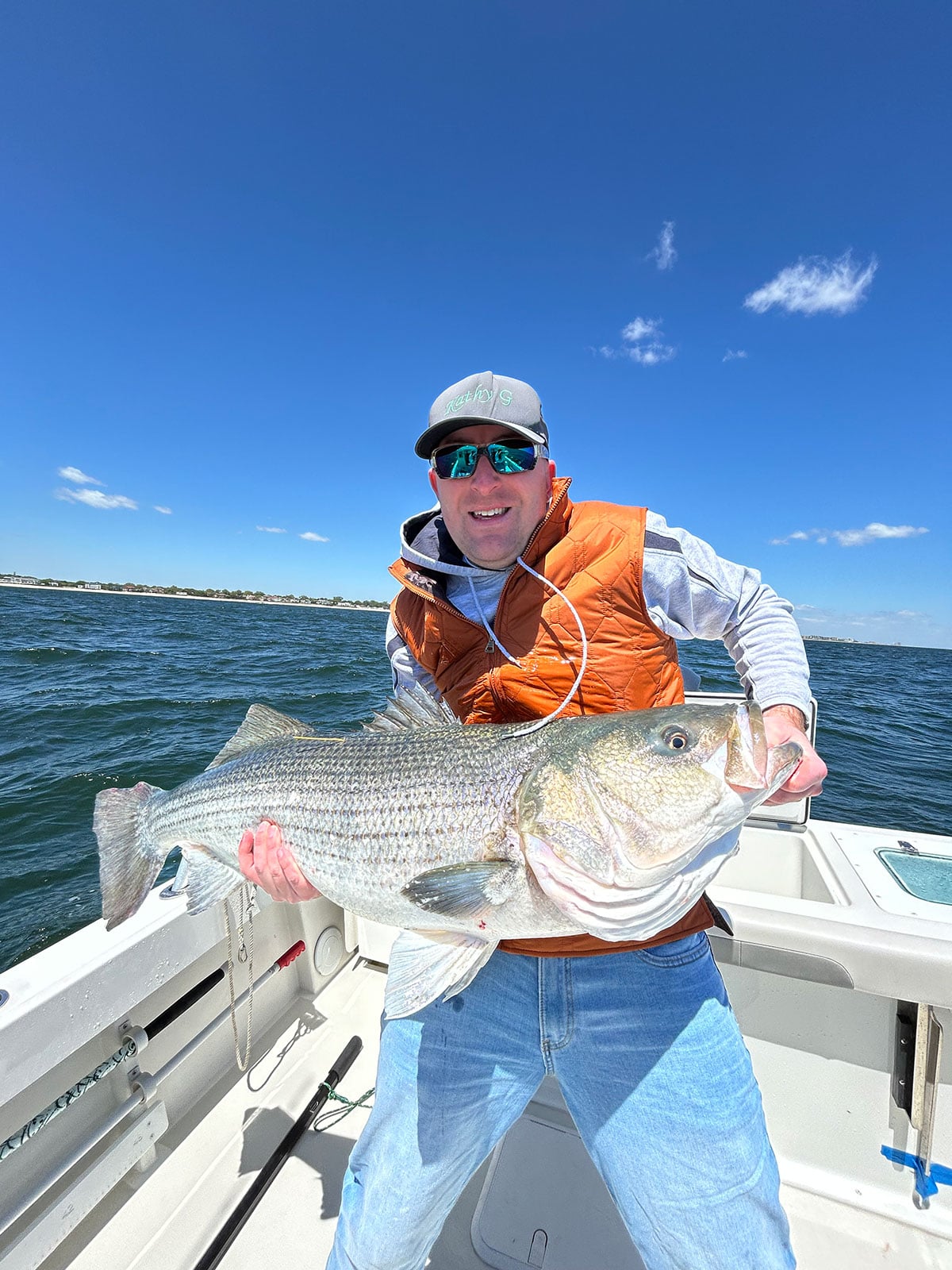
Always try to net the fish on the upwind side of the boat. Once the fish is close have the angler take a step back from the gunnel and be prepared for the fish to make one last run. Always lead the fish head first to the net. Use care when decking a big bass above the slot; take a measurement, snap a quick photo and use a lipper to drag a big bass alongside the boat getting oxygen across its gills. Watching a trophy striped bass swim away safely provides an even greater sense of accomplishment.