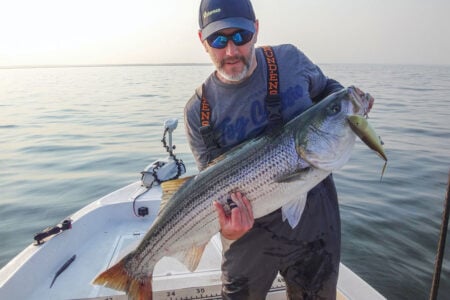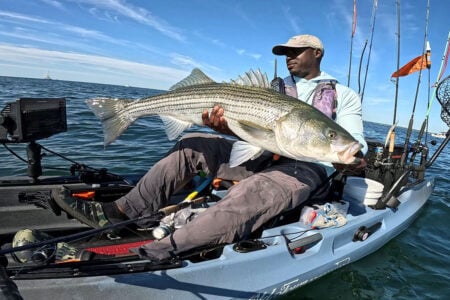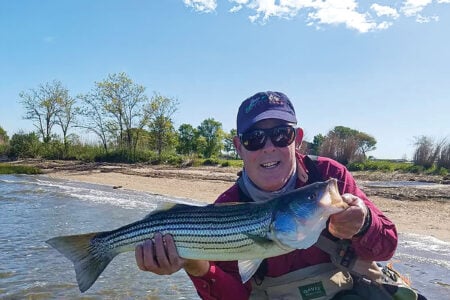
May kicks the spring run into overdrive on Long Island Sound.
By the time spring arrives, anglers are chomping at the bit to get out and catch their first striper of the season. I look at the spring run as two phases. Phase 1 is what I refer to as ‘preseason’ this is when our local population of holdover stripers wakes up and starts to move out of their backwater winter homes. Phase 2 is when the real fun begins and migratory stripers begin showing up in local waters.
Preseason
Of course, you can catch stripers throughout the winter, but I’m not a fan; those fish are lethargic and essentially hibernating in deep tidal waters, so I leave them alone. Many rivers throughout the Northeast have a winter holdover population where stripers spend the season holding in depths ranging from 15 to 40 feet. It’s when these fish begin to move and feed in early spring that I start my fishing season.
This usually happens sometime during the month of April and coincides with the ramp up of incoming alewives, things really get going during the latter half of the month. I refer to this as preseason fishing. These stripers will start to bite well when the river water reaches 50 degrees. It is at this point, they begin to move downriver and into shallower water. They can often be found along channel edges or moving up onto mudflats during a high outgoing tide—particularly on sunny afternoons. The darker bottom warms faster in the sun, making the river water warmer than the adjacent larger bodies of water.
Work the channel edges with a 5-3/4-inch Fin-S Fish paired with a Titan HD half-ounce jighead; snap-jigging in 8- to 15-foot depths will produce excellent results. Keep an eye on the shoreline for river herring swimming along the banks. Cast unweighted soft plastics, like 9- or 7-inch Slug-Go’s, along these banks and adjacent mudflats. Snap the rod to cause the lure to dart and change direction, incorporating frequent pauses. Hang on, as stripers will often smash these lures as they slowly sink. Expect this bite to last into the first week or so of May. After that, these fish will exit the river and migrate to new waters.

The May Moon
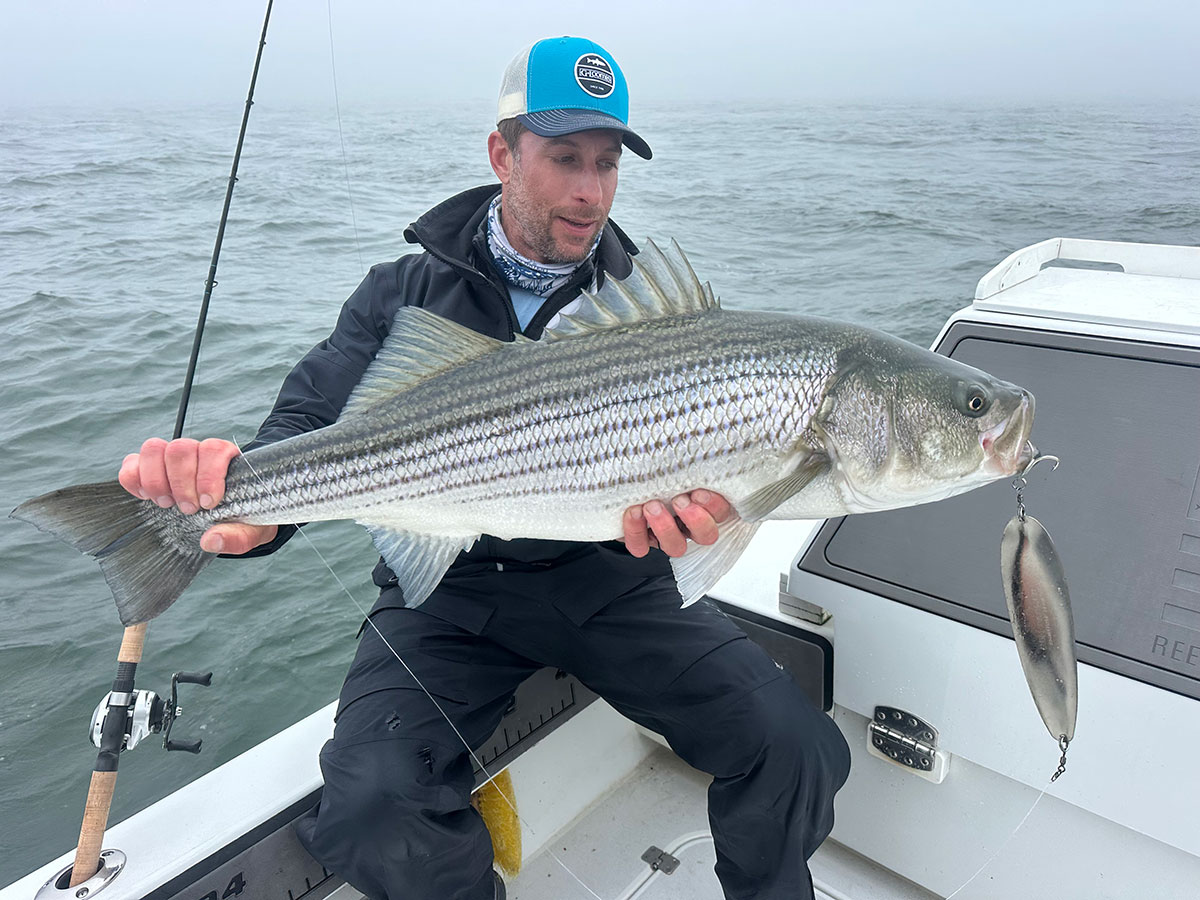
May is what I consider to be the official start of striper season throughout most of New England. Historically, the first migratory stripers show up in Long Island Sound on the first full or new moon of May on the flood tide. These fish, often covered in sea lice, can range from the 20- to 40-inch class. They show up on the deeper reefs in Long Island Sound when outside water temps hit 50 degrees. There will be a variety of baitfish on the reefs, including bunker, whiting, mackerel, butterfish, scup, sand eels, and silversides.
If large bait like bunker are present, it’s a great time to fish flutter spoons, I like the 8- and 9-inch Nicholas Magnum Spoon, but they all catch fish. These large spoons are very productive, especially in Western Long Island Sound, but they work well anywhere you have water movement and big bait. I like to fish flutter spoons on a low-profile baitcaster, such as a Shimano Tranx 300B loaded with 30-pound Power Pro SuperSlick v2 and paired with a G. Loomis IMX Pro Blue 863C. Drop the spoon to the bottom, engage the reel, and come up two cranks. Work the spoon with long sweeps, allowing it to fall on a slack line. That slack is critical; it’s what gives the spoon its fluttering action as it descends. If this isn’t working, try reeling the spoon up fast; often, you’ll see several stripers following it all the way to the boat.
In The Rips
| SCANNING FOR SUCCESS |
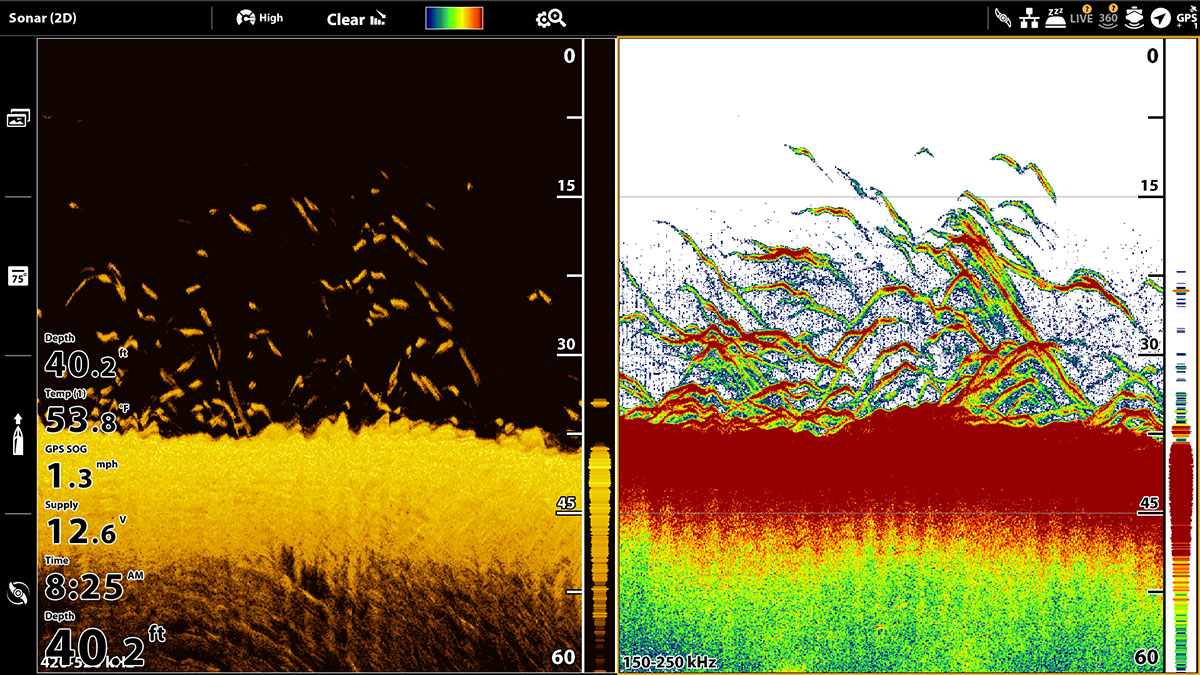
| To locate schools on the reefs, first look for birds working the crest of the rip line—a tell-tale sign that bait is present. Next, I use my Humminbird sonar to locate the fish. I prefer a split screen with both 2D (traditional high chirp) sonar and down-Imaging for maximum detail. It is not uncommon to find massive schools of thousands of stripers marking from the bottom all the way to the surface. If you locate one of these “mega-schools,” set your drift up-current of the reef, drift into the fish, and hang on!
|
When small bait is present—like alewives, silversides, and sand eels—smaller lures work best. I like to vertically jig Shimano Current Sniper Jigs (80 to 120 grams), fishing them in a similar fashion to the flutter spoon. I have caught nearly every species on these jigs, even tog! Soft plastics are also hard to beat during the spring run, especially before the bluefish show up in large numbers. Again, the Fin-S Fish and Slug-Go on a 3/8- to 1-ounce jighead are a great bet.
My rod of choice here is the G. Loomis IMX Pro Green 843S or 844S. I like my setup to be lightweight yet powerful, so I’m a fan of Shimano’s Mag-Light series reels for their rigidity. A Shimano Vanford 4000 or Twin Power XD spooled with 15-pound Power Pro and a 30-pound Aftco Saiko fluorocarbon leader is ideal. The thin-diameter braid is key because it reduces line drag, keeping the jig looking natural and swimming close to the bottom.
On many Long Island Sound reefs, mid-current velocity can range from 3 to over 5 knots. Expect peak velocity during the third and fourth hour of the tide, and even stronger flows after a new or full moon (The Eldridge Tide and Pilot Book, published annually, is a wealth of information for this.) During peak current, “three-waying” bucktails works best. The rig consists of a 2/0 Spro three-way swivel tied to a 6-foot, 60- to 80-pound leader with a bucktail and pork rind on the business end. A short, 10-inch dropper with a perfection loop is used for a 16-ounce sinker. Drop the rig to the bottom and come two to three cranks up, keeping you about 6 to 10 feet off the floor. This is the strike zone. As you drift up the reef, maintain this distance; if you drag the bottom you’ll snag, and if you’re too high, you’ll miss the fish. I like the Striper Snax bucktail (1 to 1 ½ ounces) because it has a strong hook but is light enough to swing freely in the current. Experiment with colors and pork rinds, as color can make a big difference. The bite can be very light, so don’t hesitate on the hookset. This is a highly effective tactic for deep, fast-moving water like The Race or Plum Gut. I opt for a conventional reel like the Shimano Trinidad 14a or Torium 14 spooled with 50-pound Power Pro on a G. Loomis IMX Pro Blue 904C.
Up Shallow
The 3- to 8-foot flats at the mouths of many rivers are also great spots for May stripers. By mid-month, bunker, shad, and herring will draw fish into these areas. I scan these flats with Humminbird Side Imaging, ranging out 150 feet to both port and starboard for 300-feet of total coverage. Once I locate a school, I cast large soft plastics like a 10-inch Fin-S Fish or a 9-inch Slug-Go rigged on a 10/0 swimbait hook. Large 7-inch topwater “walk-the-dog” spooks can also work wonders, though some days they get no attention at all.
| POUND THE SOUND |
| If you want to get in on this action but aren’t familiar with the area or you don’t have a boat of your own, consider hiring a local captain to put you on the fish. There are many ways to cash in that run the gamut from private charters to party boat fishing.
Reel Cast Charters [author’s boat] – Private charters J&B Tackle – Private charters Tartan II – Private and ‘open boat’ charters The Black Hawk – Private and party boat options The Sunbeam Fleet – Private and party boat options Rock and Roll Charters – Private charters |
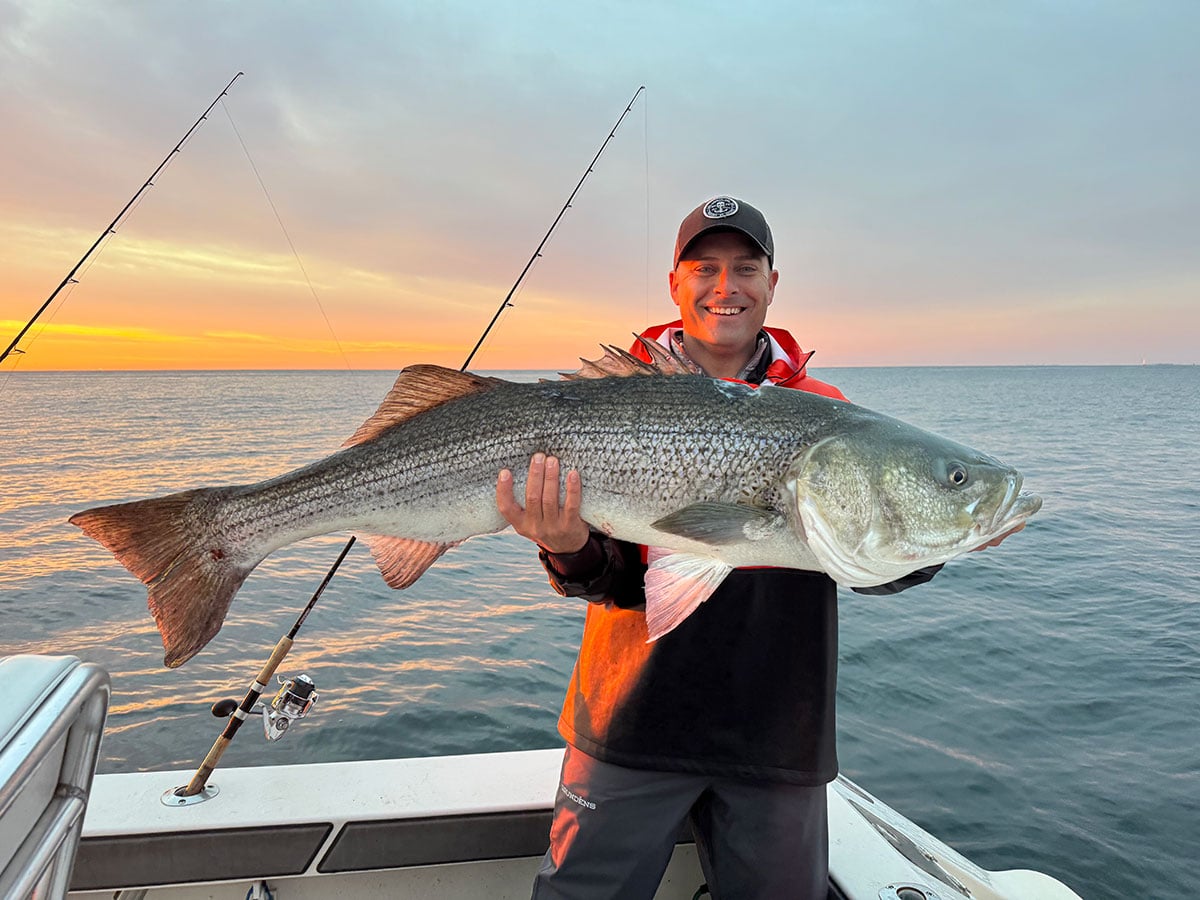
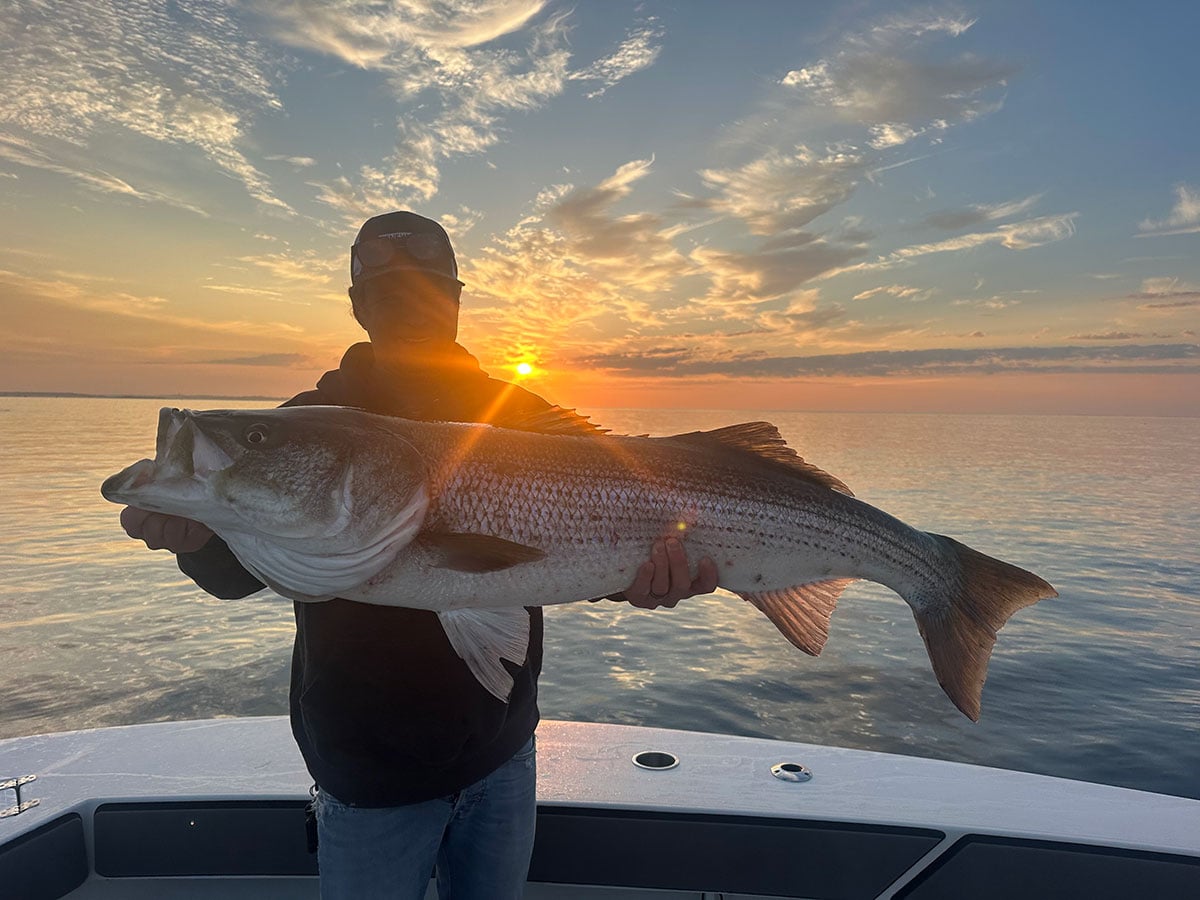
Early-season “cows” in the 40-pound-plus range are a real possibility in May. I can think of a few boulder fields that have produced giants over the years. When hunting these fish, you are looking for quality over quantity. These “Moby linesiders” are found on boulder-strewn shorelines, points, and reefs. To target trophies, it’s best to use bait and heavy tackle (50-pound braid paired with a 60-pound leader). I cast live eels along submerged boulders, using my Minn Kota trolling motor to position the boat so we can reach the heart of the habitat. Live bunker is also incredibly effective; if you can locate and catch it, I highly recommend livelining. A 6/0 Gamakatsu Octopus circle hook will easily penetrate a striper’s mouth. Another great option is fresh-cut bunker—the head and body chunks are best. Just ensure the bait is fresh-caught and kept on ice; it should never be frozen.
Once you get out there and experience how rapidly the striper fishery changes from the latter half of April through the end of May, you’ll understand why this is one of my favorite times of the season to hunt striped bass. With a variety of baitfish, stripers relating to all different types of water and structure, and the fact that you have a very good shot at catching truly large fish, it’s just an amazing time to spend a day (or night) fishing the waters of Long Island Sound.