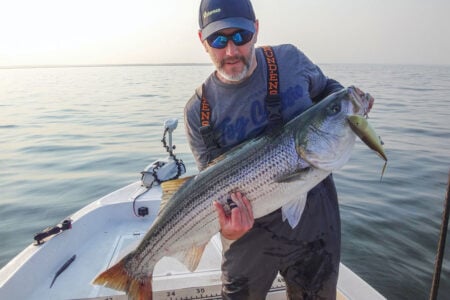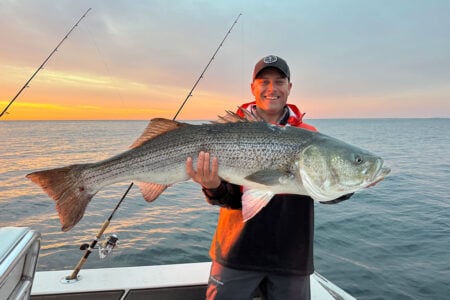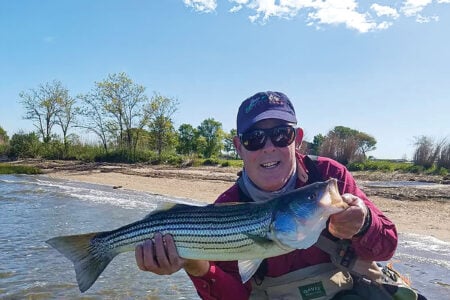
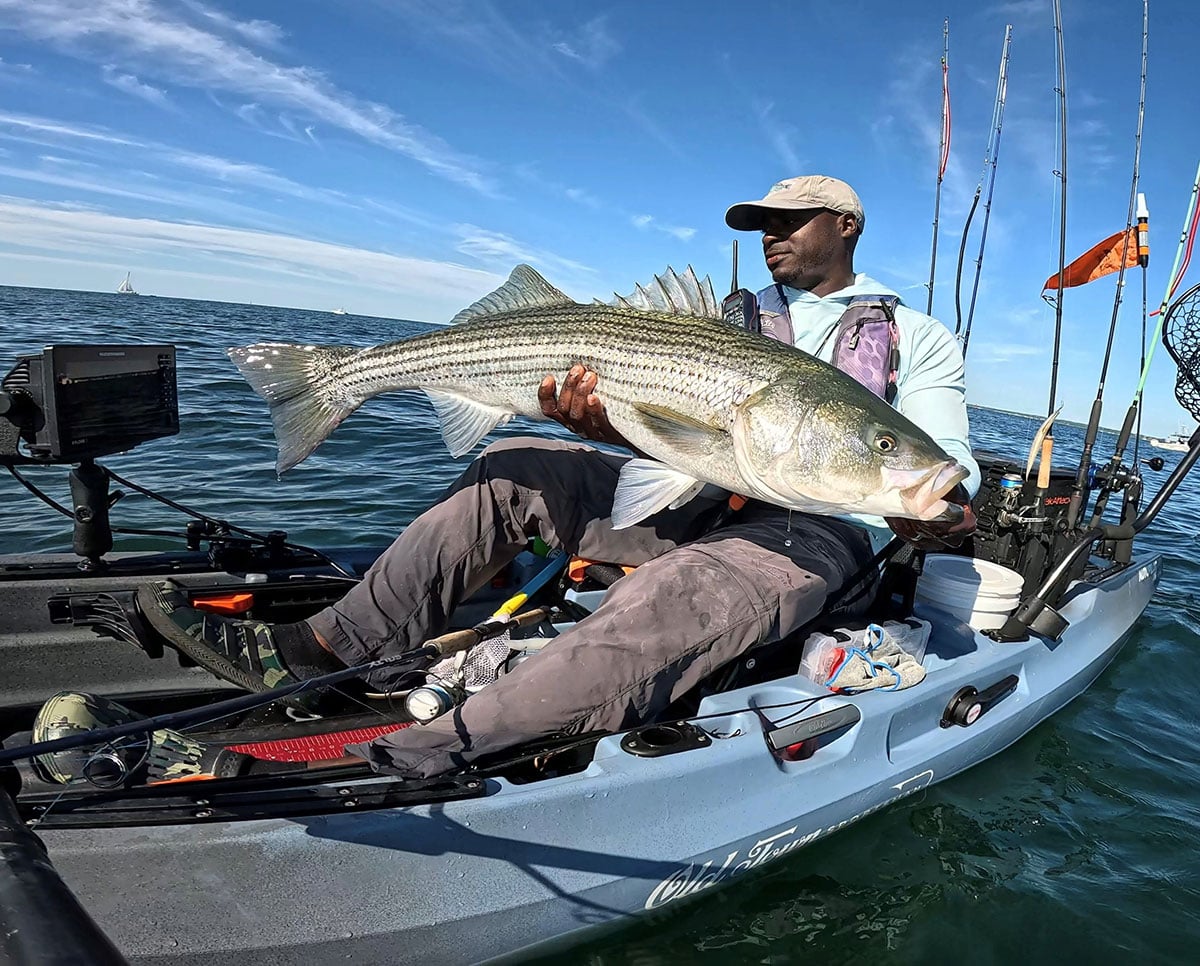
Fishing live bait from a kayak can be a rewarding way to catch big stripers, and it’s easier than you think!
As fishermen, the act of just fishing isn’t enough. We like to live by our own theories and with that comes debate. Which is better, freshwater or saltwater? Single hooks vs. treble hooks? Or the age-old favorite; live bait vs artificial… these are just a few of the debates that you’ll see on social media or overhear inside a tackle shop. In my mind, no singular thing should stand as the golden rule, especially when it comes to one’s fishing preferences.
Being a well-versed angler is something that I take great pride in and strive to be better at every season. When it comes to striped bass fishing, I love the feel of getting hit on a topwater or a fish inhaling my soft plastic, after all it makes us feel very accomplished when we can convince a striper to eat something that’s not real. However, my experience has taught me that sometimes feeding a fish what they actually like to eat can make a fishing trip so much simpler.
The Easy Way?
As technological advancements have become an ever-growing aspect of fishing, it seems that the use of live bait has fallen out of favor with many striper fishermen. It seems that some hardcore artificial lure guys feel that live bait is “taking the easy way out”. While I do agree that live bait does shorten the learning curve, I also think what you use depends on what you want to accomplish on a given day. If I have a new lure that I want to dial in, more than likely I’ll have it tied on and try my hardest to figure it out. Once I’m dialed I get a feeling of accomplishment and now I’m on to the next thing. On the flipside, having live bait ready to go makes me more efficient as angler and fishing guide.
As a kayak fishing guide, my most popular trip is the five hour trip. Most clients come out with me to experience something new and have a good time while others come out with a specific technique in mind that they want to learn. An “artificial only” trip is easier to prepare for as I don’t have to make the trip to the bait shop or pour time into trying to catch bait. However time flies when you’re on the water so having live bait as an option makes fulfilling the goal of catching a nice striped bass a less complicated experience for the guide and an easier learning experience for the client.
Bunker First
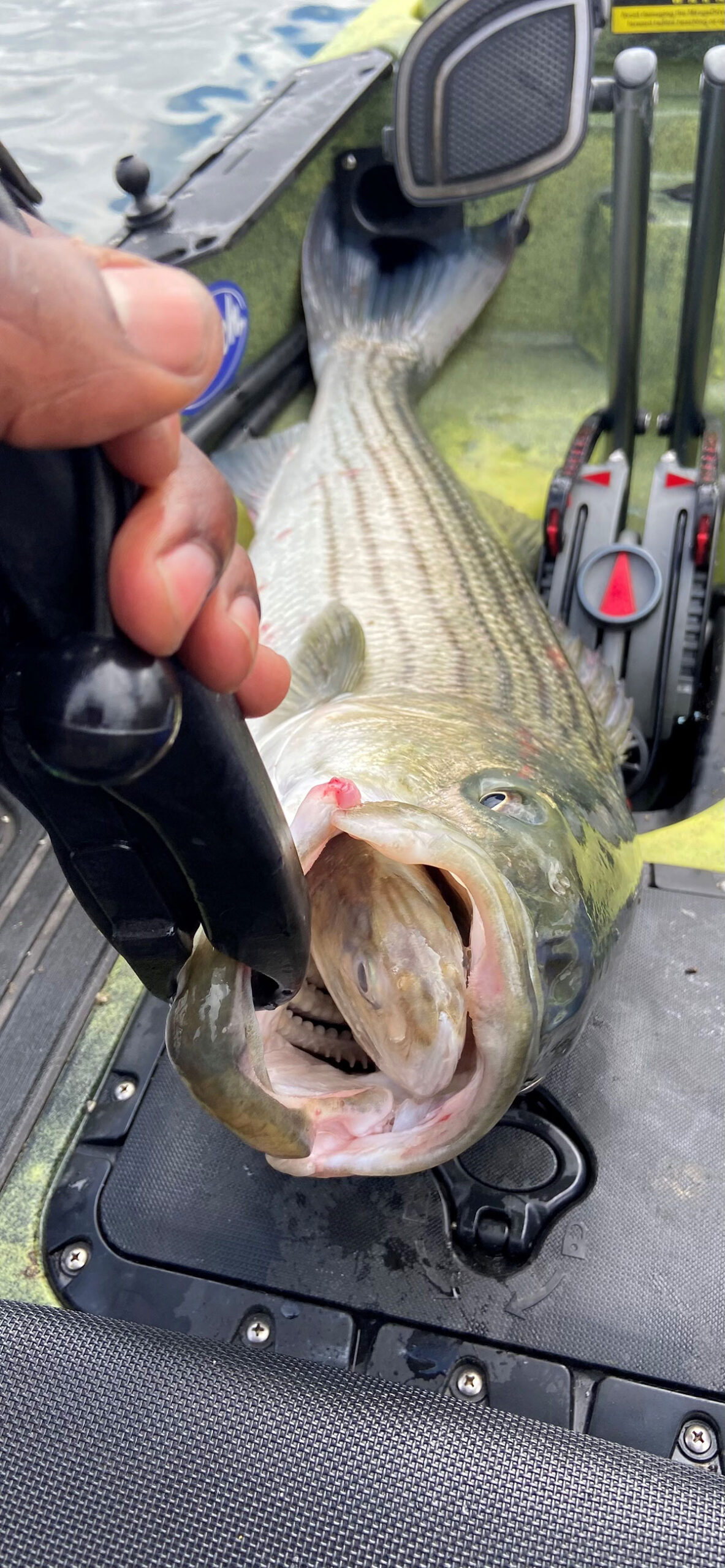
When speaking of live bait for striped bass, two species come immediately to mind: bunker and live eels. Let’s focus first on live bunker. If I had a choice to only use one live bait forever, bunker would be the choice. The live bunker experience is very visual. It starts with either seeing a very obvious bunker school on your fish finder or seeing them pop on the surface. Sometimes they are just feeding while other times they are getting harassed by stripers and bluefish. In either scenario you’ll know that prime live bait is within reach. Keep in mind that these schools move very quickly either due to fish preying on them or being spooked by boat noise.
Live bunker is not only just a good option for stripers, it’s my favorite way to catch them, period! The reason is that finding a nice school of bunker has become more challenging over the years so having access to them feels like hitting the lottery. In Rhode Island the month of May and into early June is when I typically expect to see them, and I always have my snag hook ready to go during this time to snare my fresh bait.
I love using this bait so much because the process of catching a striper on a bunker is such a visual, “National Geographic” experience. What typically happens is I cast my bait out around a school of stripers and within seconds the bunker is already being chased. Because most schools of bunker have stripers hanging out below them, the bait usually stays close to the surface of the water. This often results in multiple fish chasing your bait, in a very-visual game of ‘cat and mouse’ while the stripers compete for your bait. Eventually of the bass inhales the bunker, leading to a powerful battle and (hopefully) the landing of a nice striper. It’s such a cool an experience that never gets old.
The problem with bunker is that you never know if you’ll see them, from one day to the next. And in a kayak, keeping up with the fast-moving schools can become challenging especially when there are 30 power boats constantly spooking them. There are a few bunker hotspots and on any weekend the combat fishing can be super dangerous because everyone’s after the same thing and not accounting for other vessels while out fishing. For these reasons the next live bait comes in handy, enter the American eel.
The Ubiquitous Live Eel
If menhaden are the favorite live bait for my personal use, as a guide live eels hold a special place in my heart. They are easy to acquire, easy to keep alive… and they work like a charm. From May through October almost every bait shop has eels. The downside to live eels is they are very hard to handle. Unlike a live bunker where you can just grab and hold with a relatively tight grip, eels require a dry towel with a really tight grip. The day you show up on the water without a towel you will be kicking yourself because putting an eel on a circle hook will take several precious minutes of your fishing time.
Drifting a live eel is arguably the most popular way to present them. It’s as simple as finding a school of fish, move up current of the school and drift down past them. This presentation can be performed weightless or weighted depending on depth the fish are holding. Spot Lock technology has been around for a long time, however it’s a relatively new thing for kayak fishermen. With Spot Lock, my favorite way to fish an eel is to find a school of fish, Spot Lock over them, and cast and retrieve a weightless eel. It takes some getting used to as you have to figure out how long it takes an eel to get to the bottom but with practice it’s such a fun way to fish. I think of it as turning your live eel into a soft plastic.
The Techy Parts
Tackle is always a tricky subject because – technically – you can make anything work if you have to. For bunker I like a heavy or an extra heavy rod to account for the weight of casting out a bunker. For eels I like a medium-heavy or heavy rod since the eels aren’t as heavy as most adult bunker. To cast and retrieve these live baits I like to use spinning gear. If I’m drifting I love to use a conventional reel because it has free-spool feature, this allows a fish to take your bait and not feel resistance before you get a chance to set the hook. In general when live bait fishing use a rod/reel combo that can handle big stripers. Also, since 2021 inline circle hooks have been a requirement for live bait so that’s something else to keep in mind. For live eels I like a 7/0 or 8/0 circle hook and for bunker I like an 8/0 or 9/0 circle hook.
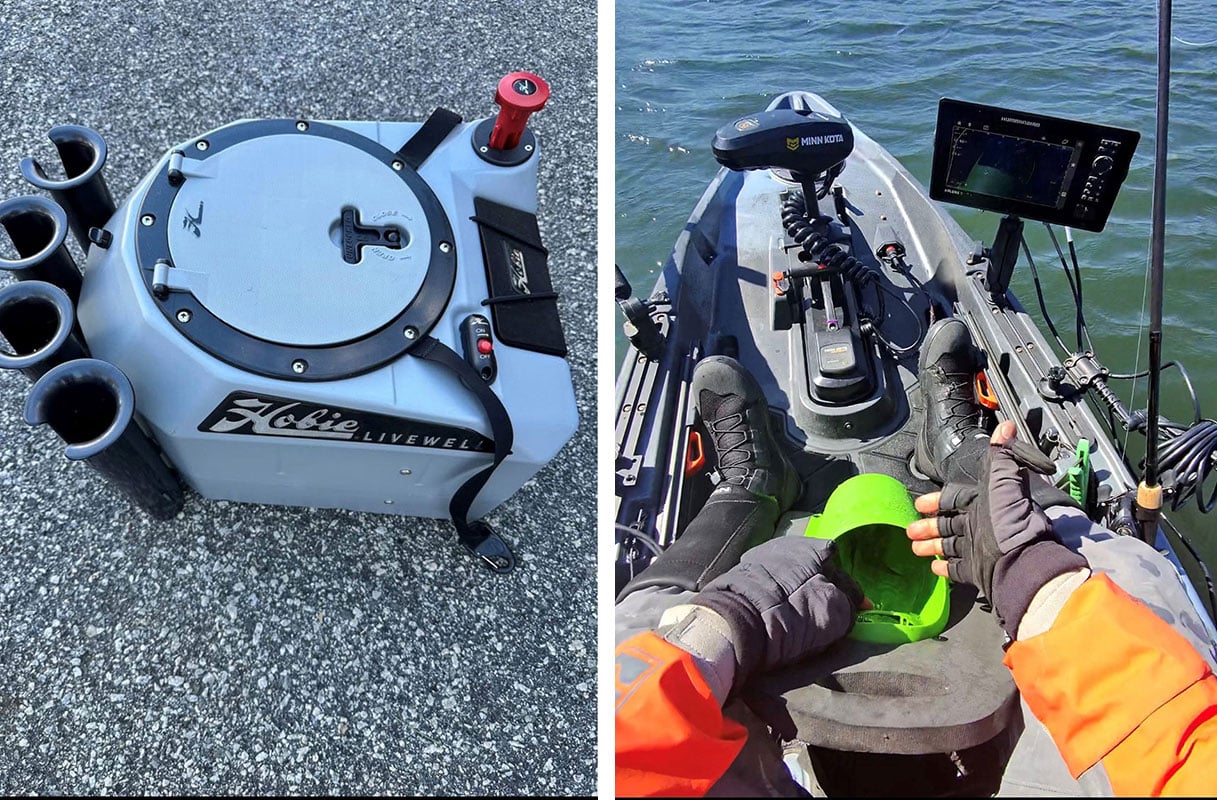
In my few seminars discussing live bait a popular question I got was, “How do you keep your live bait alive in a kayak?” Usually this question comes from boaters because a lot of powerboats come with a built-in livewell which is key for keeping bait fresh. The cool thing is that kayak fishermen have livewell options as well! I’ve tried a few different options over the years and they all worked for me in different ways.
The first thing that I tried was the Hobie livewell. This is a battery-operated livewell that feeds freshwater through the system via a scupper hole. I liked this system because it came with rod holders and I could usually keep eight to ten adult bunker alive during my time on the water. Next, I tried a couple of different DIY options with the most used being a netted laundry bag. This system worked well but was ultimately short-lived because it created a lot of drag in the water, slowing down an already slow vessel. Currently I use a product called a Baitshark. The Baitshark system is a floating livewell that attaches to the kayak by a cord. It floats and has holes so that fresh water can constantly flow in and out. I settled on this option because I carry a lot of stuff and I needed something that could attach to the kayak instead of being on it, not to mention something with very little drag in the water.
In the end I admit that I’ll never completely replace my tackle box for circle hooks and live bait, however I will always show up on the water with options. Being open minded to live bait doesn’t diminish your skills an angler. What it does is allow you to be prepared for any situation. After all, while everyone is trying to force the issue with their eel-like soft plastics you might ultimately get the last laugh because it’s not out of the question that you might find stripers that will only hit live baits and that can be very frustrating for the ‘lure only’ crowd. Especially when you’re constantly tight to another big fish!