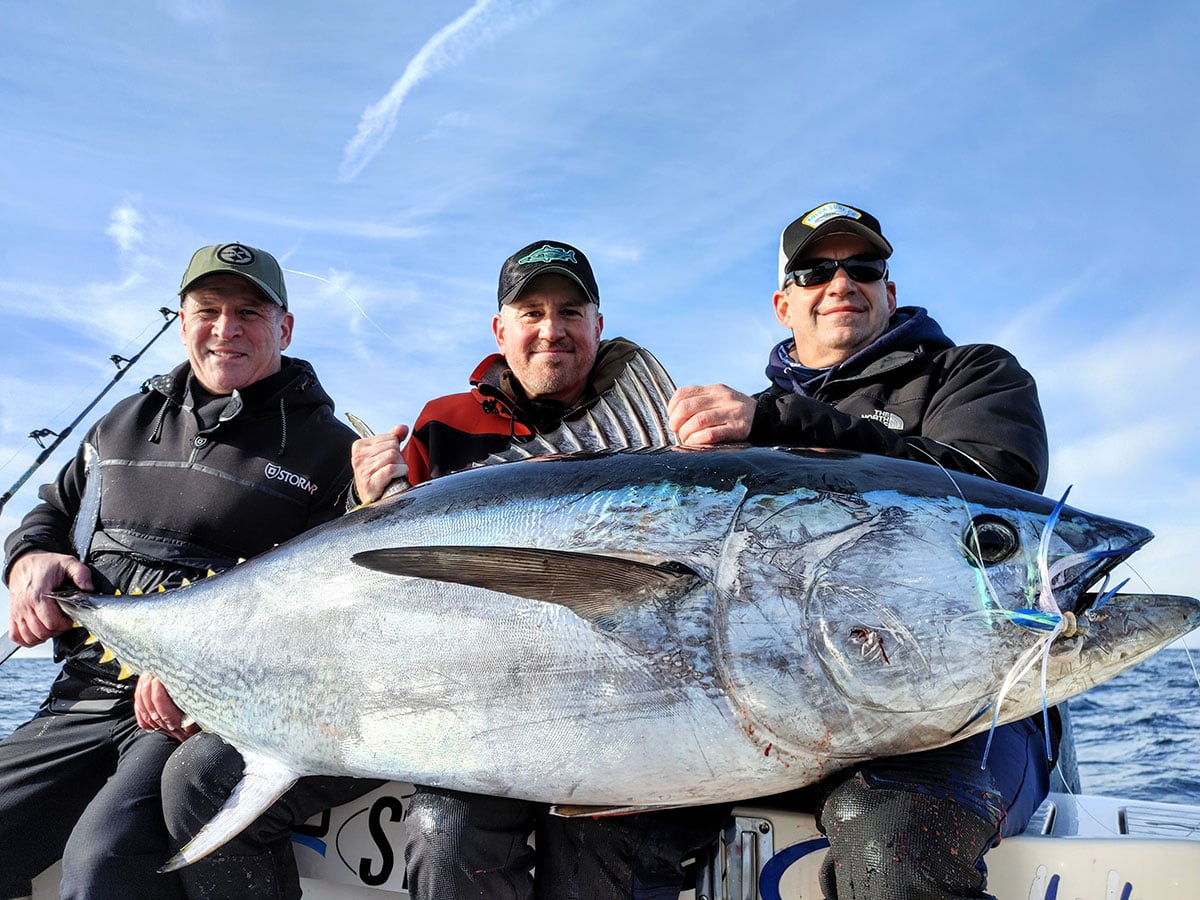
Ballyhoo tips for trolling inshore bluefin this fall.
If this November is anything like it was the past five seasons, bluefin tuna should be bending rods anywhere from along the beach out to 20 miles. Regardless of the “prohibition” on bluefin retention for bluefin last fall of course, November was especially interesting where I fish along the Jersey Shore; during the southerly migration of these tuna in 2025, on any given day, striper fishermen were hooking them or seeing them blow up alongside their boats.
Many times the blowups were like a small refrigerator had fallen out of the sky, causing quite a startle. That’s why on all my striped bass charters last fall, I always had several tuna casting rods rigged and ready to fire at any targets that suddenly came up within casting range.
When these tuna migrate from their New England waters towards the Carolinas, optimum water temperature and bait abundance will hold them in an area and cause bluefin to feed heavily. This happens when our ocean temperatures are in the range of 54 to 58 degrees, with adult bunker, peanut bunker, or sand eels being present.
One tactic is that you can run and gun and chase ghosts, as it has been coined at this time of year, and many do. Or you can set up on the troll with ballyhoo rigged on heads which is in my opinion the most productive and easiest way to hook up. Trolling rigged ballyhoo and heads was pioneered by tuna fishermen in North Carolina and are now a fixture in any spread throughout the northeast. Here are a few tips to consider when trolling by this method.
Prepping and rigging a ballyhoo so it swims correctly with the right presentation is the most crucial factor to getting a bite. This comes with practice. “One of the keys to a properly running ballyhoo is to adequately prep the ballyhoo,” advised Tom Novak, of TN-Tackle, adding “I always recommend cutting the pec fins behind the gills, poking out the eyes, depooping the bait and breaking the back. Skipping these steps can cause a well rigged ballyhoo to run poorly.”
Using a pin rig and cap is the easiest way for a beginner to rig a ballyhoo, but for the most realistic bait you will want to learn how to split bill your ballyhoo. Learning how to split bill your baits will make them dig in and dive and move up and down slightly when trolled. This is referred to as black blacking. The bait’s head is angled down as the weighted head sits on the bill. Rigging in a chin weight is still necessary which will give added stability.
The cooler inshore ocean waters from late fall into winter do not promote phytoplankton blooms so the water will have excellent clarity. For this reason you will want your leader to be as invisible as possible in the water; using fluorocarbon is a must. Also make sure your leaders are very clean. Wipe them with alcohol wipes to remove any salt, grime, and fingerprints. Be careful not to step on them or drag them across your deck. Then before you let your ballyhoo way back drop it back 10 to 15 feet behind the boat as this will allow you to watch the ballyhoo and see if it is spinning or running black back. Don’t drop it way back if doesn’t look right.
There is a misconception that when trolling ballyhoo heavier 5- to 8-ounce heads will get you much deeper than 1- to 3-ounce heads, however such is not the case. You would have to let out several hundred yards of line to accomplish this which would then hinder the action of your bait running properly. All my trolling is done with 1- to 2-ounce TN-Tackle or Capt. Joe Shute heads for ballyhoo and 3 ounce heads when using a RonZ. I like to start my troll at 5.5 knots. If I am marking bluefin and don’t get any bites at this speed I will slow down to 4.5 to 5 knots.
Another misconception is that having a lot of hair on the head will help to get a bite. Skirts will add flash and help to prevent the bait from washing out, but many times less hair on a head is better than a lot of thick hair because you want the tuna to see and key in on the bait. I also recommend that you use keel-weighted heads. The development of keel-weighted heads helps the ballyhoo to track straight and not spin making it more realistic.
A highly effective alternative to trolling ballyhoo on heads is to rig a RonZ on a head. These rigs can be added to your spread of bally or trolled separately. When trolled separately they are much more forgiven and can be trolled at higher speeds. My go to combinations are the 3-ounce red head and crystal skirt, glow head with a blue and crystal skirt, and pink head with crystal skirt, all with a pink RonZ.