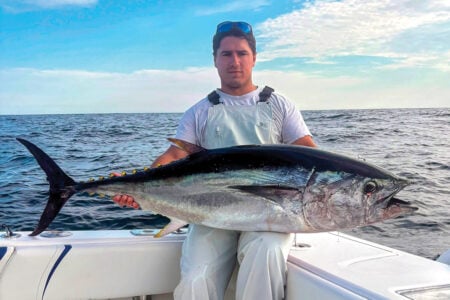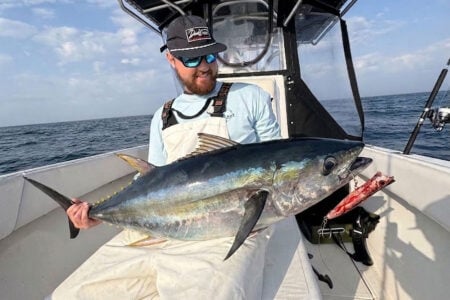
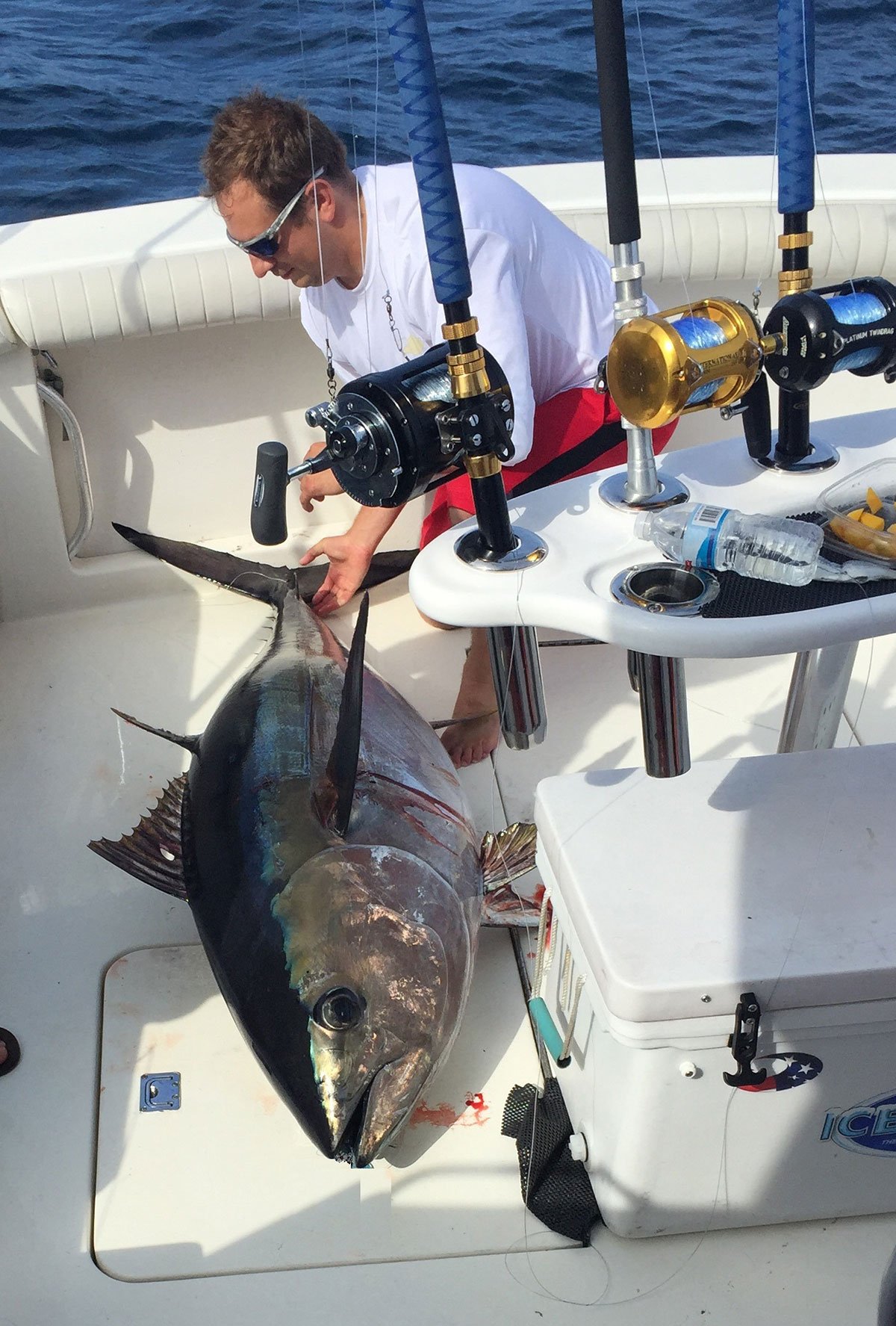
Tournament-proven tactics for targeting bigeye tuna.
If you’ve been around the offshore tournament circuit, you know Capt. Michael Yocco of the MJ’s Sportfishing team (mjssportfishing.com) is one of the captains who consistently has success targeting and catching bigeye tuna along the Northeast and Mid-Atlantic canyon grounds. I was lucky enough to get a few minutes with Yocco to gather some insight into his bigeye technique.
“When we mark bigeye, usually you will see them hang in wolfpacks of three to five fish, but there could be four or five pods in the area at any given time, totaling 20 to 30 fish in the area,” said Capt. Yocco, adding “They are deeper swimming fish that migrate vertically in the water columns, staying deep at 400 to 500 feet and more during the day, but coming up to within the top 100 feet of the water column when night falls.
“They come up at night to warm up their muscles, and also to feed on squid as they push up to the surface,” Yocco noted, while citing studies that show the average swimming depth of bigeye tuna in the Pacific Ocean is 400 meters or roughly 1,300 feet; whether that translates the same for Atlantic bigeye is up for debate. Eyeballs usually tend to stay on the canyon edges where 1000- to 6000-foot drops create upwelling conditions, but they will venture onto the flats at night in the 400- to 500-foot depths to chase squid and pin them to the surface in the shallower waters.
Dialing in the environmental conditions are of paramount importance to up your odds of finding fish. Bigeye season runs June to October, with optimal water temps at the lowest range of 65 degrees up to a high tolerance in the low 80s. “We’ve had them early as May 1 in the Norfolk Canyon and likewise in the Hudson during October where the water temperature hangs on to 65 degrees,” he said. Bigeye will follow the bait, as it’s mostly squid that they feed upon, along with tinker mackerel as well.
“Look for indicating factors such as working spreads over certain notches in certain canyons that will continually hold bait in pockets,” said Capt. Yocco, while adding “Pilot whales are a major tip off as to where eyeballs are hanging as the pilot whales are always feeding on squid, then you can mark the fish within the whale schools noting their depths.“
Yocco’s number one choices for bigeye tuna are bullet-headed, subsurface lures as they track straight in the water. Bullet lures can be rigged with or without ballyhoo. “We’ll take a Joe Shute or Ilander lure, 5 ounces and lighter, and rig a ballyhoo or an 8- to 10-inch Hogy tail on it. Then throw out other bullet trollers like Laceration Lure Bob’s Bullet or a 7Strand Green Machine, 8 to 10 inches long and 5 to 10 ounces so it tracks properly,” he advised
Ideal trolling speed is between 6 and 6.8 knots. Regarding colors, Yocco says, “During daytime go with darker colored lures for contrast like blue and purple combos or blue and crystal. Night trolling until 11 p.m. you still have the ambient light from the sunset as it usually sets around 9:30 p.m. during the heart of the summer in late June and early July. Night trolling we use a crystal skirt Joe Shute with a ballyhoo, or glo skirts or bullets with the glo resin in the heads.”
Yocco will also troll spreaders when trying to raise fish. “Spreader bars can be effective during the day, and we will implement them on the short riggers, usually with shell squids in green/yellow combos. That said, the most important squid in that spreader bar is the last one. We rig it 5 to 6 feet behind the rest and load the head with egg sinkers so it trails down and behind the rest of the bar, mimicking a wounded look. That extra weight in the squid also helps set the hook as bigeye will blow light baits clean out of the water, while that weighted squid will help sink the hook.”
The MJ’s crew has also jigged a few fish using 180- to 250-gram jigs, mainly during the morning and evening hours, but that is an uncommon occurrence. The crew was also able to not only raise a bigeye on a topwater popper in recent years, but had him hit and landed the fish. “It was a 170-pound bigeye that was hanging around pilot whales when it hit the wooden yellow popper.”
Tuck Yocco’s bigeye tips into your back pocket and see what the Atlantic canyons hold in store for you this season.