Taking a passion for fishing to the next level.
“Hold the rod at a 90-degree angle from the bow of the boat as you pedal,” said guide Dustin Stevens, as Bob and his 14-year-old daughter Melanie pedaled their kayaks, trolling tube and worm rigs across the sandy shallows toward a small boulder field in 17 feet of water. Bob and Melanie had agreed to get up early on this calm August morning, so Dustin had the time to introduce them to operating their kayaks and what he had planned for their 5-hour trip, before the morning sun was over the horizon.
Bob fished a few times each year and was hoping that fishing might become a shared activity with Melanie, who had never held a fishing rod before. “Your tubes are tipped with that juicy seaworm, so when we start to get over the boulders up ahead, everything with fins is going to be investigating your tube and worm. Try not to react to the first ‘tap-tap’ of a fish biting, but rather pause until you feel the weight of the fish, before setting the hook,” instructed Dustin.
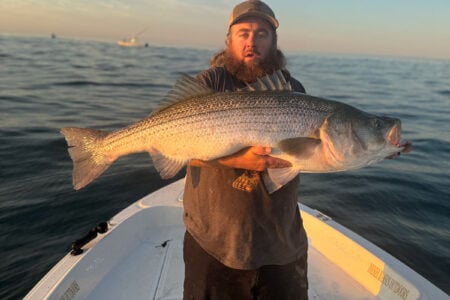
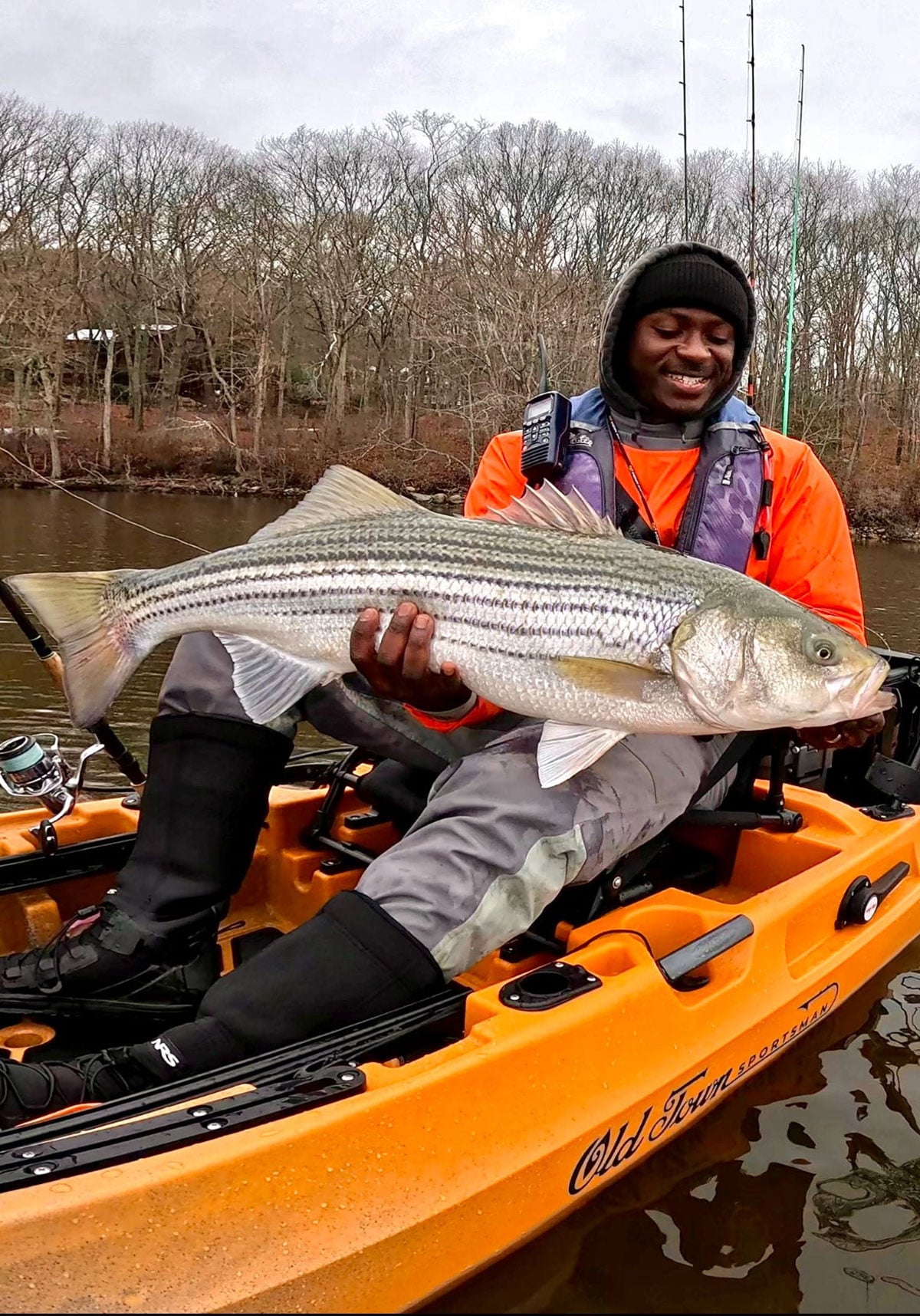
Muscle memory can be both an aid and an impediment to our reactions. Sure enough, as the sandy bottom gave way to the dark color of weed covered boulders, Bob felt the first tap of a fish on his worm, swung to set the hook and missed. In just a few seconds, he felt another tap, swung again and came up empty once more. Melanie held her rod as instructed while she watched her dad, then felt a “tap-tap” but kept pedaling. There was nothing, then her rod tip curved back, she felt the weight of the fish and set the hook. After a squeal of excitement, the kayak turning to face the fish and quite a few exclamations of, “I don’t think I can do this”, a 35-inch striper splashed alongside her kayak and into Dustin’s landing net. Everyone was very happy.
The Role of the Teacher
Whether coaching a successful college basketball team or teaching high school math students, those who coach and teach for a living share the ability to partially-understand and fully-respect what their players and students are thinking as they learn. A high school geometry teacher can’t help his or her students see how geometry gives a carpenter the math to design a complex staircase, unless the teacher can break geometry down into understandable and useful elements. Likewise, a college basketball coach can’t convey the power of gritty man-to-man defense, unless he or she can tap into the pride each player has, in their ability to shut down an opposing team. Who better to introduce young and old adults to the sport of kayak fishing than someone like Dustin who learned to fish, then specialize in kayak fishing, as an adult himself.
Though Dustin doesn’t think of himself as a “professor”, he finds it very satisfying to guide people who are new to kayak fishing, teaching them how to use their kayaks to catch a wide variety of gamefish and table-fish. A high percentage of Dustin’s clients eventually buy their own kayaks and often make return trips to fish with him, furthering the improvement of their skills.

Fishing Foundations
Dustin grew up in Georgia, focused on playing a number of sports in high school and college. He’d never spent much time on the water until he moved to Rhode Island and was invited to fish for largemouth bass and panfish, by two friends. Those first few trips had a significant impact on Dustin, so much so that he reorganized his life’s priorities to make time for fishing. Given that his priorities are his wife, children and his work with the airlines, the only “reasonable solution” was to reduce the amount of time he slept each night. Starting from shore, Dustin soon extended his range by purchasing a kayak and honing his skills along Rhody’s extensive shorelines, either at night when the kids were in bed, or preferentially at first light with the discipline to be back home in Warwick before their children got up in the morning.
At some point, the idea of using his kayak fishing skills to contribute to the family’s “bottom line” began to take root. He and his wife Jennifer, discussed how guiding could fit with their family life and compliment his work in the airline industry. He took a year to see if taking others fishing was a fit for him. It was and that was 6 years ago.

Immersive Angling
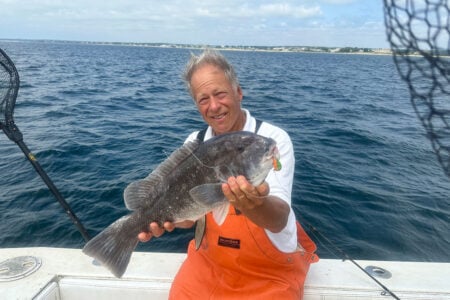
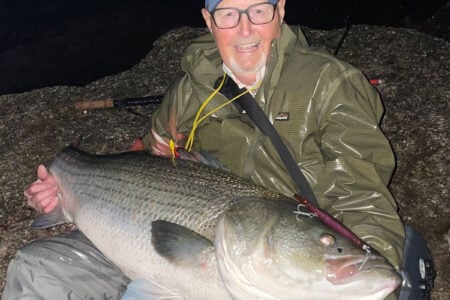
While many people do catch their “personal best” tautog or striped bass when fishing with him, Dustin’s focus is really on helping people get comfortable with using a kayak to catch more fish than they thought they were capable of. He really appreciates guiding people who are eager to learn how to kayak fish, in addition to having a fun day on the water. His current “charter boat fleet” consists of Old Town Autopilot motorized kayaks that are outfitted with user-friendly 7-inch Humminbird fish finders. Initially Dustin guided using pedal kayaks. As a member of the Old Town Pro Staff, Dustin finds that the Old Town motorized kayaks really allow his anglers to focus on their fishing. He can guide up to four anglers in a trip, but he greatly prefers to fish with just two, so he can give each angler more attention and help them improve their skills.
“I really like kayak fishing”, says Dustin, “because it is pretty affordable, you can access many different saltwater and freshwater spots, and it is “immersion fishing”. All of your senses are engaged when you are literally sitting on the water and immersed in your environment. You can see and hear signs of fish, that aren’t so obvious to guys fishing from a larger boat.”
Like most skillful fishermen, Dustin is very intentional about his time management. He plans and uses his time wisely, so as to maximize time on the water, fishing, observing and learning. His guiding season starts in March, fishing for trout and largemouth bass. In April, he begins fishing for striped bass and tautog, then larger stripers in May, bass, fluke and sea bass during the summer, albies and bonito in September, then migrating bass in October and tautog in November. He continues to fish during the winter for holdover stripers when the weather and his other responsibilities allow, though wintertime is largely devoted to his family, given he is on the water so much during the warmer months.

Learning to Learn
To become a more skillful fisherman, there is no substitute for time spent on the water. Whether guiding fellow anglers or fishing before he takes the kids to school, Dustin is on the water 5 to 6 days a week, March through early December. Many of us grew up reading The Fisherman Magazine, as well as every book and video we could get access to. Dustin has read quite a few pages of The Fisherman since he became smitten with fishing, but his primary means to become more skillful is to make time, to be sitting in his kayak, casting and trolling his way to more experience, regardless of the weather or conditions.
Coming to the sport of kayak fishing later in life than most of us, means that he has developed his own system for prospecting new fishing spots and dialing into what the feeding patterns are for the bass, blues, or bottom fish on that day. He likes to think of his approach as “systematic and simple”, which is based in large part on what he initially learned fishing freshwater with his friends Phil and Sam. “Freshwater fishermen rarely experience the surface feeding blitzes, diving birds and concentrated fishing fleet that are part of saltwater fishing”, says Dustin, “so they typically are very intentional about how they prospect for concentrations of largemouth bass and choose the best artificial to get the bite”.
Inspiration
Asked what his favorite type of fishing is, Dustin answers, “I love to fish live bunker in less than 10 feet of water and watch a big bass knock that bait into the air a couple of times before engulfing it in a huge swirl”. The Old Town kayaks can be outfitted with a small rectangular live-well and pump, capable of holding six to eight bunker, but most days Dustin and his clients are fishing with artificials. In addition to fishing the Butchie Built 24-inch tubes in red or black, Dustin’s “systematic and simple” approach also relies on Game On Duratech Eels (6-, 9- and 13-inch versions) and paddletails (3, 5 and 6 inches), as well as medium-sized (7-inch) flutter spoons and some topwater X-Walks or Doc plugs.
“Depending on what species my clients are interested in catching and where we have fished in the prior days, I have a repertoire of spots to investigate,” says Dustin. “I prefer to start a guided trip by trolling tube and worms at daylight, not only because it helps my anglers get used to the kayak and fishing gear, but equally important because it is very effective and it allows us to cover some ground as we look for concentrations of fish. Even if I am fishing by myself, I will most often begin my morning by trolling, whether a tube and worm, plug or paddletail.”

Familiar Themes
Like Old Saybrook’s Captain Mike Roy, with whom Dustin served on an expert panel this past February as part of George Poveromo’s Saltwater Sportsman National Seminar Series, Dustin typically fishes closer to home before venturing farther afield on a guided trip. Like Mike, Dustin finds this strategy offers much better time management and gives his clients more fishing time, in comparison to spending half of the 5-hour trip transiting to and from a distant location, in the hopes that the fishing might be better.
Many fishermen try to schedule their fishing during optimal conditions of wind, tide and daylight. While Dustin thinks of how each different species might react to a given day’s conditions, he feels that the most important strategy is to launch the kayak, then explore and experiment until you find the fish and understand their feeding pattern. When asked how he would handle striper fishing after three days of hard northwest wind that had blown the warmer water offshore, Dustin replies, “I’d start with a sense for where I and my buddies have been getting fish in the prior week as a base, then execute a searching mission, investigating more spots with different depths and bottom structure than I would normally do, until I begin to see a pattern that I can exploit. It’s the same approach that a largemouth bass tournament angler uses when he is dialing in his abilities on a new tournament lake.”
Disciplined, skillful recreational anglers and charter boat captains often keep a detailed logbook, making notes of the date, wind direction, tide stage, amount of sunlight etc., as well as fish landed. Dustin has devised his own method of recording daily environmental conditions and his fishing success. It might be called a “digital retrospective fishing log system”, though that is definitely too much of a mouthful. Dustin makes frequent use of the camera on his phone whether fishing by himself or with clients. His photos tell him what he caught where and when (because the time of the photo is noted). Understandably his photos are in chronological order. If he wants to take a look at the environmental conditions when he caught a mess of big tautog on April 17, 2024, he can scan through his photos till he finds those of where and when he caught those tautog, then go online and look up the tide, moon, wind direction and weather for that day. Very clever.
If you like learning and have a special interest in kayak fishing, you can’t go wrong fishing Rhode Island waters with the “Kayak Fishing Professor”, Dustin Stevens of Warwick, RI. You can contact Dustin through his website www.rikfa.com or by cell at 401-286-4152, give him a follow on Instagram @rikayakfishingadventures and @dustingoesfishing.