
The full history of braided fishing line can get a little muddled. While doing a little Googling, I found one blog site (tenkaraangler.com) in which the authors cite Dame Juliana Berners’ A Treatyse of Fysshynge Wyth an Angle from 1496 as describing “snooding (twisting) and knotting lengths of horsehair to form a fishing line,” while Izaak Walton’s Compleat Angler first published in 1653 noted how tapered horsehair lines were being employed.
For anglers who’ve been around awhile, the development of Dacron in the 1950s probably comes to mind first when the topic of polyester fibers in fishing line comes up. But without a doubt, the braid revolution really kicked off in the 1990s, with PowerPro becoming somewhat of a proprietary eponym (think Coke or Xerox as other examples).
I caught up with the founder of PowerPro, Konrad Krauland, while walking the ICAST show floor in July, and I asked him about the 30 or so years that have passed since PowerPro hit the market, and what those early days in the 90s were like. “When we introduced PowerPro we were clearly battling the lower cost monofilaments versus the super high price of braid,” said Krauland, adding “At first we were trying to just scratch that market, so we produced the lowest cost braids we could possibly do.”

Once lower cost braids were embraced in the market place, PowerPro began to improve upon the development process with release of the “super slick” version of PowerPro. “That took almost like 15 years before we had that level of sales,” Krauland noted in our conversation, then turning to discuss how that evolution brought us to be with PowerPro’s new Max 8 braid. Winner of Best New Line category at ICAST ’25, PowerPro Max 8 features an eight-carrier Spectra HT construction that cuts through current with ease for precise vertical jigging.
“Nowadays we are moving from the regular Spectra to this new HT Spectra, Spectra high tenacity they call it,” he explained, noting how the new HT is also represents a revolution of sorts in the braided arena, having taken place in the past 10 years to improve the strength of braid, going on to describe this next generation of PowerPro as maintaining high tensile strength with a 25% thinner diameter.
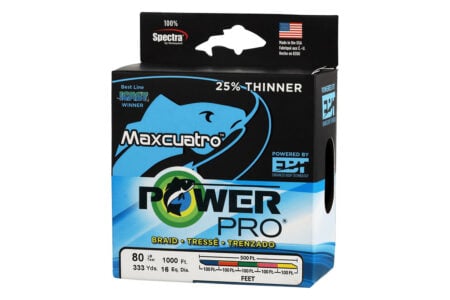
“What we’ve been able to create is this whole HT set of products that we market under the Max name,” said Krauland, adding “So we have Max Quatro which is Max 4, and now we have our new Max 8 which is a very smooth and slick product.” Using Enhanced Body Technology that infuses each fiber with resin, you get a rounder, smoother, and more durable braid with greater breaking strength in an even narrower diameter with 25% more capacity on the spool.
The eight-carrier Max 8 from PowerPro is available in white and four-color sized from 30-pound (comparable in diameter to 6-pound mono) on up to 100-pound (comparable to 18-pound mono). A 300-yard spool of 30-pound white will run you about $84.99, while offshore anglers looking to gear up for tuna will find a 300-yard spool of 100-pound PowerPro Max 8 in white going $109.99.
“I think that people that are not price sensitive and want to have the absolute apex of performance in their equipment, I think they will go to the HT product which is the crowning jewel of our fiber offerings,” Krauland added.
Check out our full interview with Konrad Krauland at TheFisherman.com.