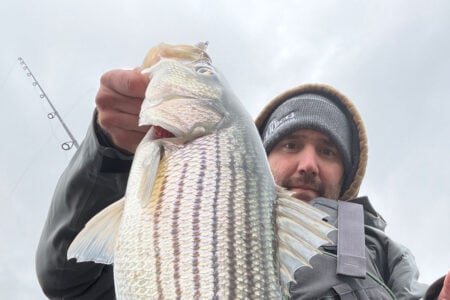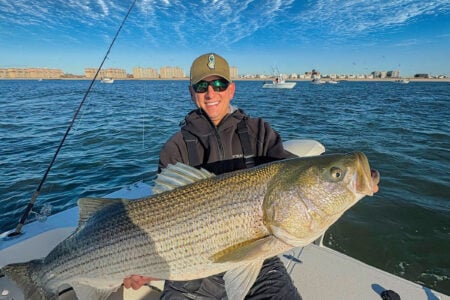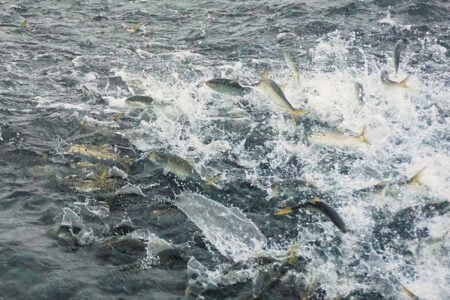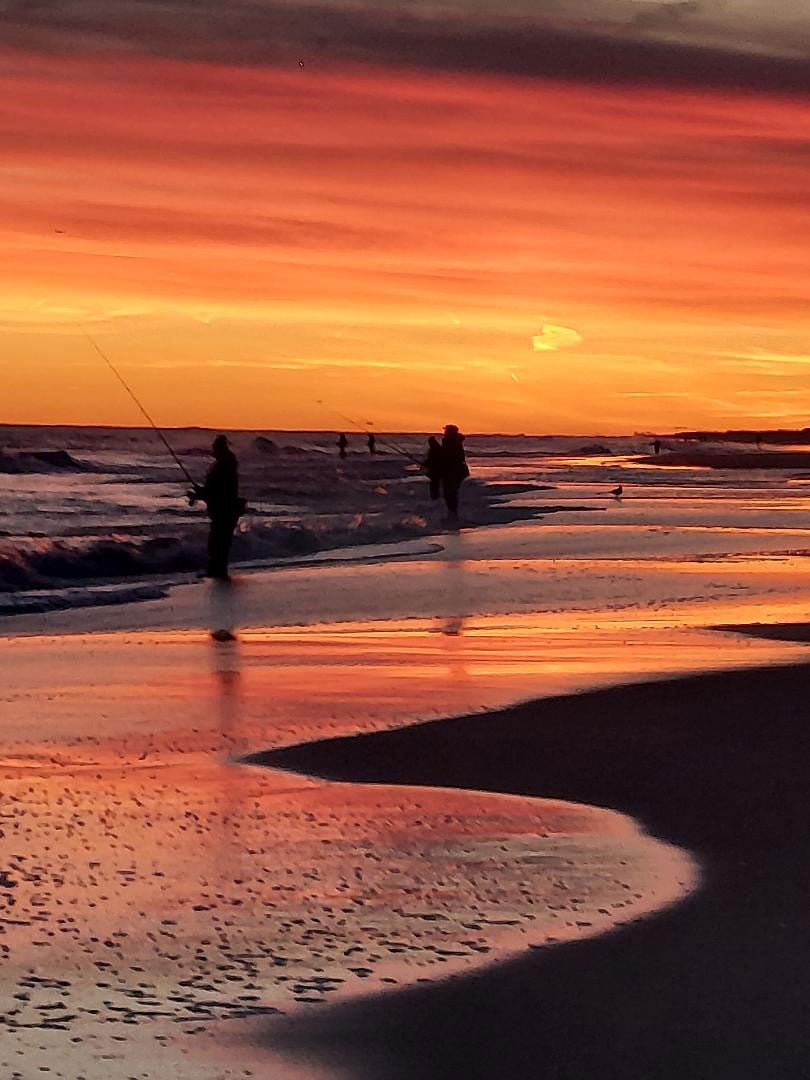
Shorter November days make low-light conditions increasingly important for successful striper fishing.
No news here. Every surf rat worth his or her salt understands that low light enhances surf fishing success. Of course, the absence of light at night is often even more helpful. However, the return of the stripers in the 1990s spoiled us. The striped bass population improved, the bluefish population remained large, and bait was plentiful. As a result, no matter where you fished—North Shore, South Shore, western Sound, or East End—daylight fishing was often very good.
Levels Of Low Light
In my mind, there are three different levels of low light. First is the twilight of sunrise and sunset, when there is no direct sunlight, just light bent around the earth by refraction, resulting in residual light in the sky. Second is sunlight blocked by cloud cover. Clouds reduce the amount of light, but more light reaches the surface compared to twilight.
Third is the almost total lack of light at night. There are nights of complete darkness, but also nights with moonlight and/or ambient light from streetlights, stores, homes, and businesses. I call this very dim light. All of our gamefish feed at night when bait supply, weather, and tidal conditions coincide, but they will also feed by day when bait is abundant and fish stocks are high.
Bait, And More Bait
An abundance of gamefish and bait can overcome the preference for low light because, quite simply, “they gotta eat.” Sand eels, bunker, anchovies, and mullet were plentiful in the 1990s and encouraged feeding during the day. When bait is abundant, gamefish don’t necessarily need to wait until darkness to feed.
When there are large numbers of gamefish, competition also forces fish out of their dim-light comfort zones and into daylight feeding. That’s why daylight surf fishing in the 1990s was so good. There were plenty of fish competing for plentiful food, and daytime opportunities were often excellent.
Three Parts
I divide each season into three parts because each segment is different, not only in weather patterns but also in bait abundance and seasonal conditions: spring, summer, and fall. Spring is usually dominated by sand eels that move inshore in dim light and at night. Summer is about peanut bunker, and when they’re plentiful, many small stripers feed throughout the 24-hour day.
Early fall offers a variety of baits, including peanut bunker and anchovies, while in late fall, sand eels move into the surf zone and join the bunker. By late fall, sand eels often dominate. Obviously, each of these autumn periods demands different lures and presentations, and understanding the available bait is an important part of success.
Things Keep Changing
One of the great truths on planet Earth is that things change constantly. For years, there might be an abundance of one type of bait and one or two species of gamefish, and then the ecosystem shifts into another gear. Some fish and bait become less abundant, while previously less common species increase sharply. Sometimes bait and gamefish decline at the same time, which is where we are now.
In the 1970s, weakfish dominated, and it was also the beginning of the giant bluefish bonanza. In the 1980s, it was giant blues, while the 1990s offered both blues and bass. As bait species and gamefish abundance change, so does the best time of day to catch them. What worked well during one period may not be as productive during another.
Make Adjustments
For decades, I’ve been touting the concept of adapting one’s techniques and behavior to maintain success during times of reduced abundance. I can’t say I’ve always followed my own advice, but I keep trying, and I get there eventually. Naturally, some folks don’t want to change, others do, and a few aren’t thrilled about it but adapt reluctantly. Human psychology is alive and well in fishing.
Although I love seasons with consistently good action, I also enjoy a challenge, so I’m not deterred when fishing slows. Instead, I look for ways to adapt by changing my normal routine. Sometimes that means fishing different tides or times of day, while other situations require a more significant adjustment.
The 1980s
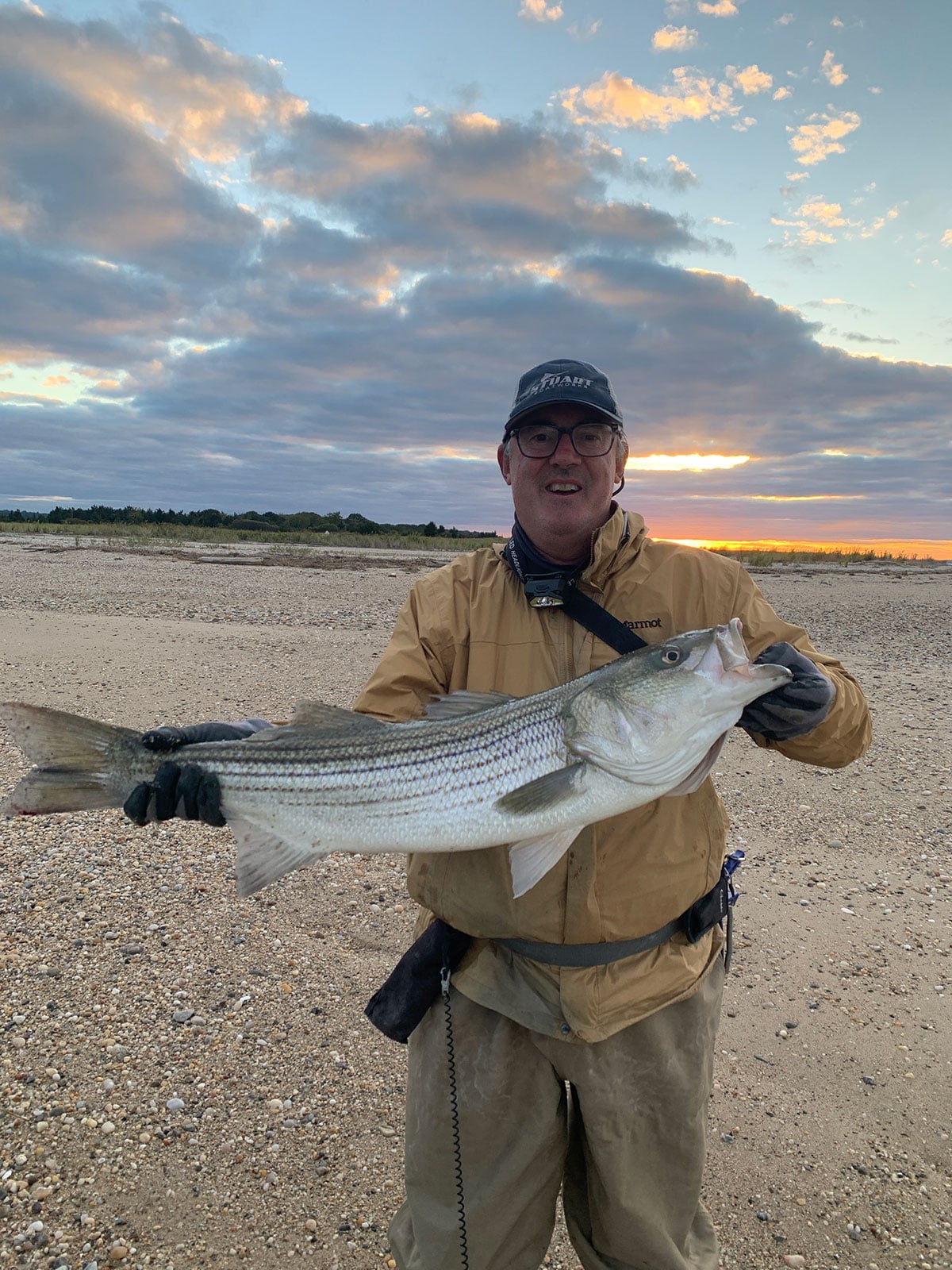
Although stripers were as rare as hen’s teeth during the 1980s, my friends and I caught big fish by targeting structure in inlets during moon tides, night after night. We paid a price through lost sleep, boredom, and exhaustion, all for the chance to hunt big stripers. There were plenty of long nights with little to show for our efforts.
During the 1980s, twilight didn’t help much in the search for stripers, but the very dim light of night eventually led to success. We learned that when fish were scarce, putting in the time under the right conditions was often the only way to connect with a quality bass.
The 1970s
When weakfish dominated in the 1970s, they often fed during daylight in the spring. However, by the end of May, the water warmed, and low-light conditions became best for catching weakfish. I caught very few weakfish during daylight or twilight throughout the warm-water months.
Weakfish were also rarely a target during the fall because fish four years old and older moved onto the continental shelf, while weakfish under four years old migrated south. Their seasonal movements and feeding patterns dictated when and where we fished for them.
Bluefish, Bluefish, Bluefish
As blues became bigger and more numerous throughout the 1970s and 1980s, daylight angling, especially under cloud cover, became increasingly successful. However, blues are notorious for low-light feeding, so even when daylight tides didn’t produce, they often suddenly appeared and attacked lures at sunset.
Daylight success was prompted by plentiful bait and hordes of competing bluefish. Today, fewer and smaller schools of blues and bait have reduced competition, allowing blues to favor low-light feeding. It’s another example of how changing abundance influences the most productive fishing hours.
It’s About Time, Doc
I know you’re thinking, what does all this have to do with 2026? Well, I’ve always believed we accomplish more if we come to the table with a little history under our belts. In what we know as time, there are three parts: past, present, and future. In this case, how can we succeed in the present without knowledge of past events and feeding patterns?
If we compare past information with present conditions, we’re better able to make good adjustments. If we fail to do this, we can lose perspective and become less successful. Understanding what has happened before helps us recognize when familiar patterns are changing.
The 2025 Fall Run
For example, in 2025, a guy new to surf fishing might approach me on the beach dragging a slot fish and proclaiming how great the striper fishing was. When I asked how many stripers he caught that day, he’d tell me it was his only one. Obviously, his perspective was based on recent experience, and he didn’t have much room for comparison.
If his next four or five trips were unproductive, he might decide fishing was terrible or that the season was over. On the other hand, if his database of experience stretched back further, he might have a better sliding scale of success and decide that one fish was better than none, while no fish might simply mean an off day.
Empty Beaches
Smaller fish generally provide more opportunities during daylight. The bigger they get, the more their shallow-water feeding is linked to low light. Smaller fish eat small bait and expend more energy per calorie consumed. As a result, they feed for longer periods, including during daylight tides.
In 2020, there were plenty of bass measuring 16 to 20 inches feeding by day along the beaches during the fall run, and the beaches were quite crowded. Catches of 50 stripers weren’t unusual. Success isn’t difficult during a time of plenty. In 2025, however, a catch of 50 stripers was a bonanza.
Reality In 2026
There were so many small bass in past decades that I delighted in daylight fishing. I admit that daytime angling is much more convenient, and the allure of numerous blitzes is powerful. However, reality dictates that bigger stripers and blues are often caught around sunrise and sunset, when light levels are reduced.
In 2024 and 2025, there were far fewer small bass following seven years of poor spawning success. It was time for a change, and anglers who continued relying on productive daylight patterns from previous seasons often found themselves struggling.
What Some Did
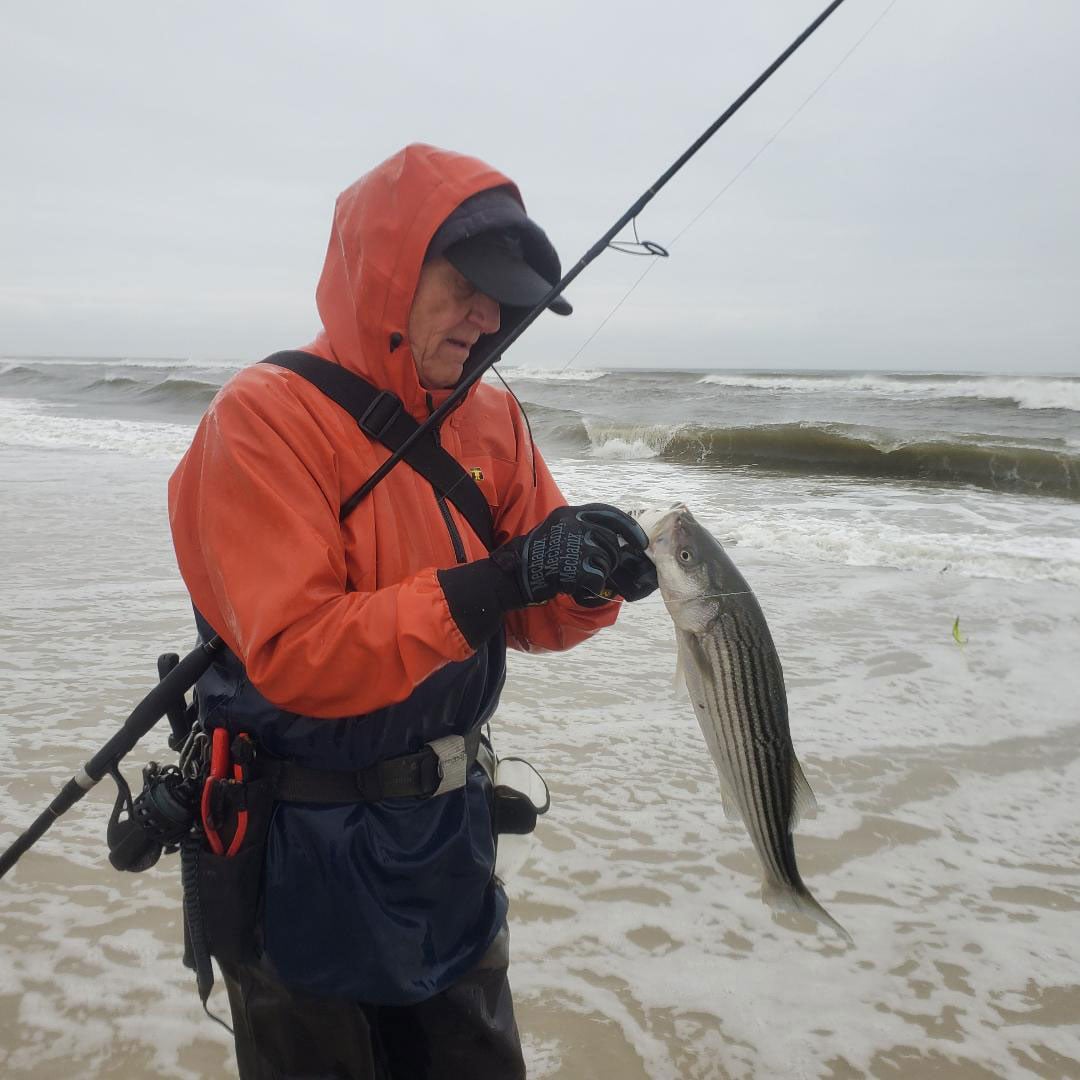
Anglers with a wider view and knowledge of recent fishing history began analyzing the reality of “now.” Serious surf rats put two and two together and realized that bluebird days were unlikely to be consistently successful. Knowing that night and twilight tides are usually better than daylight fishing, they adopted new strategies.
Some fished at night and eventually encountered runs of big fish that lasted several days. Those runs depended on a good supply of adult bunker or shad. No big bait, no run of fish. Many others preferred what they found to be more reliable twilight bites. They arrived before dawn and were gone by the time the sun rose above the horizon. Likewise, if they could, they’d return just before sunset. However, these productive windows were often short, rarely lasting more than an hour or so.
Why?
That begs the question: Why is low light often more productive than bright sunlight when bait isn’t very abundant? First, fish eyes are different from ours. They are flatter, they don’t have eyelids, and they can’t squint. Their eyes are designed to see well underwater and gather more light, which helps them feed in darkness. Bright sunlight can make them less comfortable in exposed areas.
In addition, from the time they were small, instinct drew them away from brightly lit areas because predators could more easily spot them. Those early instincts can become ingrained and persist as they grow, even though an osprey can’t lift a 20-inch bass out of the water.
Bluefish eyes are especially well-suited to low light. Stripers are coastal fish that evolved to feed in water that is often turbid, while blues are pelagic fish that need to detect predators and locate schools of bait at a distance. Look carefully at the eyes of both species, and you’ll see differences. Bluefish also seem better able to track an angler’s movements out of the water. That’s why, when an angler unhooks a bluefish, its eyes may follow the hand before it snaps at anything nearby.
The Fall Of 2025
In the fall of 2025, surf fishing trends changed from those of previous years. As is my habit, I returned to the South Shore for the fall run. There were plenty of bright, sunny days, and I picked away at a few stripers here and there. However, when I realized how important low light had become, I focused my trips on those conditions. In fact, my only really good days occurred under low light. The first was on a mostly cloudy afternoon when, as the sun fell below the horizon, a slow pick turned into every-cast fishing. The size of the fish increased as well.
The second occurred at dawn. I arrived at first light and bumped into an old fishing buddy who had been fishing since 4 a.m. He hadn’t had a hit. Then, in the dim light, the fish appeared, and we caught stripers one after another. Unfortunately, the sun was rising rather than setting, so the period of low light was short. Catching fish is always appreciated, but a longer bite would have been better.
The third event happened on a dark, cloudy day. The light was so dim that I struggled to see anything clearly in the distance. Peanut bunker and bass arrived a little after high tide, and the bite continued for several hours. Once again, reduced light played an important role in extending the feeding activity.
Decisions
The point of all this is that, for the best results over the decades, I’ve needed to shift my fishing hours from night to day to twilight. The recent trend toward a low-light bite has sunk in now, and it’s something I’ll continue to consider when planning future surf trips.
For the next few years, with bluefish and striper numbers down, and if bait schools remain smaller and fewer, twilight will grab much of my attention. However, I’ll remain vigilant because, sure as shootin’, there will be another shift in fishing based on weather and abundance. When that happens, I’ll need to adjust once again.