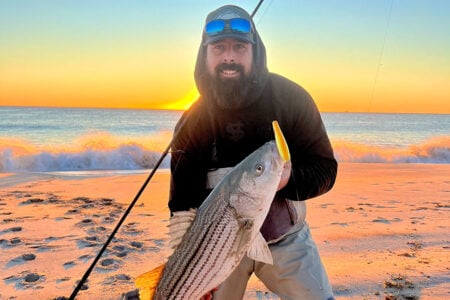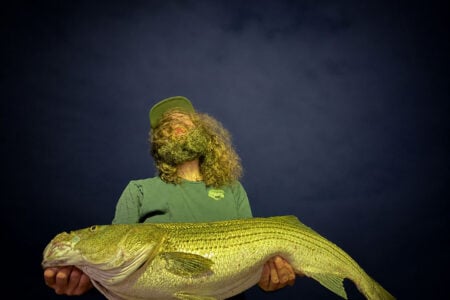
Heavy-headed soft plastics fill a special niche in the late-summer surf bag.
August is a weird month for surfcasters throughout the Northeast coastline; summer temperatures combined with longer nights, the threat of tropical weather, and of course there is the looming change to September when the fall run unofficially begins. Below the surface, striped bass are already feeling these changes and they are switching into a new mode: bulking up before the migration kicks into gear.
These facts may be amplified the further north you live or may be delayed if you live further to the south, but your personal geography has very little to do with the relevance of this story. The most important thing is that you realize that this change is going to happen and that you recognize it and take advantage of it.
There are many factors that can set it off, the main catalyst is usually a sudden injection of baitfish, they could be young-of-the-year herring, peanut bunker, mullet or something more exotic. But when that first rush of bigger, abundant baitfish spills onto the beach it usually doesn’t take long for some stripers to find it and that bite usually becomes a competitive hit in short order.
There is nothing that compares to a competitive bite, when a vast school of heavy striped bass clashes with a massive school of larger baitfish; it makes for a surfcasting dream scenario. The big difference between the final weeks of summer and the first weeks of the fall run is that in the summer most of this action happens under the cover of darkness.
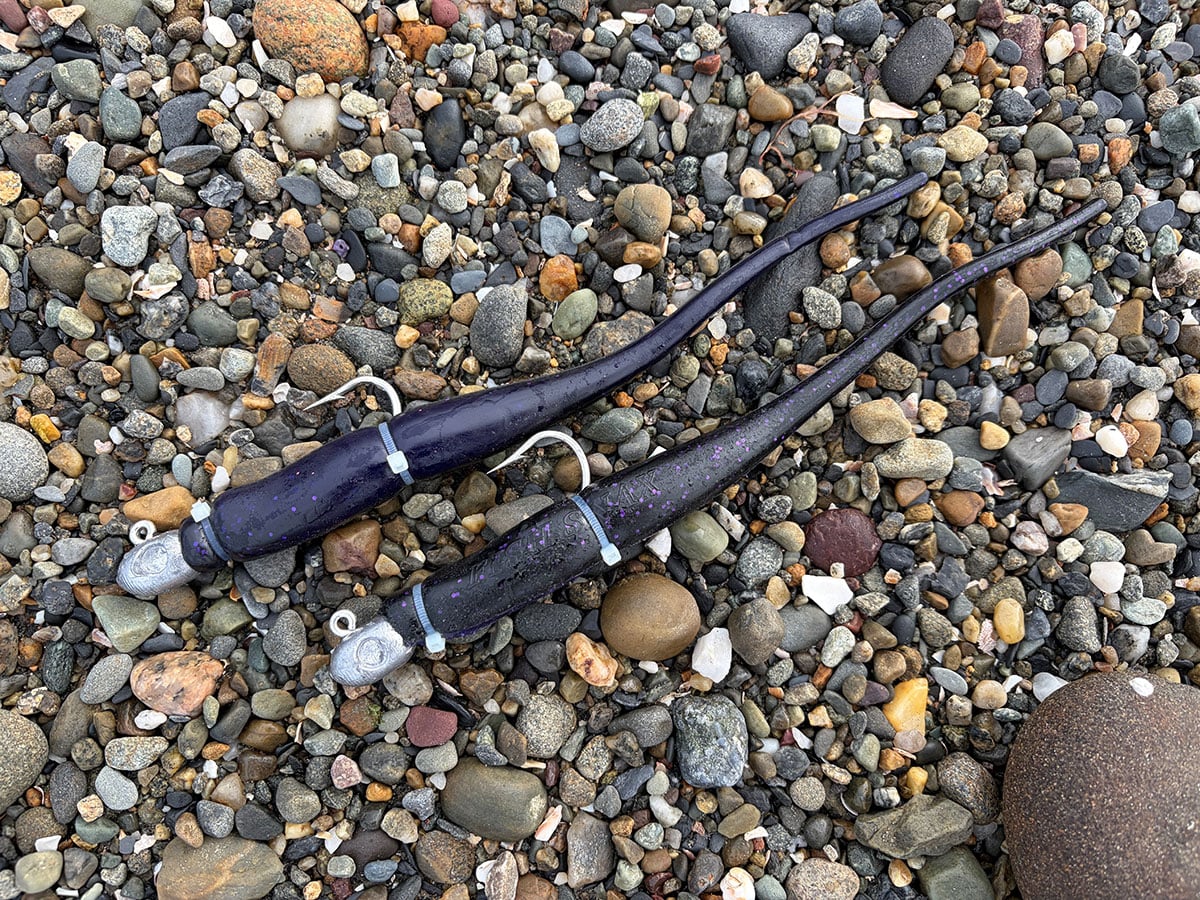
For me, there are two major considerations, (1) success in a competitive feeding scenario is often amplified by speed, and (2) a single hook lure is best for fast action because they facilitate a swifter release.
I’ve learned the lesson about the value of a fast retrieve probably hundreds of times in my life as a fisherman, but one that really sticks out happened about 15 years ago. After a cool and rainy week in mid-August, there was word that some mullet were leaving a large bay near my home. I started the night with ‘mullet-sized’ swimming plugs and I caught a few fish. But soon the repeated use of my headlamp attracted the attention of some nearby casters, so I had to “go dark”.
When I have to stop using my light, I reach for something with a single-hook, this time it was a black Mega Shad on a 1/2-ounce jighead. For whatever reason, the fish just didn’t want it. I tried all my usual tricks, straight and slow, deep and slow, intermittent twitches, bouncing bottom…etc. Nothing was getting more than an occasional bump. After thinking through my sequence, I realized that the swimmers ran pretty shallow and I hadn’t really covered the upper part of the column with the plastics. The only way to do this was to fish faster and it worked well for several casts in a row until my Mega Shad was snipped off at the hook by a bluefish.
Rummaging in my bag, the only other black Mega Shad I had was threaded onto a 2-ounce head. I clipped it on and started fishing it at warp speed just to keep it out of the shallow snags. You would have thought I had these fish hypnotized! Reeling so fast that I was breaking a sweat, I had fish on almost every cast for the remainder of the tide. And not a single snip from a bluefish! Best of all, I never had to use my light again! Two-ounces is a bit heavier than I’d typically suggest for this technique, I usually use 1 ounce or 1-1/2, but the example over-makes the point, and that’s why I used it.
When using this tactic, I stick to what I call “rat tail” baits. These baits are offered by a long list of makers from the popular Mega Shad and SuperSnax to garage-poured slayers like the Bag Man made by BigWater Baits. Their hydrodynamic shape makes it possible to streak them through the water without the resistance of a paddletail or an overly bulky body and their size is perfect for replicating a long list of surf zone baitfish species. I typically fish 9-inch baits in this manner but you can go larger or smaller, as needed, no surf bag should be without this style soft plastic.
These days, I always carry a few heavy-headed soft plastics in case I encounter that wild competitive bite. Could I fish a lighter head at these intense speeds? Yes. But the heavier head stays down in the surf, is harder to bring all the way to the surface where a lighter head might kick out and it forces the issue, because, if I slow down, that bait is going to drag bottom. These heavy-headed baits don’t get used every night or even every month, but when the bite calls for speed, there’s nothing that compares.