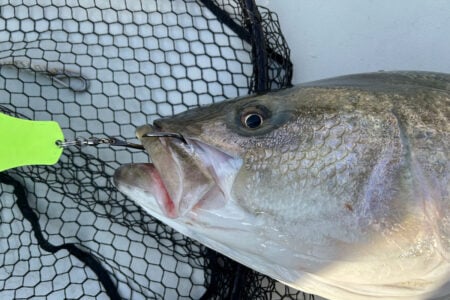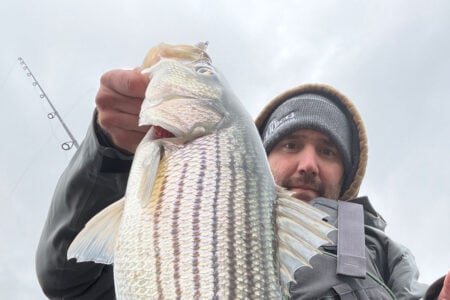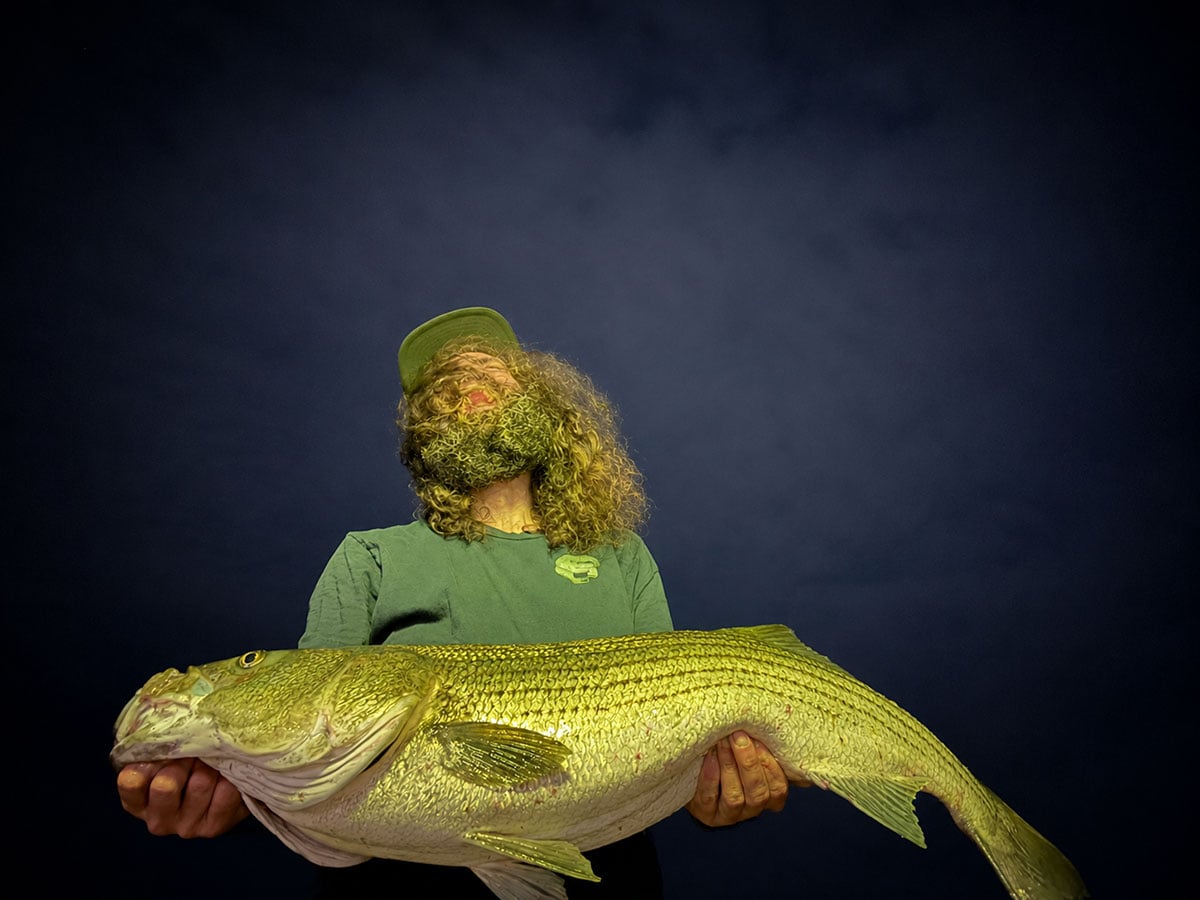
Striped bass are known to exploit shadow lines, here’s how to take advantage!
What if I told you that you can pull big striped bass on light tackle with large soft plastics right under the lights at your local dock or marina?
The thing I love most about striped bass is their versatility. They adapt to their surroundings remarkably well, allowing you to fish for them anywhere, from back bays and small estuaries to beach fronts, open water, and directly beneath your feet at local docks. There is nothing quite like wrestling a heavy fish out of tight spaces between dock pilings, sea walls, and boat hulls.
Your terminal gear is everything in this environment. Eight out of 10 times, a big fish will try to break you off on a piling, an anchor chain, a barnacle-encrusted concrete pier, or a boat motor. To give yourself a fighting chance, start with high-quality fluorocarbon leader material—I rely on Opsin Fluorocarbon for nasty structure. Pair that with a four-carrier braided main line, like 30-pound test Yo-Zuri Super Braid or original PowerPro. Four-carrier braids hold up better against abrasive structure than eight-carrier does.
For the rod, I prefer a medium-heavy setup like the Jigging World Onyx (1 to 4 ounce spin). It has a light, finesse feel with enough backbone to set the hook and keep large fish pinned up and out of the hazard zone. I match it with a Van Staal VR50. Its compact, lightweight, rugged, and packs plenty of winching power to turn a fish away from any kind of sticky or sharp obstacles.
Dock stripers are stealthy, and you will not have success if you stomp around the docks and blindly throw lures. When bass are keyed in on squid or other shallow water baits, you must use the shadow lines created by docks and boats. Squid have exceptional night vision and stay alert to their surroundings. The artificial lights attract small baitfish, the baitfish attract the squid, and the striped bass use the dark side of the shadow line to ambush them. You need to exploit that ambush point.
I prefer large soft plastics ranging from 9 to 14 inches. They match the profile of a squid and using soft plastics is far more cost-effective since you will inevitably lose some gear to the structure. These baits will typically be rigged weightless on a swimbait hook, either an Owner Beast or a BKK Titanrider, the weightlessness of the lure is key when making the finesse presentations required to fool these dock-dwelling apex predators.
Cast your plastic along the shadow line where the light meets the dark water. Marina depths vary widely – some spots are 10 feet deep while others drop to 50 – so use a countdown method to locate the bottom. Once your lure makes contact with the bottom, twitch the rod tip to make the plastic dart upward like a startled squid. From there, begin a slow, and I mean s-l-o-w, retrieve. An occasional twitch of the rod tip helps, but simply swimming the lure steadily along until it meets the point where the light meets the dark and bang you’re tight! That’s usually all it takes.
Once you hook up, all bets are off. I’ve had bass run 100 yards under boat slips and snap me off, never to be seen. Everything happens fast in close quarters, and mistakes happen. But sneaking around after hours and hooking large fish right under other people’s noses is the kind of stuff that gets me amped!
Beyond the action, paying close attention to fish behavior in real time will transform your success rate. Taking time to observe how the bait moves, how bass are reacting to the real thing versus your lure and all the other things happening in these illuminated ecosystems can teach you so much about how to get better at your craft. Write these observations down and study them all winter long.
Pay attention to the fine details: What are the fish actively eating? How are they reacting to your retrieve? When stripers turn into dedicated squid hounds, matching their behavior can be a hair-pulling experience. A lure that looks perfect to you might be completely ignored by the fish. Stock up on large soft plastics, hit your local marina (where permitted), keep your shadow off the water, and let the fish tell you what they want. And this game can be played all season long, from when the squid arrive in the spring, right through the fall run.