Optimizing your surf belt will pay off in more ways than you might expect.
I’ve always considered the plug that’s between you and a fish to be most important piece of gear at any given moment. Followed by your rod and reel and then, your belt. This is especially true if your plug bag(s) is a part of your belt system.
While a lot of a belt set-up is personal preference, I think we can all agree, it’s crucial to have it dependably, laid-out properly and tailored to the style of fishing you do. After all, it holds nearly 100% of everything we need on any given night and we don’t exactly have a console or leaning post storage like someone would on a boat.
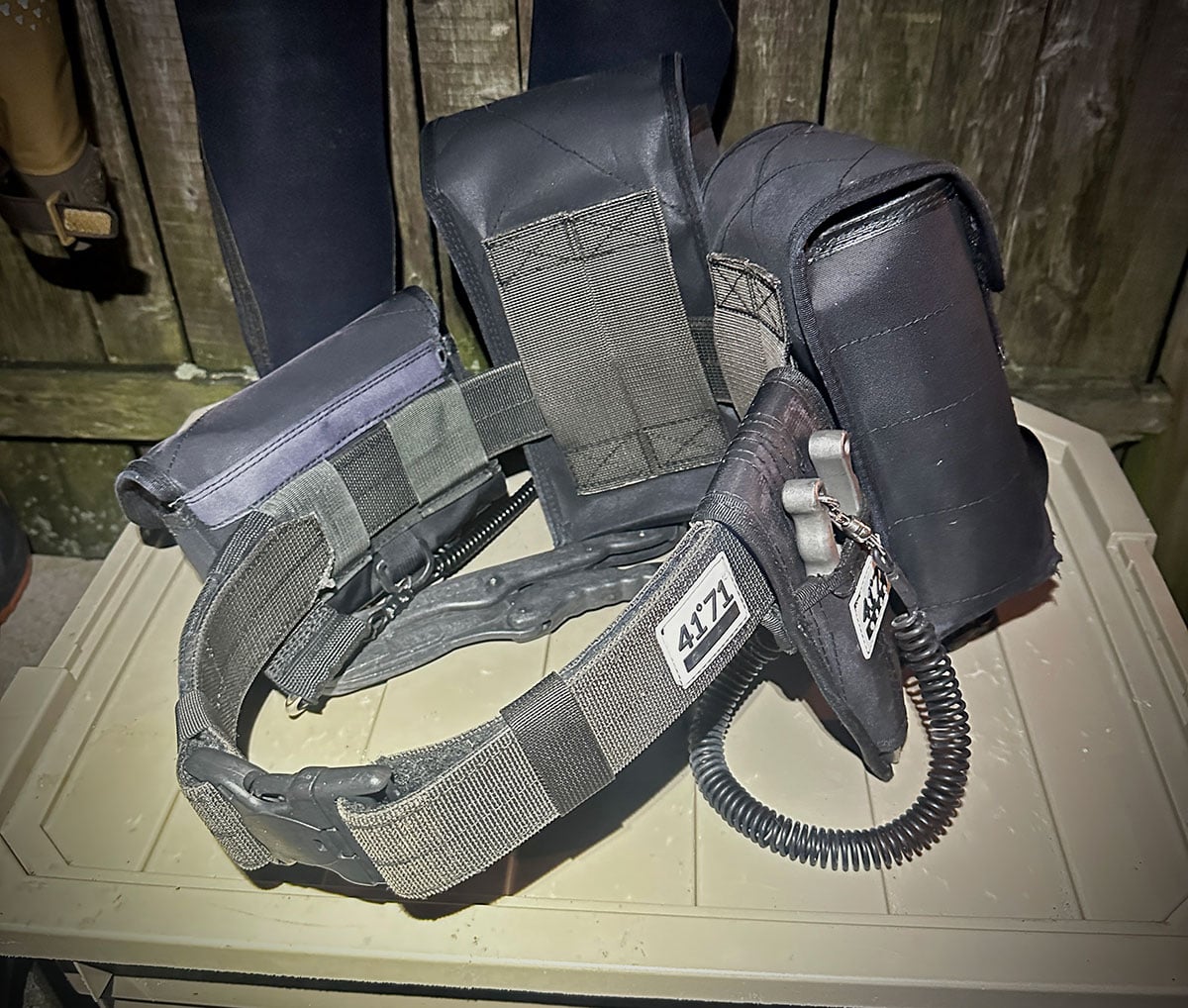
Like most, I carry the essentials, pliers, a knife, d-ring, Boga or some sort of grippers, a camera and most importantly, two bags that I alter according to my needs or where I’m fishing. Now, my setup isn’t for everyone and certainly nothing out of the ordinary, but maybe for the angler starting out or still not settled on a layout, this could shed some light.
With my belt buckle at twelve o’clock and working counterclockwise, my sheath and pliers are first and most easily accessed. Being left-handed, and lipping fish with my right hand, I can draw my pliers from their sheath the moment I see they’re needed. Never having to look down or feeling around for them, I can get a fish, unbuttoned and pliers back before the release, without fail.

Continuing counterclockwise, are my plug bag(s). Since I’ve never been a fan of casting with a plug bag over my shoulder and having to constantly push it back at the end of every cast, I experimented with mounting them to my belt long ago. A single three or four-tube was a burden as it was either too wide and wouldn’t bend to the contour of my waist or a “cube-style” bag simply stuck out far and was often hit by my elbow. I then tried a two-tube set up and found it worked perfectly. With one right behind the other, this gave me all the storage of a four-tube shoulder bag but at my waist.
Like most, the contents of my bags vary but for obvious reasons, I keep my most used plugs in the first tube working my way back to my least used. All properly hanging in their appointed tube and organized before each night out thus eliminating having to deal with a mess in the dark or during a good bite.
Both bags have not one, but two vertical belt straps, neither are loops as I believe loops cause them to sag (especially when wet) and I wanted them flushed to my waistline. Although both bags have Velcro, as a failsafe I have two clips to prevent them from opening during a short swim and or in a swell; it provides peace of mind. Rather than a leader wallet, I opt for a zip lock style bag for leaders which is neatly tucked behind the first two tubes for access.
Moving on, behind the two plug bags and now where my back is I keep a horizontal, double-looped bag for a camera in a dry case. This is also attached with clips and a lanyard to a dry case. I also keep a few back up AAA batteries in there for neck lights. If you don’t have a small dry case, a food vacuum sealer can seal anything you might want to carry but that you’re afraid might get wet. Also in there are a few sealed bug repellent wipes, which have come in handy on some calm nights.
Positioned at four o’clock is my water bottle holder. This is for nights where I’m going to be far away from where I started. Guzzling a Gatorade before you head out isn’t helpful hours later, I’ve tried. Second to last, a D-ring which serves as a tether for grips and a rod holder. Be it, a Boga or plastic grips, something easily accessible for fish handling is critical. While I prefer to “thumb” my fish, there’s nights where I’m just too tired and or my reaction time is off. Therefore, I opt for using grips rather than find myself hopelessly attached to a thrashing fish.
Lastly, at 1 o’clock, a knife, and although mine isn’t currently on my belt… and fortunately, I’ve never needed it in an emergency, we can all agree, it’s wise to have it almost front and center. While I prefer a sturdy three point of contact buck and many others opt for a dive style, make sure if you’re considering a similar setup to use a quality stiff webbing for the sheath that won’t fold over.
Almost nothing we use in the surf is inexpensive thus, if it is removable from your belt, have a good lanyard on it. While I prefer old school coiled lanyards, there’s a ton of options available today. Anything with a coiled lanyard gets a swivel, to avoid any twisting whilst keeping it condensed. In many ways, your belt is your lifeline and it pays to set it up properly.