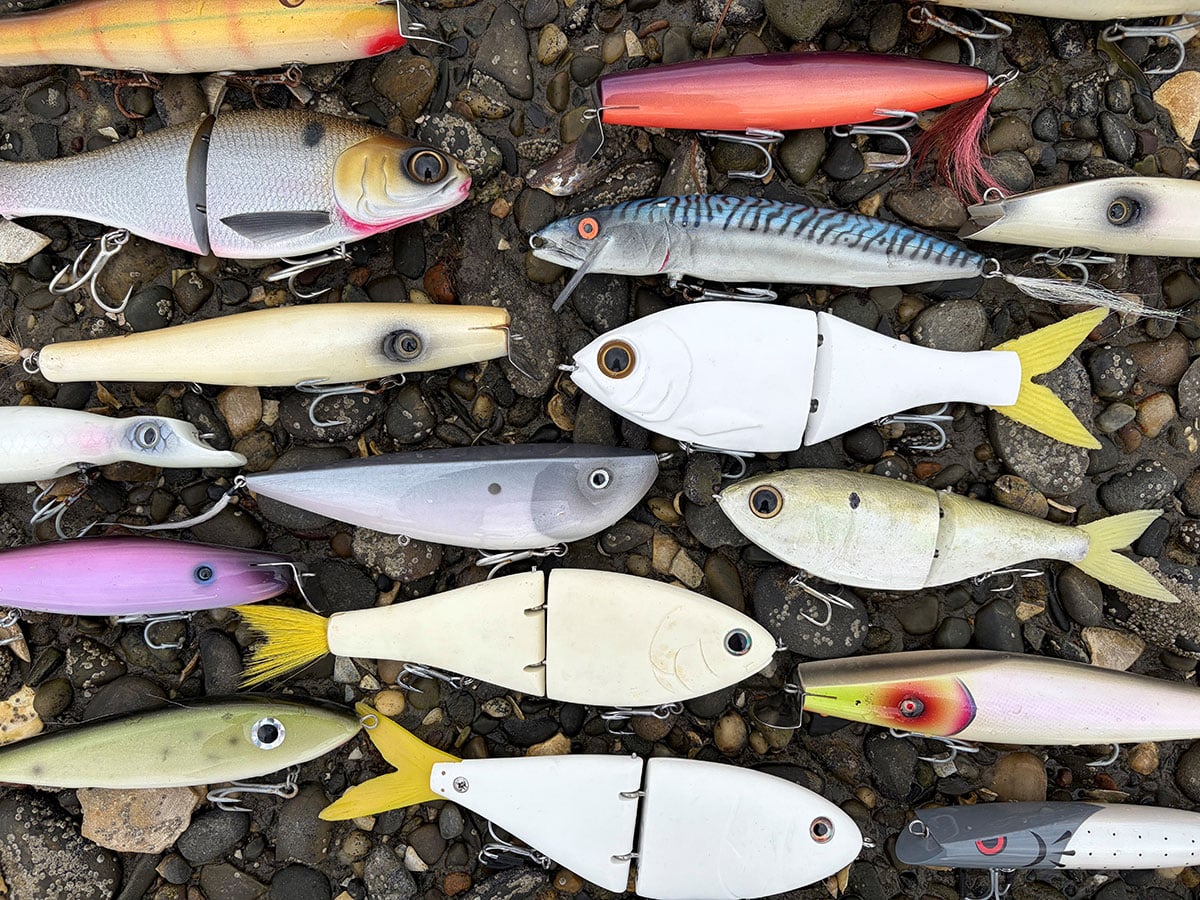
The justification of the expense comes from the precautions you take to protect your investment.
I know how much it hurts to shell out $60, $70, $80 or even over $100 (I’ve even shelled out more than $150) for one bait. We can analyze my particular type of psychosis at a later time, but the fact remains I have paid my dues in the world of expensive baits and I can sympathize with the pain that comes from dropping that kind of dough. Sadly, I can also sympathize with the pain of watching one of these lures snap off on the cast or hang up in some deep rockpile, never to be seen again.
At surface level, it is an irrefutable fact; an angler does NOT need to pay this kind of money to catch stripers, bluefin tuna, largemouth bass… or any other species of fresh or saltwater fish. And there are many reasons why we have slowly advanced to this point where it’s not uncommon for custom striper lures to eclipse $100 per bait, and not even unheard of for certain types of striper lures to exceed $150. In the largemouth bass arena, it’s commonplace that custom lures exceed $200 and some of these baits are soft plastics! It’s hard to figure, but it’s a fact.
One of the big reasons why we’ve come to this point is influence. Everyday anglers and well-known pros are finding an avenue through which they might become “YouTube Famous” and suddenly, they find themselves wielding the wand of influence. Their subscribers and fans want to use what they see them having success with, and these captive audiences have proven, that they will pay a premium to acquire these things.
On the other side of this seesaw is the builder. Many of the best baits and plugs are made by well-known anglers who have a track record of success in their species or angling discipline of choice, the assumption is that these people have an eye for making lures that will catch fish, and most of the time, this seems to pan out. And as material costs continue to rise, as the durability and aesthetic expectations of the consumer evolve to expect more from the builder and as the construction of things like glide baits becomes more and more complicated, the price keeps going up.
This has fostered a separate lane, of sorts, where anglers buy certain plugs just to have them. I’ve heard it hundreds of times, a group of surfmen talking about Franktown Slims or Voorhies Trollers or whatever plug is going viral at that moment, and someone will inevitably interject, “I have six of those.” It’s very telling when that same person doesn’t have anything to add when the conversation moves on to the subject of actually fishing them.
I get it, I do. These plugs can be hard to get, and their cost is often enough for the average plug-buyer to think twice about throwing them into the type of area where they might get eaten by a giant bass or they might hang up and be lost. It’s a strange conundrum that I believe has only existed in our sport for the last 10 to 15 years, as plug prices have risen.
I look at it differently, and I would urge you to follow my lead on this. I let the rising cost of plugs be my failsafe. When I stand at the edge of a boiling rip or ready a cast destined for a boulder field blanketed with white water, the cost of the plug and the likelihood of losing it are a big part of the reason why I’m religious about every detail. I check my leader incessantly, and closely inspect my braid after a tough battle, cutting two rod lengths of line off my spool every time I find a fray. I scrutinize my snaps constantly. I re-tie any knot that doesn’t cinch how I want it to. I do all this because I can control these things and I can dramatically reduce the instance of failure that might cost me that plug, or worse, that plug and a big fish!
And this naturally progresses to keeping the plug in top shape. I check my hooks and splits, and also keep an eye on the swivels inside the plug – if they ‘oval out’ I rewire the plug with new swivels. If the hooks are dulled or rusted, I change them out and I make sure there’s a dangerously sharp point on each tine of every treble I replace. I figure, if I’m going to spend all this money, I’m going to do everything I can to protect that investment and I’m going to make darn sure, that the bait is in top working order so that I don’t lose the kind of fish that would help me justify dropping the cash in the first place.
And once these things become a habit, you’ll be better prepared for that next giant, whether it eats your $130 custom glide bait or an $18 plastic swimmer.