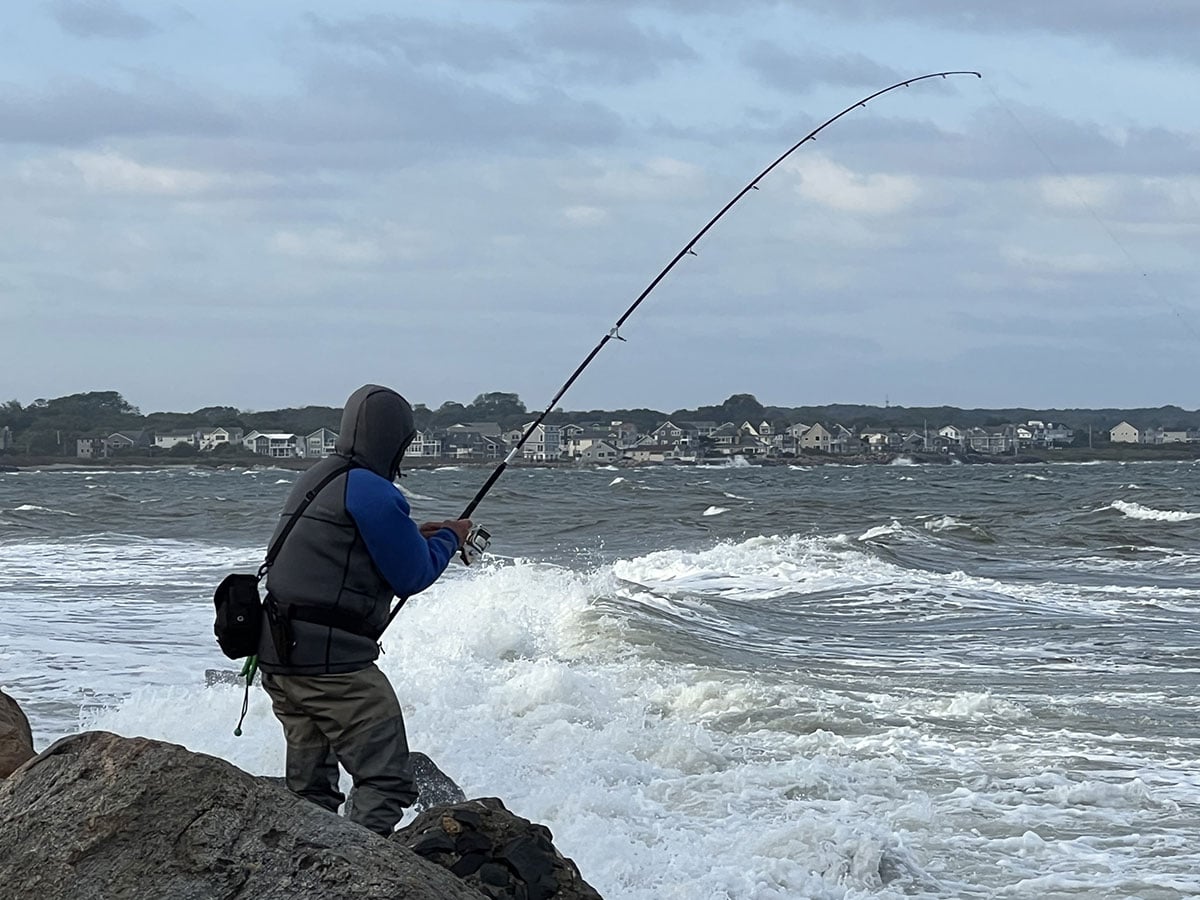
Connecting the dots between spots and conditions will put you in the best position for consistent surf success.
Most good surf spots are well known these days. Many of these highly-productive locations are highlighted in reports and social media. Yet, these great spots don’t always produce. When you read they are crushing fish in a location one day, it certainly doesn’t mean the fish will still be there days later. That’s because it is often the conditions and not necessarily the spot that makes or breaks these hotspots.
Every productive spot along the Striper Coast has its ideal time or conditions to produce. A lot of factors are at play. Tide, wind, surf conditions, moon phase, water temperature and the all-important ‘bait situation’, these all play some role in determining the prime time to fish. Experience also plays a big role in knowing the best conditions and matching it to the place you intend to fish.
This spring I was into an incredible run of large stripers in one of my spring hotspots. For three days I fished what I considered ideal conditions with a blistering southwest wind right in my face that drove rough but clean white water ashore. Few surfcasters were in on it at first but by the fourth evening, the place was loaded by an army of surfcasters that found out about it through social media and word of mouth. But, by the fourth night, the wind had shifted to light northwest which was at our backs in this spot, the ocean turned calm as a freshwater pond, and the fishing completely died. Looking back at my logs, I knew the right conditions almost guaranteed action in this location, while the wrong conditions meant poor fishing.
I keep a log of all my surf fishing adventures. In the log I note tide, wind and surf conditions. After years of doing this and collecting this data, I can see patterns that develop, and that’s how I know when to fish many different locations. If you don’t keep a log, make a mental note of when and why some areas produce.
Spring and fall bring migrations of striped bass. Because of this, there are certain areas that are great spring spots, but don’t fish so well in the fall. Other areas produce better in the fall. Most experienced fishermen will tell you that summer fishing involves catching resident fish. Even though the hotspots may change with each season, the same best conditions will deliver the best fishing.
I’m constantly on the lookout for moving water, as that condition brings the best shot at catching stripers. Stripers love to search for food in moving and rough water. Various factors can cause moving water, but your best chances at finding the best water from shore come from wind and tide. Wind often plays a critical role in determining where I plan to fish. A strong onshore wind in your face brings rough water to your feet. Stripers often ‘turn on’ in wind-driven whitewater that moves. Casting may be limited in a big blow, but fish are often right close to shore playing in the surf. Be aware, though, that some spots may weed up in sustained onshore winds. Best to hit these spots in the beginning of the blow. Some places might even be good with a wind at your back. You’ll only find that out with experience.
Tide is another important aspect. Every spot has its ideal tide. Tide can also move the water and it really shows up in places of flowing water like outflows or breachways. Here, you don’t need wind to push the water out and move it. Many surfcasters make a living during the dropping tides along outflows where moving water often dumps bait out to stripers who wait at the mouth to ambush their next meal. Mix that outflow current with rough water out front and you’ve got a great combination for success at any time of the year. In addition, realize those moon tides (new and full) will set up an increased exchange of water that always works to the surfcaster’s advantage. Note that inlets and breachways can also work in reverse with incoming water sometimes producing great action in the backwaters.
While we know conditions are a key factor in most good spots, big amounts of bait can override all these conditions. When there is a lot of bait around as we often see in the fall, it can deliver great fishing in calm or rough water, low or high tide, wind or no wind. So, the lesson here is that while most fishermen key on certain spots to fish, they should probably be focusing on the right conditions. The right conditions can light up any location regardless if it is a known hotspot or not. And, of course, always be on the lookout for bait.