Timestamped logging can reveal windows of magic.
If you want to truly own a striper spot, you have to be paying attention to more than just the tide and current direction. These factors are simply the baseline. To stop at this level, and say, for example, that a spot is “just” a flood spot, or it’s “good” when the current is moving right to left, is just not enough. It will get you fish, maybe even a lot of fish once in a while, but you can be a lot more consistent, on big fish specifically, if you go at least one step further.
There are two things I do constantly while fishing: check my watch and talk to myself. Please don’t let the second fact influence your buy-in of the first! I have found that, by tracking the tide or current phase almost to the minute, I have been able to identify numerous windows within the same tide or current direction that differentially produce larger or smaller fish. It isn’t just about identifying slack or current peak either, as often gets passed around the internet. All of my best windows are mid-tide or outside of slack! Meticulously tracking time as the current and/or tide progresses can reveal exactly when your spot will reach its highest potential.
If you take nothing else away from this, just know that you should be noting the precise times that you’re catching fish. At first, it might seem like they’re coming in a few hour span, but if you carefully collect that data over time, you might find that there’s more to it. Case in point: I have a spot that I just thought produced for 2.5 hours equally. But as the seasons went on I realized that, while it can produce at any time, on slower nights the biggest fish always came in a small, 15-minute window two-thirds of the way into the tide. Tracking the time is not a complicated thing to do, and doesn’t require much work. Just glance at your watch to note when a bite starts, or the biggest fish comes, or the bite dies, etc. and log it later. Then, go to the next step; what happens environmentally during that exact time? What’s the depth, speed, and direction of movement of water? Why are the fish suddenly showing, in numbers or size? If you can determine that, you can really “drill down” on your spot, and – suddenly – big fish windows appear like magic.
These findings may also influence other spots. For example, if you realize a reliable bite has to do with the depth over a bar at spot A, you can extrapolate that to another bar at spot B. You cannot be afraid to make this complicated either. There is no such thing as keeping too close track. I realize that much of what is being shared online these days is dismissive of angling being complicated, but if you want to be good, and you want to catch large fish, you can’t possibly have enough data or document enough details.
Let me give a real example: at said spot, I need a dropping tide, but there must also be current. During most of the moon phase, this typically starts in the first 75 to 80 minutes. But, it’ll get compressed during moon tides or by certain wind directions/velocities (possibly starting at 60 minutes), and stretched during the worst of the neap tides (sometimes holding out as long as 105 minutes!) I have to account for all this, or miss the first window. It took me two seasons to feel confident I had this locked down. That first window can be really good for a quick blast of numbers, though generally nothing huge; but I remain committed to changing that stat.
From there, the next 2 hours are pretty steady, but the current builds so I have to keep track of the time on my watch and make sure I’m really staying in touch with my offerings. It often requires moving from slow-sinking plugs I swing at hour one, to plugs that dig and hold by hour three. Then, there is a surge that happens around 3 hours that coincides with a larger change in pattern happening in the general area. This is short, about 20 minutes, but it is what I consider the first real big fish window. I keep close track of that, because I want to make sure I’m triply focused if I’ve become complacent due to lack of action. The current then dramatically falls off, but doesn’t stop, and that last 30 minutes is time for me to just contemplate the world and maybe test swim plugs because the vast majority of nights I won’t even get a hit.
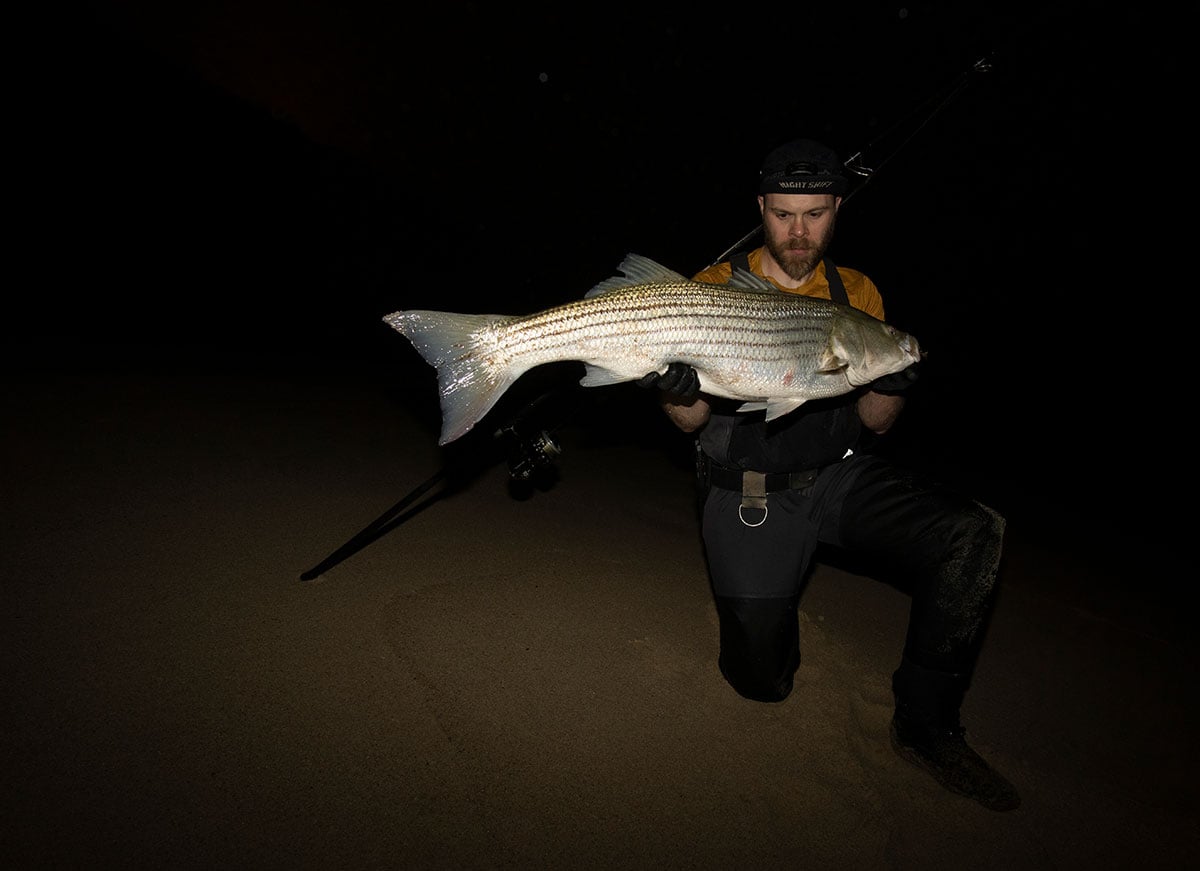
Then, the glory window comes. It’s no more than 8 to 15 minutes in length, and during moon tides it compresses to perhaps 3 minutes! Can you say plug choice anxiety? My theory is that as the tide nears dead low, big fish move. And as they move, they slide through the spot between positions along the shore. While the early stages might produce 15- to 30-pound fish, this small window has given me fish to 45 pounds. It’s a small window that doesn’t coincide with the tide switch or current cessation, and it took me several seasons to confidently pattern it down to the minute, based on tide, moon, wind, and any storm surges. But it was worth the vigilance. With all I do – with all we do – to try and catch these fish, keeping track of time on the clock seems a pretty low hurdle to jump.