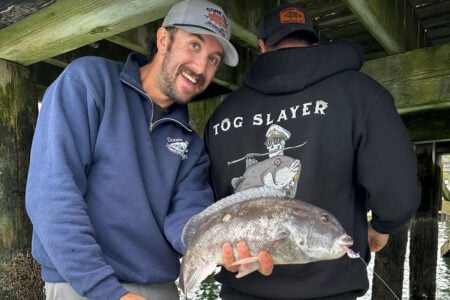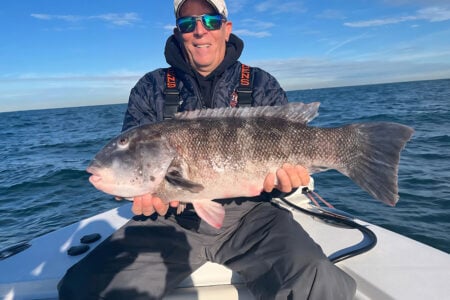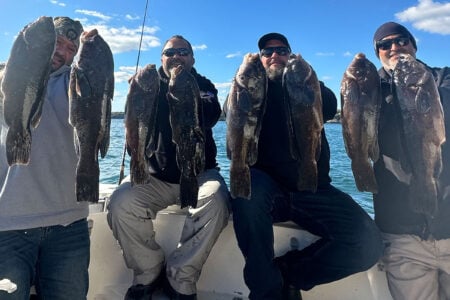
Don’t wait until October, September produces some of the best bites of the season!
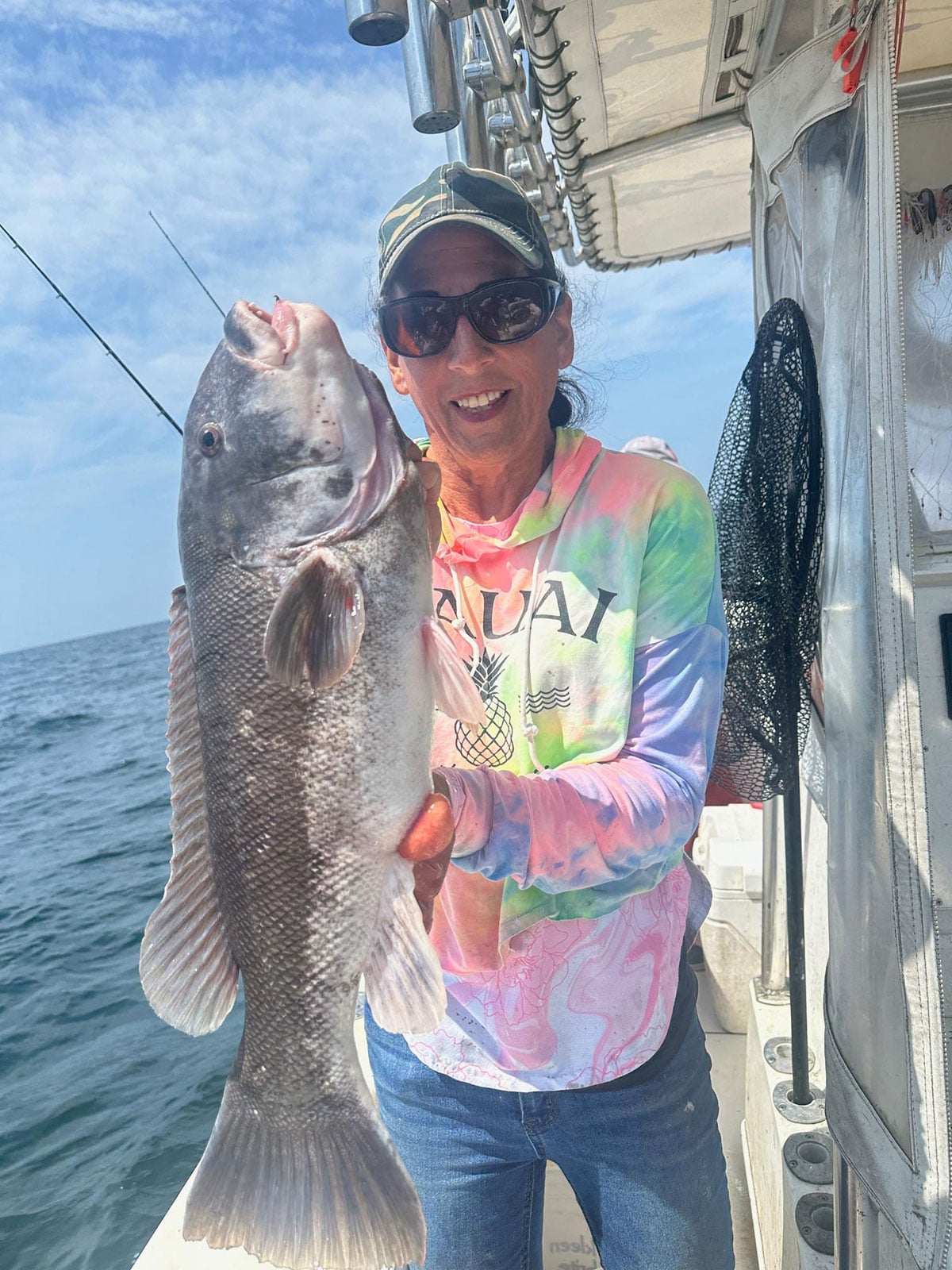
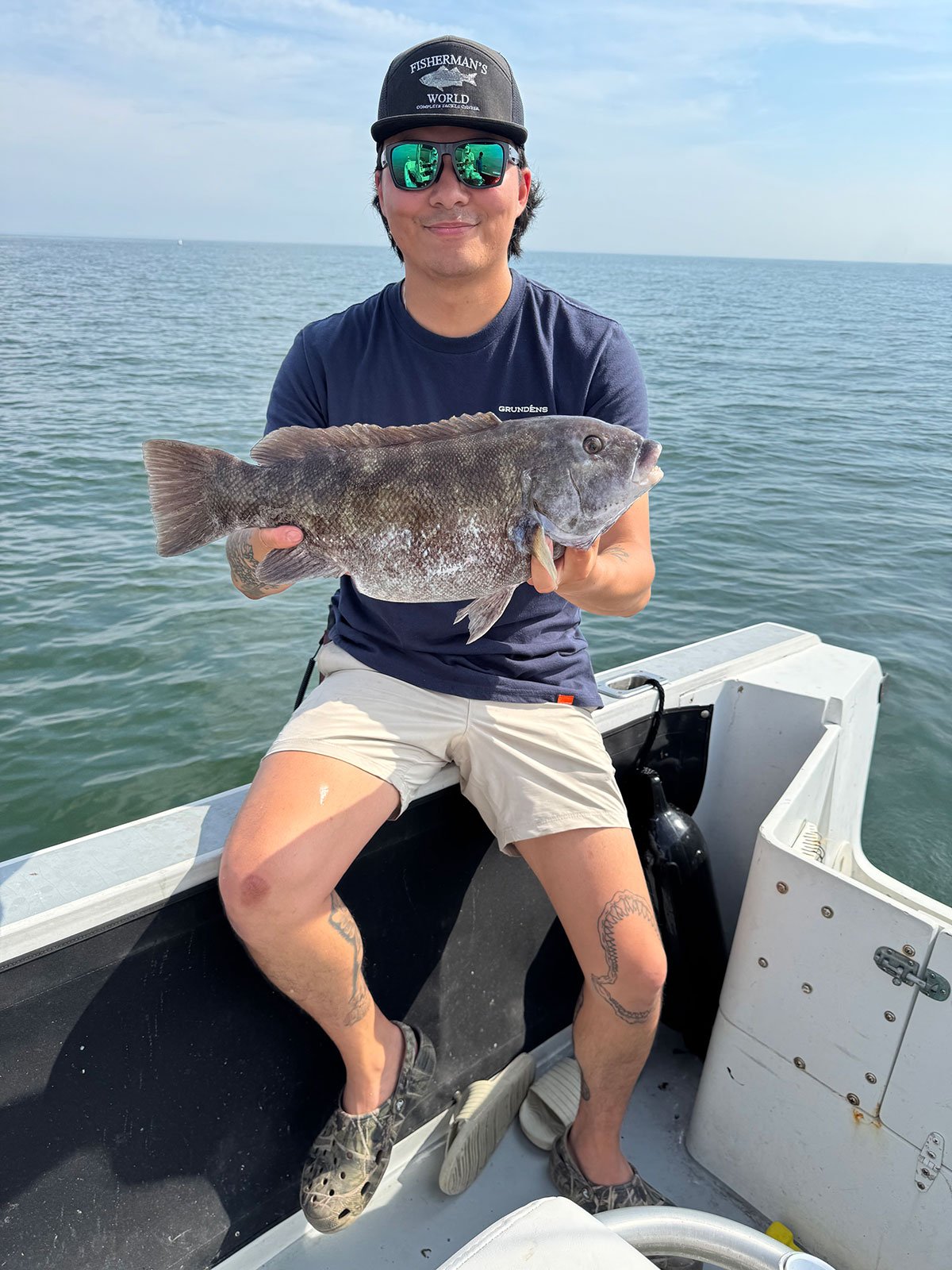
It’s funny how things work out! Editor, Dave Anderson texted me on August 12th that he needed an article about “September Blackfish” to replace a tuna article after the bluefin closure. That very day, Jessica, who is a regular aboard my charter boat Little Sister, got her limit of tog by fishing for sea bass with green crabs instead of the clams we always use (she easily got her sea bass limit too!)
I try to have crabs onboard as much as possible over the summer but the desire for blackfish is pretty low in June and July when the limit is only one per person. However, all bets are off come August! The fact is, there are resident tog on a good percentage of my sea bass spots (many of my sea bass spots over the summer are also my tog spots in the fall) most of the time. Knowing that, it’s simply a matter of fishing for them.
Cool Concentration
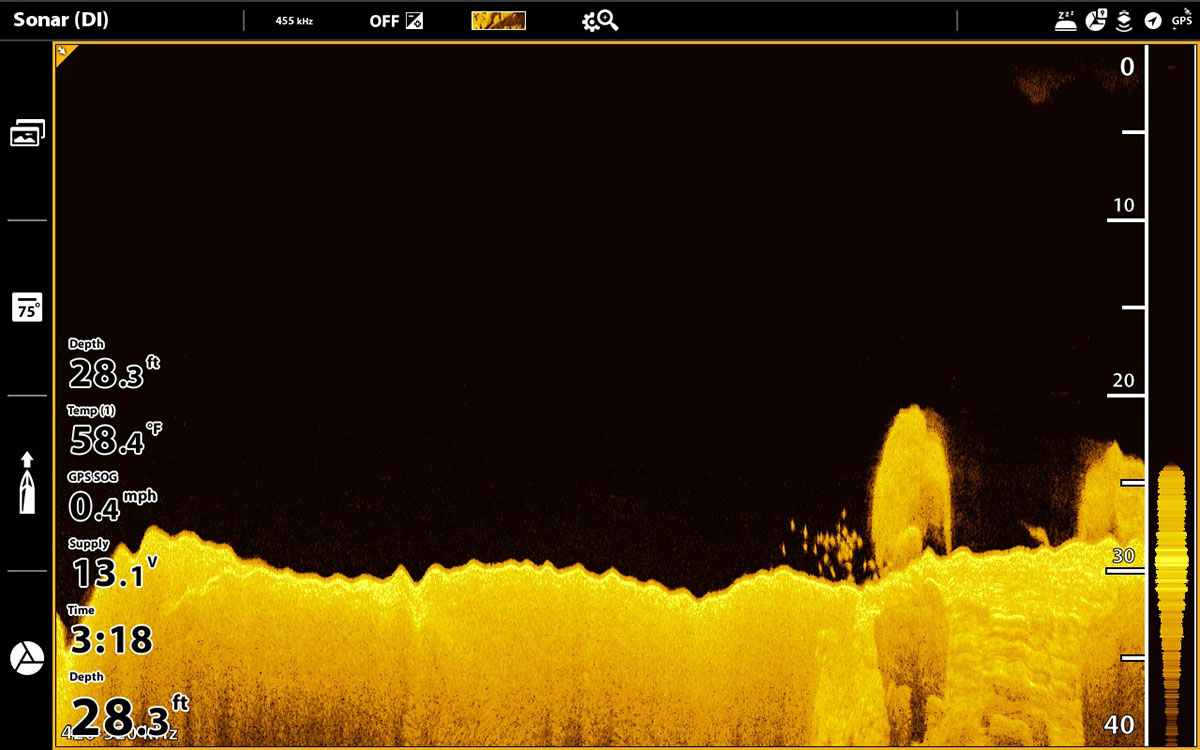
The fish, as well as the spots, are quite scattered through July and August but come early September things change as the water starts to cool and large numbers of tog of all sizes move onto rocky or broken bottom areas in 10 to 30 feet of water and they seem to stay there throughout the month. I like to see water movement (good current) because the tog will concentrate under your boat from areas down-current once you get some fish chewing up your initial baits.
Broken crab scent moving with the current sends every tog along the line searching for its point of origin and the sound of crabs getting crunched does not hurt either. Be patient by giving each spot at least 20 minutes of effort before moving on. Don’t be lazy by staying in one spot unless you have a very compelling reason like: “I know there are fish here and as soon as the current moves well enough (like within 30 minutes) I believe they will bite.” And you know this because you got them there on that tide yesterday or the day before.
Note that sometimes (often) that theory does not work because you likely caught most of the good fish on that spot when you were there before. In that case set up on a very similar spot not far away but at least a few-hundred feet. If it seems I throw spots around like water it’s because there are so many rockpiles in my area (basically where Buzzards Bay and Rhode Island Sound meet) that I can fish several rockpiles every day and not have to fish the same ones twice in a season!
If you do not have this sort of fallback ability, a good bottom machine and GPS can cure that! Try fishing good looking structure and when you catch fish on spots, mark them on your GPS and make notes of the species, time of year and other data you think will be helpful on future trips. Play the long game and make spots you go over one day (on your way elsewhere) and come back to check them out the next time you are in the area. This applies to any area you fish.
Unnamed Spots
In September, I’ll often fish south of Gooseberry Neck to Cuttyhunk Island and in just a one half mile band between those two points I bet there are thousands of excellent tog spots just waiting to be fished. And most of those – I’m quite sure – have never been fished! I know that it would take me several lifetimes to sample a small percentage of what’s out there and I often play a little game with myself when fishing for sea bass or tog on those structures and that is to “find at least one new spot every time out”.
The crazy thing is that it’s actually very easy to do and one thing that really helps with that is a trolling motor paired with a GPS (spot lock) for anchoring. With that, you can work an interesting area by “unlocking yourself” and moving slowly to the next structure or just to the other side of what you are already on. My current Minn Kota unit is far more accurate and user friendly than the old metal anchor route. It saves my back too!
Crab Considerations
Just like later in the fall, green crabs are the preferred bait. Many people get all excited about Asian crabs or hermit crabs but the truth is that if you are on the fish, you should catch as long as the water is moving. I used to have “head trash” about hermit crabs thinking that they were somehow better. I heard a story about how a guy on a party boat pulled out his stash of hermits and all of a sudden, everyone on the boat using green crabs couldn’t buy a bite while the hermit guy was cleaning up and winning the pool.
A few years back I put that to the test and I had Brett, who is a professional green crab harvester use his hermit crabs on one side of the boat while I fished green crabs on the other. I was actually expecting to get outfished but that didn’t happen. We were each getting bitten within seconds of hitting bottom and it did not seem like there was any difference between each’s effectiveness.
I find Asian crabs to be too small (I use 5/0 hooks) and I would need to put two or three of them on a hook to make them work and that is just adding more work and taking from efficiency. When you are on the fish, “efficient” means releasing the fish you just brought up (or bleeding it for retention), baiting your hook and getting it back down there for another fish ASAP. Extra steps or slower steps mean fewer fish. Piling multiple small crabs on a hook takes extra time and that means fewer fish. But it all works, if Asian or hermit crabs are what you have, then go for it.
RIigs, Jigs & Rods
Speaking of hooks, I really like Gamakatsu Octopus SE 4X Strong 5/0’s for my two-hook bait rigs. They are tough, they penetrate the fish well and they do not bend out under extreme pressure. I wish I could get tog jigs with a similar hook! Most tog jigs have “faster” (thinner wire) hooks that penetrate well with spinning rods but if you apply too much pressure, only the best of them will hold up to a double digit fish. Through the years I’ve seen many “heartbreaking break offs” including many that mangled the jig hook like it was overcooked pasta. Set the hook hard so the point is buried to the bottom of the bend of the hook. There, most fish will not have the leverage necessary to distort the hook at all (or enough to end in a lost fish).
What is helpful with jigging tog (you actually don’t “jig” tog, the jig is just a delivery method for your crab) is a rod with a lot of backbone. A soft tip is not necessarily bad but at a point of less than 50% of your “sweep” while setting your hook, the softness of the rod has to end and the “pure backbone” needs to be driving the hook. Take into account too, that much of your hookset is wasted on taking any bow out of your line so by the time you get to the “point driving” aspect of your hookset there may not be much room left to do the job in a good current with a lighter jig. When you think that could be the case with a fish you just stuck, it is not a bad idea to get really tight and then smack that hookset a second time before really settling in to fighting the fish.
Over-prepare
While September usually starts off with some of the warmest water temperatures of the year, the fact that they are falling temps so that is what the tog are responding to. If you get on them in 20 feet of water it would not be unusual to catch 50-plus fish in a tide! Think about that when you are buying bait. Even cutting green crabs in half, a gallon would not last long with a couple of people fishing so you might consider buying your crabs by the bushel and having a holding cage to hang by your boat at the dock so you can save any leftovers for the next trip. Put a good rope on it and let it sit on the bottom. I’ve even had crabs left over from the fall still be good to go in the spring.
The cages are not expensive and if you fish tog a lot, then you will probably save more than the cost of the cage in lower crab costs in one season. You can also try catching green crabs yourself. Most tackle stores sell effective green crab traps. Please check regulations and be sure you are not violating any town or state rules. I’ve also tried “artificial crabs” (Gulp) and find that it does work, “to an extent” but does not compare with the real thing.
So if you’re the type that waits for the more “classic” tog timing of October and November, I would urge you to take a break from your albie and striper pursuits to target September blackfish. At this time of the season, the fish have seen less pressure and they tend to be up shallower, making them easier to target with jigs and light tackle. Also, don’t be afraid to experiment; the tog bottom that blankets southern New England is loaded with structure that never get fished, because most people won’t stray from the reefs and wrecks that everyone already knows! If you dare to branch out, you will find tog hotspots that you can have all to yourself.