Pro advice for starting your spring season off with a tog!
Spring is an amazing time. Our little world is done hibernating and nature’s alarm clock finally sounds after a long winter. Everything around us comes to life and all the colors are suddenly vibrant again. To me, and other anglers like me, it’s a starting point for a new saltwater season and also new beginnings! While it’s fun chasing stripers and finessing the holdovers, or skipping worms on the bottom for white perch, my focus is quickly shifts to the next best thing; spring tog. As I’m still a realist, I’m also very big on superstition. Growing up, the tog rods got dusted off at the first sign of forsythia and dandelions emerging. However, as I’ve grown older, I’ve realized that this phenomenon (like everything) is backed heavily by science. As trees and the earth start to pollinate on land, the same thing happens in the water.
Reproductive season for ascophyllum nodosum (rock weed) usually begins in mid-March depending on the severity of the winter we’ve had. Once this brown, beady, dry weed transforms into a vibrant, rich, deep green “kelp”, it signals that the underwater ecosystem is resuming. The crabs and microorganisms move in from deeper water to feed and take shelter under it on the shallow, rocky shorelines and structures. Why is this important? Because this is what draws the tautog into the shallows and wakes them up from their dormant winter, to focus on feeding, not just spawning.
Back Bay Blackfish
For as long as I can remember, once April 1st (opening day) came, we finally got to put the clams and crabs to good use. It always starts first in the back bays and estuaries surrounding the upper bay. This is when the new fish filled with sea lice join the tog that stayed all winter. This was always kept pretty quiet between my close circle of friends and family, but word always gets out.
Togging at this time of year takes a lot of finesse though and definitely puts your tog skills to the test. They will be freezing cold to the touch and the bites are extremely light, especially within that first week of fishing, so the right tackle in your arsenal is essential. Your box should be stocked with jigs from 1/8 to 1 ounce, maybe a few 1-1/2s and 2s, but it’s rare to need anything heavier. Color carries more weight at this time of year as well, the clear water of the spring season allows the tog to use their sight more than they do in the fall. Orange is my go-to because it imitates the eggs on the backside of the crab that we all know, tog crave!
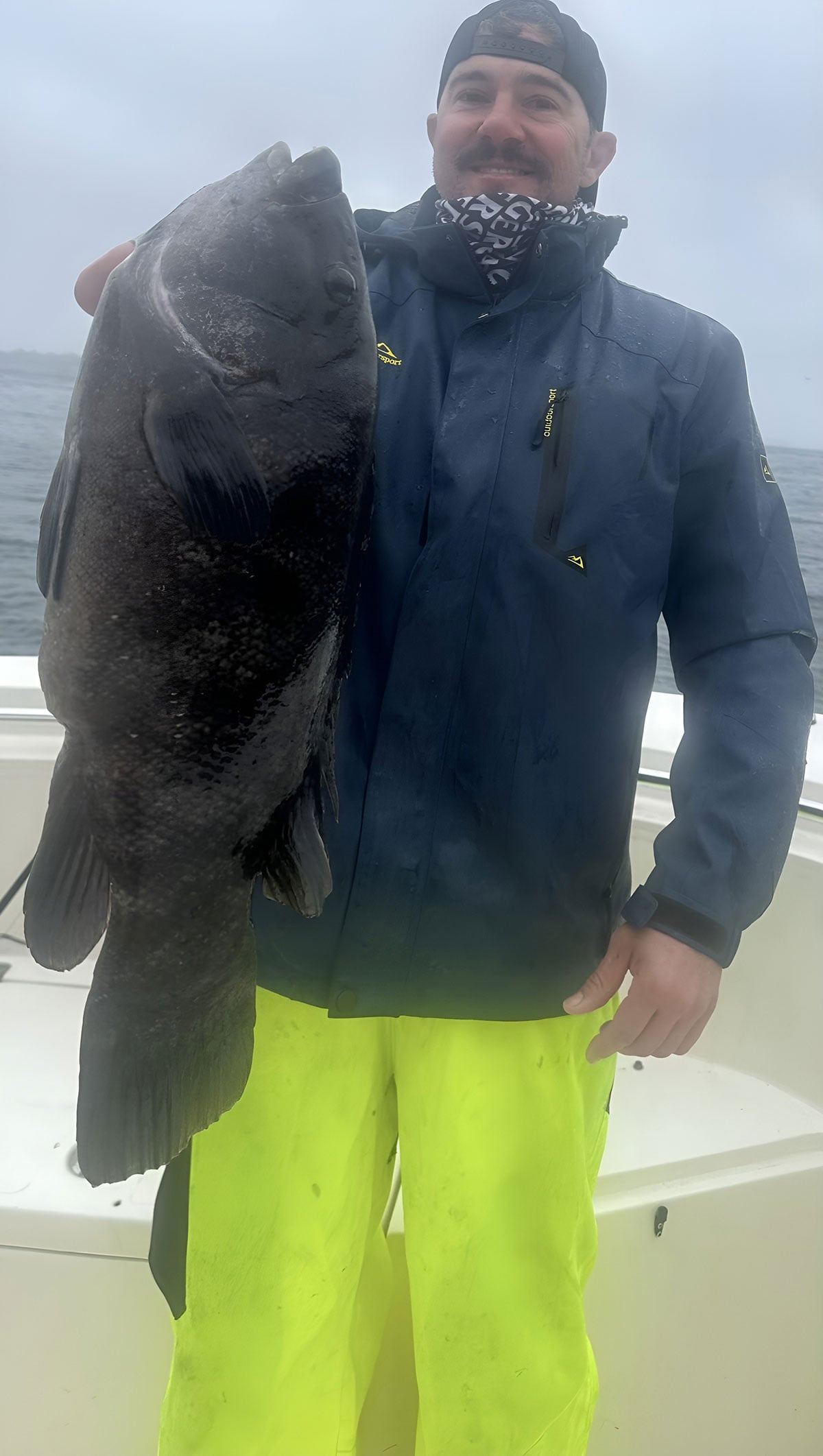
Remember, these fish are typically in 5- to 15-feet of water during the first weeks of early-spring, so they can see that very easily. With that being said, reach for those medium-light, fast-action rods with enough sensitivity to feel those really small taps, but enough backbone to pull the fish out of structure. I recommend 20- to 30-pound braid with a 30-pound fluorocarbon leader. Because of their keen eyesight in skinny water, I always go with fluorocarbon over mono, as it doesn’t reflect light and create an unnatural look in the water. It’s also extremely abrasion-resistant and sinks, keeping it level with the rod and jig, so it doesn’t create that “vibration” when fishing a stronger current like mono does.
Spot Science
| PRO TIP |

A really effective technique for feeling the bite and not spooking the fish is to extend the index finger of the hand you’re holding the rod with and pinch the line in the first crease of your finger and feel for changes in tension or movement. Focus on that, not your rod tip. This will allow you to feel the most subtle bites and even when they pick up your jig and start swimming up or toward the boat with it, you’ll feel a slight “thump” or “tick” then it’ll go slack. That’s when you want to set the hook. |
The most common question I get on charters is, “how do you always know where to look?” In the springtime it can be extremely hard to locate these early blackfish, as unlike the late-fall, they are spread out in an area rather than schooled up tight. Anywhere you look should have a lot of tidal current, but also have a lot of eddies, coves, and pockets in the same area (as successful spawning requires current flow but also settling points). So target docks, eel grass with deeper water nearby, rock jetties with sandy substrate surrounding it, mussel beds, old wrecks, and lastly, my favorite: old rock walls.
Just like any other fish in the spring, they will follow the sun to find warmer bottom. For example, if the suns hitting the east side of the structure, fish the east side of it, unlike the summer where they will utilize any type of shade they can find.
Tog are known as “broadcast spawners”, meaning mated pairs will simultaneously release eggs and sperm into a prime location where they will be fertilized and scatter along the bottom. During the early season, they will often be found roaming an area, such as a sand flat near dock pilings, a random wreck in the mud or the outskirts of a rock pile in search of the right mate as well as food. This scattered roaming tendency is why I advocate chumming in the spring, to draw them closer to you and get them riled up to eat. It’s very common to find them higher up in the water column, which is why having a really light jig setup that you can pitch to them is extremely important. This setup will fall extremely slowly, yielding most bites as it’s “floating” down. Sometimes that’s the only way they’ll bite! Because of how soft their mouths are in the early spring, I’ll chum with clams, bait my jig with a small Asian crab then tip it with a little piece of clam. This results in them inhaling your jig rather than pecking at it.

Don’t Miss It!
| REG ROUNDUP |
| Staying up-to-date on seasonal regulations is always important…
New York: LI Sound: April 1-30, 2 fish / October 11 – December 9, 3 fish, 16″ minimum size. NY Bight: April 1-30, 2 fish / October 15 – December 22, 4 fish, 16″ minimum size. Connecticut: April 1 – April 30, 2 fish per angler, 16” minimum size. Rhode Island: April 1 – May 31, 3 fish per angler, 16” minimum size only one fish per limit may exceed 21”. |
This spring, when you’re getting your gear ready, don’t rule this fishery out as it can be extremely fun and effective. Don’t be afraid to think outside the box because I’ve found these fish in spots nobody would ever think of or expect! This includes up in the middle of busy cities, miles up brackish rivers, the farthest up you can go in an estuary or harbor, or even places you usually target other species that holds any of the elements I’ve mentioned here.
As much fun as this is, please keep in mind, while we all love targeting tog, the spring is the most important time of year for these fish. This is the time of year that produces the future generations of the species and dictates their abundance in the years to come. Be sparing with how many fish you keep and move around a lot so as not to put too much pressure any single spot or concentration of spawning fish. I’ve seen too many great areas get overfished to the point that the fish never came back, even years later! If you’re lucky enough to find one of these untouched spots, keep all of that in mind and be very cautious of who you share this information with! If you do that, you’ll have a spring tog hotspot you can count on for years to come!