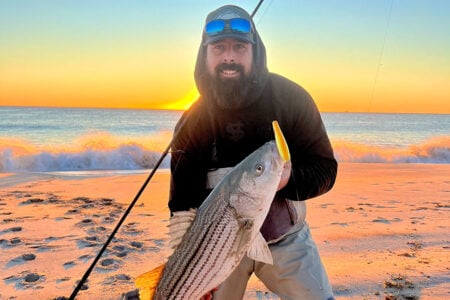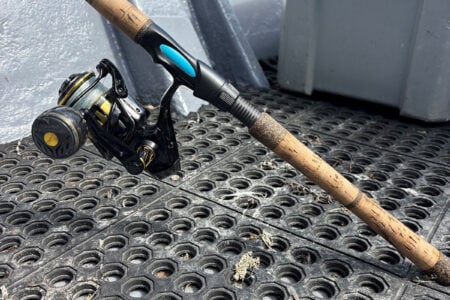
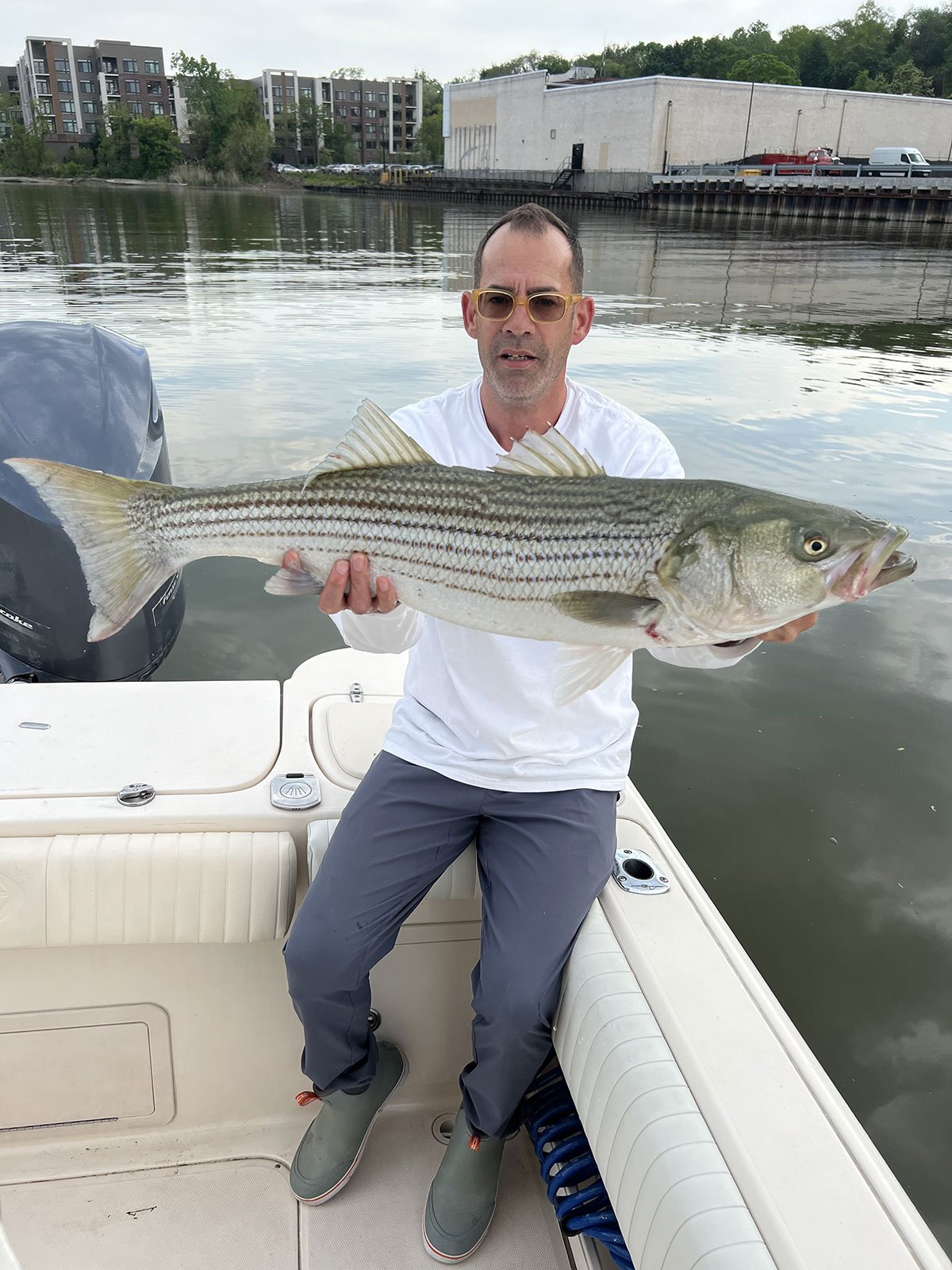
When traditional doesn’t work, it’s time to switch the approach.
Whoopie! It’s live-lining time in the Western Sound. It’s exciting fishing that many of us look forward to. After all, the fish are big, bites are explosive, and an angler just never knows if the next striper might be a true trophy. The live-lining season can last up to 8 weeks if bait migrations and good weather converge into a perfect marriage, or as short as a few weeks if the weather gremlins have their way. Unfortunately, we can’t count on a perfect marriage.
In the 90s there was lots of bunker every spring along with a burgeoning striped bass population after a decade in decline. The result was great live-lining with many big stripers caught. Bait and stripers have been less abundant in recent years and success may not be as consistent, but take heart, there’s still plenty of opportunity for exciting fishing.
The Dance
I enjoy the “dance” between striped bass and adult bunker in traditional live-lining. The dance takes time and becomes as much a visual thrill as a fishing thrill. What’s not to like when a striper knocks a bunker several feet in the air, circles and terrorizes it, or the huge swirl when a bass finally attacks, perhaps misses, leaving behind a giant hole in the water and a bruised by still-swimming bunker? However, that scenario wasn’t in play in 2024: not for us anyway. A lack of adult bunker preempted the dance, but nature provided a replacement in the form of schools of winter-over 5 to 6-inch peanuts. Yes, nature changed and adapted, so live-liners began to seek an adjustment of their own.
Perhaps you won’t agree, but for me, hunting for a variety of species using different methods stirs my fishing enthusiasm as much as catching a coveted trophy striper. That’s why I love fishing for porgy, fluke, blackfish, kingfish, white perch, crappie, yellow perch, largemouth bass, and bluegills in addition to stripers and blues. Each species offers its own challenges and satisfies anglers in different ways. Although it can be frustrating, I get a kick out of fish behavior that varies: today they feed here and tomorrow over there, and they don’t respond to the same techniques every day, either. Sure, during a hot bite I throw myself deep into it and I get lost in the brainless hustle and bustle like everyone else. However, when fish get picky, the challenge of figuring out how to catch them stirs my juices just as much. Live-lining is no exception. There are hot days, but also years and trips that need some reckoning.
Plans A, B & C
2024 was one of those seasons that needed a little deductive reasoning and some tenacity. We began with plan A: traditional live-lining. We were able to get a few adult baits on the first trip, and employed conventional methods in favored spots, but few stripers responded. On some structures they were piled up on the recorder, but refused to chase or eat the bait. Okay, go to Plan B. Plan B employs fresh chunks, lets them sit on the bottom, spew marvelous bunker juice into the tide, and hopefully lure a striper out of its doldrums. Plan B failed, too.
Rich Lazar and his son Marc began the process of reckoning, seeking a presentation that would catch fish. Of course, terrible spring weather impeded their efforts. When they did get out, adult bait was difficult to find. Finally, Rich and Marc figured out that there were more winter-over 5 and 6-inch peanuts than there were full adults. That definitely rang a bell. They recalled situations in the past, while casting for stripers in the harbor, when fish were reluctant to engage, and they were forced to use a different approach.
The Lazars tried that approach now, and netted some large peanuts. Plan C. This plan involved spreading live peanuts around the boat, and casting with 1-ounce pencil poppers. Rich said, “I think they’re swimming around looking for ‘candy.’ The pencils should get a look.” Was that the answer? Casting & “candy,” Striped bass candy to the Lazars means 5 to 6-inch peanuts because they are calorie-rich, fish can’t resist them, and the bait is eaten with a single gulp. Alas, Plan C failed, too.

The Source
Always go to the source for answers. If it was possible to ask striped bass how they go about deciding when to be active and when to be idle, why they sometimes prefer one bait over another, or switch feeding time from one stage of the tide to another, fishing would be a lot easier. However, we know they’ll never talk to us or volunteer their secrets, so the best we can do is interpret what little evidence we gather through observation and experience, and use these data to adjust our fishing techniques.
Part of interpreting information is to match old success with new evidence. If stripers have little interest in adult baits, then perhaps they can be triggered by small baits. After all, switching to smaller offerings often triggers picky fish, from panfish to tuna, when they’re in a snit. Once realized, we had a bud of a new plan that might offer an opportunity to catch reluctant stripers fixated on one-sized food. In the end, it was Plan D that succeeded.
Okay, the fish were keying on size, but what else? Obviously, it’s easier for a fish to engulf a 5-6-inch bait compared to a 10-12-inch bait. Obviously, we also needed to modify our approach. Whereas great patience is needed when using large bunker, attacks on “candy” are typically quick and decisive. Plan D required us to adjust more than presentation, we also needed to be on our toes and anticipate sudden attacks.
Plan D
Okay, we had live peanuts in the well, moved off the idea of artificials, and began searching for active stripers pushing and feeding on schools of peanuts. Next problem: Find the schools of peanuts.
If you think the harbor was boiling with stripers attacking schools of 5 to 6-inch peanuts, you’d be wrong. In fact, the harbor was quiet save for an occasional gull or osprey, head down, fluttering, and looking for a meal. Anglers, expecting more active feeding might be put off by the quiet harbor, but experienced live-liners know that in this scenario the fish don’t usually feed on the surface with ferocity or accompanied by flocks of screaming birds. Question: How to locate the bait and stripers when they weren’t feeding in blitz mode? Fortunately, the surface was calm, and we started looking for any water that didn’t match its surroundings. What I call, “funky water.” Disturbed water might be peanuts being pushed along the surface, flipping casually, or even stripers streaking towards a bait school.
From Anchor to Drift
The next decision was whether we should anchor and let the school come to us, or try to move with the school. Plans A, B, and C all involved anchoring, but was that the best approach now? Perhaps, but schools of bait moving quickly with stripers pushing them, might render anchoring a non-starter. Within the scope of Plan D, it made more sense to find a school of stripers following bait and present live peanuts as close to the school as possible on a drift. The bait and fish were moving quickly around the harbor, so we kept the engine running in order to give us a faster response time as bait moved away. Most of the time we kept up with the bait school as it moved on, unless we were fighting fish, and lost sight of the bait.

Atmosphere
Although peanuts were in vogue, the density of the bait schools was important, too. Also, fast-moving bait triggered a predatory response that we used to advantage. I can offer an analogy that might make some sense. Visitors to Yellowstone National Park are told by rangers that if they see a bear do not run. Why? Because running is what predators expect prey to do, and it stimulates their predatory instinct and they attack.
I think something similar happens when striped bass and “candy” get together. Stripers find and stalk the bait, the prey moves quickly, the stripers are triggered to attack, and an active feeding event occurs. That is, the size, vitality, and behavior of the bait just turns the fish on and causes them to commit to the attack, and BAM!
The behavior of fishermen changes when we live-line peanuts. For one thing, although we put rods in a holder while tending adult bunker, it was a big mistake in our 2024 technique since the attack is so definitive that by the time an angler removes the rod from the gunnel holder, the striper has snatched the peanut off the hook.
Down Time
There was also down-time between finding bait, catching fish, and relocating the bait. Then, in a flash the school is around the boat, baits are tossed out, and mayhem ensues. After the mayhem, a quiet time follows as we relocate a bait school. Once found, we move the boat ahead of the fish, get baits in the water and settled, and wait for the attack. This takes coordination between the captain and the anglers in order to be successful. Of course, sometimes the bait turns in the opposite direction and we resume the chase, but last year we were lucky and, all but twice, the action proceeded in a single direction.
As army veterans often say, war is long periods of boredom followed by short periods of chaos. In their case, the intensity is about fierce combat. In this angling scenario it’s about excitement. Even though an encounter with an active school may only last a few minutes, the adrenaline flows freely and, when it’s over, the let-down is palpable.
We watched bait approach, we held the rods, we tracked the peanut on the hook, we gauged whether or not our baits might end up in the bait school, and hoped the stripers noticed the vulnerable hooked peanuts. There were only minutes to hook up as a school passed, and we remained intensely focused.
We use circle hooks. When live-lining adult bunker, with rods in holders, the fish tortures the bait, eats the bunker, we free-line briefly before engaging the reel, pick up any slack, and wait for the line to become tight. This is different. We hold the rod, the conventional reel remains engaged, the striper doesn’t fiddle with it, the pick-up is clear, the line gets tight, and the angler starts reeling. When line-lining with adult bunker, we rarely hook up more than one fish at a time, but in this case, multiple hook-ups happen more often. Therefore, we couldn’t really relax into the fight, rather we remained alert to other anglers fighting fish in order to avoid tangles.
I look forward to line-lining with Rich and Marc every spring, and also the adrenaline rush that comes with it. Yet, every year offers different challenges and experiences that enhance the fishing in a special way. This isn’t unique to live-lining from a boat. For me, every species and every new landscape of techniques and fish behavior excites me and keeps me coming back for more. Whatever Nature has in mind in ‘25, we’ll be ready.