If the season ahead is for the birds, you may find more success.
It was an early June morning and we cruised along the back bay sedges looking for signs of striped bass life with anything from a pop, swirl, or a splash. But this morning was different, it was relatively quiet with morning tide flushing into the bay estuary and unfortunately showing nearly zero signs of baitfish, and more importantly, stripers.
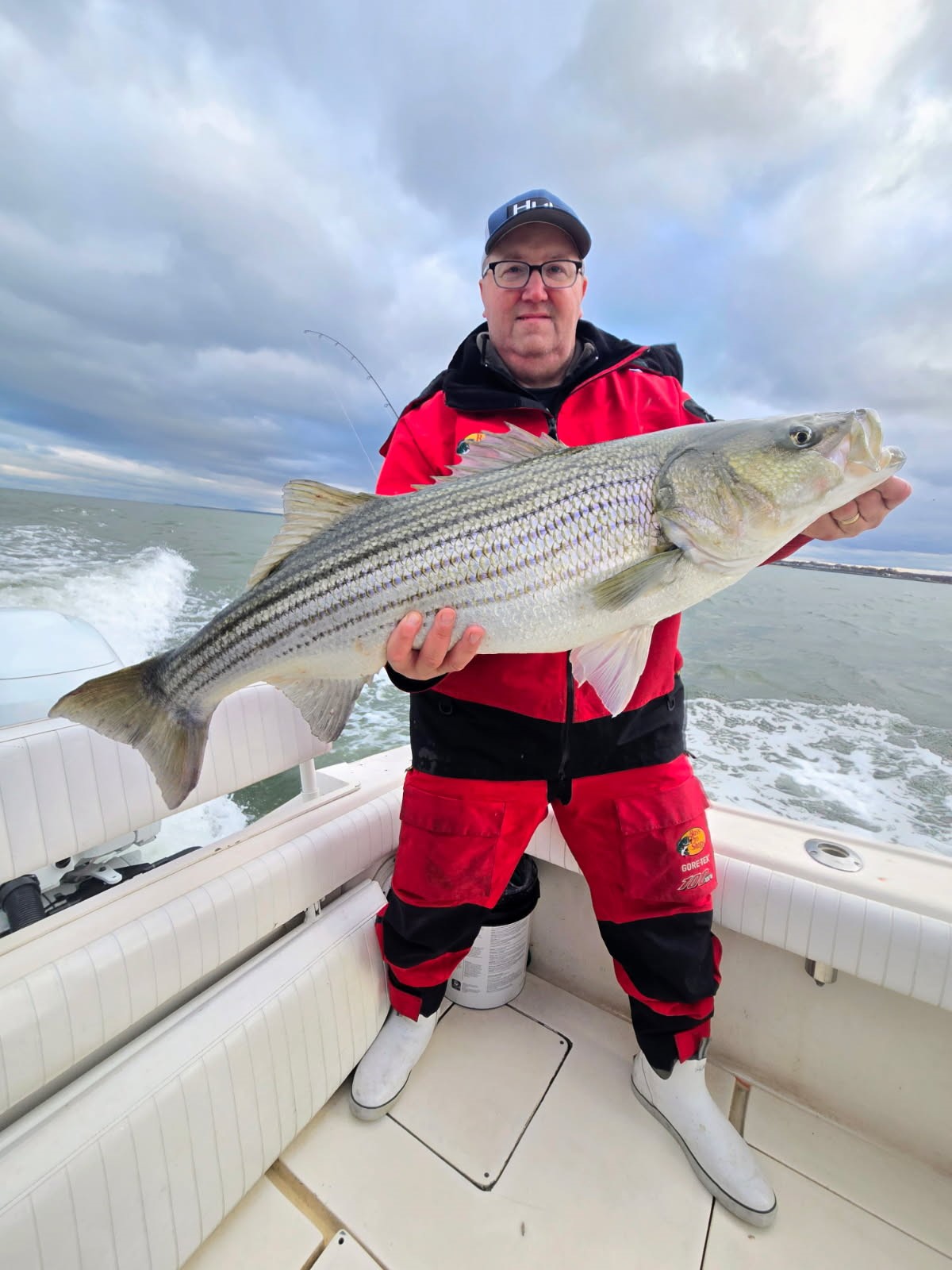
As we rounded a tree-lined sedge, we spotted two lone terns working the mouth of one of the small feeder creeks. The terns were hovering maybe 8 to 10 feet off the surface, but occasionally swooping down to pick up food. We slowed, shut the motor off, and gently gliding within casting range of the terns sending a small 4-inch popper a few feet of the birds. The terns flew up from the splash of our lure, but a solid 25-inch striped bass exploded on the popper within seconds of the first tug.
We ended up playing catch-n-release for the next 30 minutes with four more striped bass off the same creek. The birds showed us life and breathed hope into our fishing day.
Offshore anglers can account for similar experiences with different species of marine sea birds. Bluewater anglers heading offshore in search of tuna and other pelagics understand that the Atlantic can often be a virtual desert, with boats covering miles and miles with visibly nothing on the horizon or on the depth sounder below. But our marine feathered friends can be a welcome sight as they cue us into unknown underwater activity.
For any tuna fisherman, the sight of storm petrels also known as “tuna chicks” or “Jesus birds” for their ability to hover and “walk on water” are a big indicator of baitfish and feeding pelagics. The petrels are usually found near feeding oil slicks, picking tiny pieces of leftovers from feeding tuna and whales. Many of tuna fisherman have had days saved by these little grayish feathered birds.
Scenes of marine seabirds are always a welcome sight for savvy anglers and these marine avians work coastal zones to pick up invertebrates, vertebrates and even crustaceans finding suitable nutrition to power the wings and high-metabolic cores. Fisherman not only can learn from the behavior of our winged anglers, but also can use the particular species and size to forecast potential baits and gamefish below the surface.
Birds, Baitfish & Success
Many animals have certain adaptations which allow for their survival and success in obtaining vital nutrition. Although flight is a major adaptation – along with hollow bones and high metabolic rates – vision by far is one of the most important features that marine birds use to find and capture prey. Just as vessels with tuna towers or high bridges have better shots at spotting schools of tuna, birds can fly high over the water using their visual acuity to spot schools of baitfish. Many times I have witnessed ospreys flying high over the bay mud flats, followed by a closer approach, dive, and picking off a summer flounder as they fly away with the flatty in their locked talons.
Diving birds have several adaptations which help to keep their vision laser focused even when going from air to sea. For instance, gannets have a third eyelid which acts as a google when looking underwater and additionally they can change the shape of their lens to focus underwater. With their exceptional eyesight, marine birds should be your eye in the school to key in on feeding gamefish.
If you’re out on the water and take notice of the flight behavior of various species, it can help clue you in to the happenings below the surface. As gamefish essentially push baits from below to the surface into tight bait balls, birds of prey will feed from above on these opportunities.
Most marine birds will exhibit similar flying patterns, regardless of species, when in the search mode. When birds are searching, you will see them flying higher than normal and they may look as if they are haplessly flying. Generally, there will be a lot of head movements as they are scanning the areas for surface splashes, oil slicks, and other disturbances. These can be easily noticed by birds which can pick up on these close to a mile away as they scan below from above.
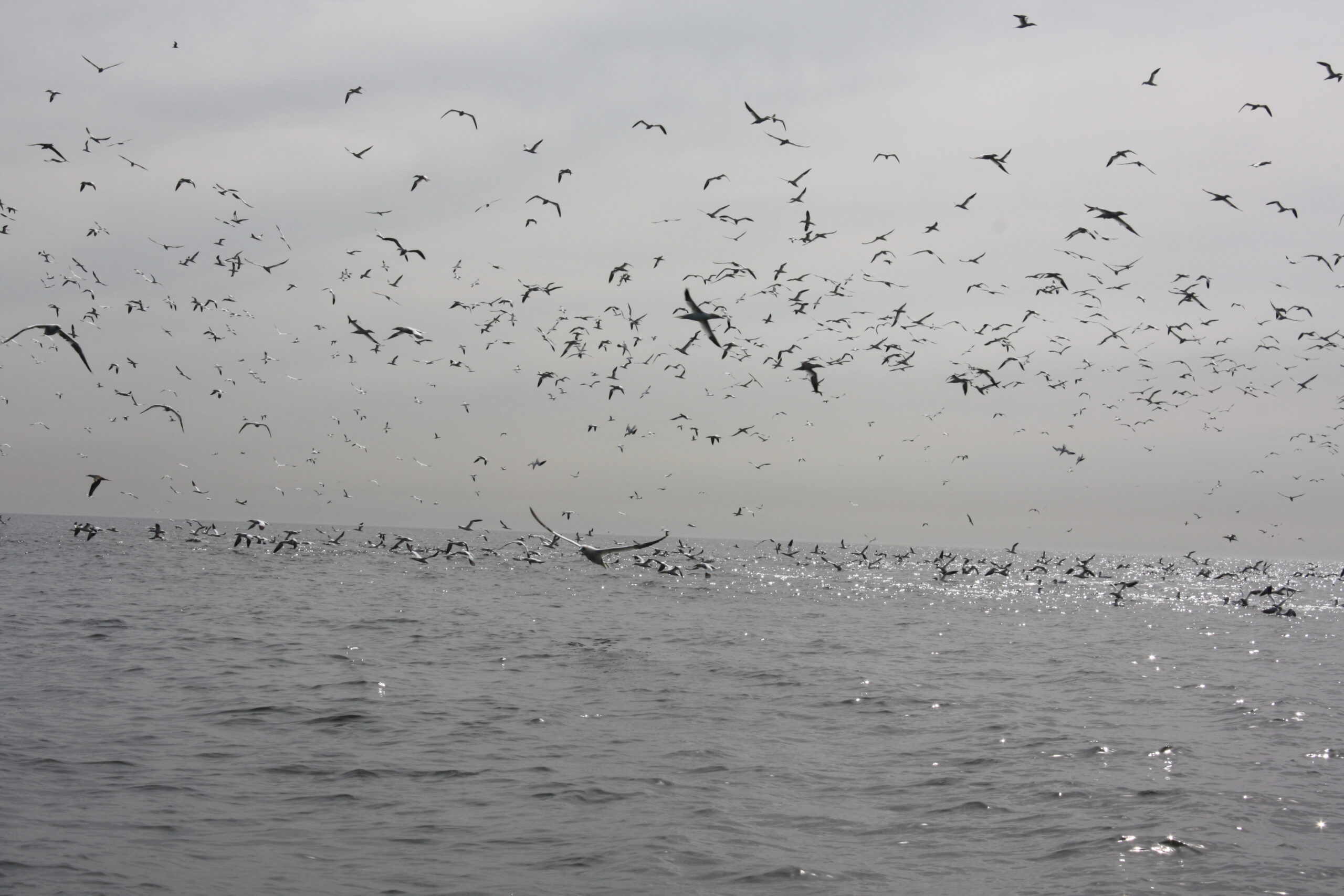
When birds begin to stay in a specific area, the search mode changes to a found mode. Birds may hover in circular patterns until active feeding begins below the surface as predator and prey come together. When anglers witness this behavior, it is time to investigate as more times than not, gamefish will be in the area. Anglers can look for electronic sonars to see schools of bait and hopefully, the telltale boomerangs of game fish.
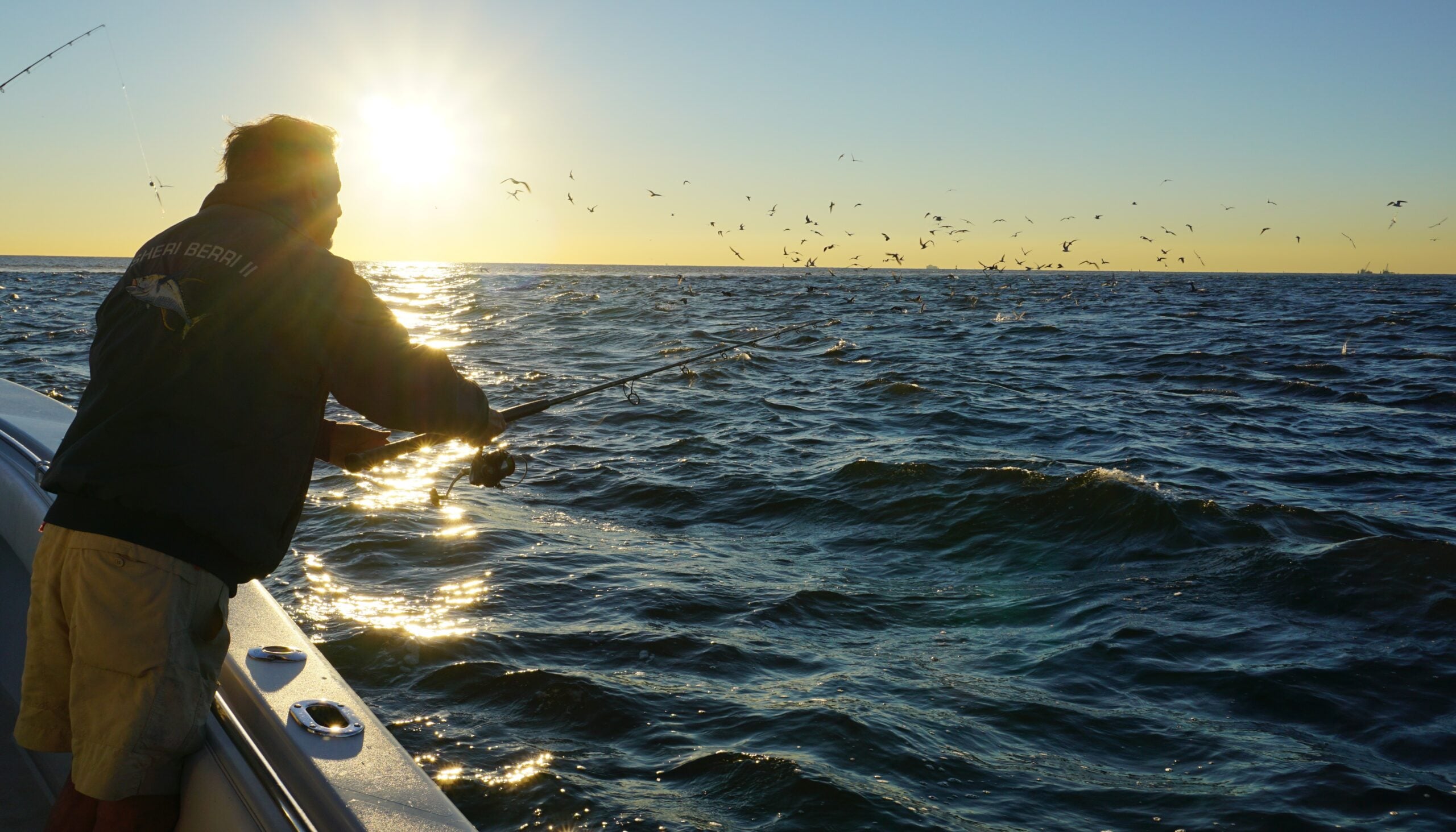
Actively feeding birds are easiest to spot as they will be hovering very close to the water and sometimes picking off whole or the remnants of baitfish. The best way to approach these feeding situations is up-current as not to disturb fish and birds allowing fish and bird action work into your position. A quick cast into the melee will usually result in an instant hookup as long as your lure matches the proverbial “hatch”.
The dreaded “sitting bird” indicates feeding most likely occurred before you got there and birds like herring gulls may just be hanging out, conserving energy and digesting the recent meal. Gamefish, like striped bass or blues may still be around, but most likely active feeding is not occurring. It does pay to try a cast or jig in the area, but I wouldn’t concentrate efforts here if no hook-ups occur as these fish may be turned off for the time being.
Bait & Birds By Size
The statement small birds like small baits and big birds like big baits generally holds true. There are a variety of coastal birds that can be encountered in our bays, inlets, and ocean with the following being the most common: herring gulls, black-backed gulls, laughing gulls, common terns, oyster catchers, brown pelican, gannets, cormorants, ospreys, etc.
Smaller gulls and terns are good indicators of smaller baits like spearing, grass shrimp, juvenile peanut bunker and small anchovies. Whether you’re fluke fishing on a tidal flat or run-n-gunning in the ocean for albies and bonito, these birds will usually be in the area making it likely to find actively feeding fish. Larger birds like herring gulls, black-backed gulls and gannets are great indicators of larger baits and potentially larger gamefish, like striped bass and gator bluefish. Gulls will feed on surface-pushed baitfish, while gannets will perform aerial missile-like strikes hitting the surface to dive below, with both species feeding on baits like: sand-eels, adult menhaden, and blue-back herring. Osprey will tend to feed on larger baitfish and even gamefish as I witnessed on one of my local webcams with an osprey perched, feeding on a 20-inch-plus. Brown pelicans will arrive later in the season, but more recently have become a regular visitor to our area feeding on schools of peanut bunker, mullet, and spearing. If you’re fluking later in the season and notice pelicans diving on baits, try drifting the same areas for keeper fluke.
Bird feeding behavior directly correlates to locations and depths of gamefish as non-diving birds will feed when baitfish are pushed higher in the water column. For example, all types of gulls, petrels, and terns will engage when baitfish are at or within a foot of the surface, whereas cormorants or gannets will indicate feeding far below the surface. Amazingly, gannets can dive into the water with speeds up to 60 miles per hour and max out depths to nearly 85 feet with air sacs inflated in the head and chest to protect from the impact.
If you’re striped bass fishing and see gulls hovering close to the surface, it’s best to work lures close or at the surface. In comparison, when you see gannets diving and remaining under for some time, try dropping baits or jigs down deep.
By understanding the feeding behavior many of our marine seabirds, allows one to get there lures in the right area to catch gamefish. In a few months, we’ll hear the first sound of laughing gulls again, a good indication that the bait, and a few of the migratory gamefish, are already here.
Think about the upcoming 2026 season as one for the birds; they may lead you to a boat load of fish.
| Marine Seabirds | Potential Gamefish |
| Terns – Common, etc.
Laughing Gulls |
Bay: striped bass, bluefish, weakfish, fluke
Ocean: striped bass, albacore, bonito, bluefish |
| Large Gulls (Black Backed, Herring, etc.) | Bay: striped bass, bluefish, tuna, shark, cobia |
| Petrels / Shearwaters | Ocean: tuna, billfish, shark, various pelagics |
| Pelicans | Bay: striped bass, blues, fluke |
| Gannets | Ocean: striped bass, bluefish, tuna |
| Osprey | Bay & Ocean: striped bass, bluefish |