A tale of an East End taxidermy marlin that’s over 100 years old.
He was an old marlin who hung alone over a fireplace inside a boathouse on the eastern end of Long Island and had gone 38,325 days without being moved.
This is the start of a true story, with a tip of the angler’s cap to the first line of Ernest Hemingway’s The Old Man and the Sea, “He was an old man who fished alone in a skiff and he had gone eighty-four days now without taking a fish.”
While the main character in Hemingway’s masterpiece is the Cuban fisherman Santiago, here it is William Farnum, a rod-and-reel enthusiast with New England roots, who takes center stage. Quite literally. Farnum, when he wasn’t casting about on the water, was selling out Broadway theaters and headlining Hollywood movies. One of the highest paid actors of the silent film era, Farnum was the “John Wayne” of his time, admired for playing rough and tumble characters in rough and tumble scenes. Which, as it turned out, proved ruinous for his health and his career.
“My Big Fish Must Be Somewhere”
In 1915, after a successful run on the stage, Farnum signed with Fox Films. For the next 8 years he made 7 to 10 silent movies annually, including Riders of the Purple Sage by Zane Grey, a writer famous for his fishing stories. During this period, Farnum brought home about $10,000 a week, equaling more than 10 million dollars per year today. He was so valuable to Fox they insured his face for $100,000. This was not a case of over-caution. Actors in those days did their own stunts, and Farnum played many a “bruising” role. Ironically, in 1924, while making The Man Who Fights Alone, he was injured and hospitalized, slipping in and out of a coma for months. It took him a total of six years to recover and to work again. But by then the “talkies” had arrived, and most silent sensations, like Farnum, never again enjoyed the spotlight.
In 1918, however, Farnum was at the top of his game. Known to combine his vocation with his outdoor passions, he took time from shooting a movie to go fishing off Santa Catalina Island in the Pacific. There he landed a 10-foot, 350-pound blue marlin which, as one news clipping gushed, “he fought for several hours before it succumbed to his strength.” The “Samson of the Screen” had added another trophy to his collection, shipping the fish cross-country by train to his home in North Haven.
“Think about something cheerful, old man,” he said. “Every minute now you are closer to home.”
― Ernest Hemingway, The Old Man and the Sea
North Haven is a 2.7-square-mile peninsula surrounded by the waters of Shelter Island Sound and Noyac Bay. To the south, North Haven is connected by bridge to Sag Harbor. Farnum’s home was on the northeastern side of the village, on Actor’s Colony Road, so named because it was where the elite of America’s theater community built residences in the late 1800s and early 1900s. Farnum got there thanks to his second wife. Olive Ann White was also a thespian, known for her roles in Irish-themed stage productions and as the inspiration for the song “My Wild Irish Rose.” She acquired the property a few years earlier while married to her future ex-husband, yet another actor.
Olive and Farnum wed in 1906 and had one child together – a daughter. Over the next two-plus decades they alternated time between Los Angeles, filming locales, and North Haven, where they had a barn, caretaker’s house, chicken house, doll’s house, beach cottage, and boathouse.
The Boathouse
Built in 1915, the William Farnum Boathouse is a two-story, three-bay by four-bay, gambrel roofed frame building covered in wood shakes and resting on a concrete foundation. It is listed in the National Register of Historic Places. As described in the application for this status, “it was constructed on the beach, 12 feet from mean high water. This allowed boats to be floated onto a wooden cradle at high tide, tied into position, and then hauled out of the water and into the boathouse through its large front door on a set of steel train rails. Given the boathouse’s proximity to the bay, it continually was battered by waves, wind and flooding during hurricanes and storms. During a storm, the front and rear doors of the boathouse would be opened, allowing the seawater to pass through its lower floor, allowing the waves to move through the interior without taking down the supporting beams. In addition, the boathouse was designed to allow seawater to completely encircle the outer perimeter of the building, again, to reduce the shock that oncoming waves would impart to the building supporting structure.”
Despite being designed to withstand the elements, one wonders the wisdom of Farnum choosing the boathouse to store and showcase his treasures. But once inside the second floor you understand the decision; it is a magnificent space, suitable for angler or artist, the aesthetics falling between the wing of a museum and a cigar lounge. The room is a visual paradox – expansive with a high ceiling and wide windows providing vistas of the bay, but also cozy. Hardwood floors, built-in cabinets, a brick fireplace, nooks and crannies galore, give warmth and a sense of intimacy to the surroundings.
Beside the dramatic views, what most grabs attention are the sporting fish mounted on the walls – tarpon, tuna, swordfish and more caught by Farnum in local waters or on trips afar. While each is impressive, the marlin is the “star of the show.” Farnum recognized this, giving it “top billing” over the fireplace. One can imagine the actor regaling guests at the very spot, describing his epic battle with the fish. In those moments, basking in his fortune and fame, I imagine Farnum felt invincible. Perhaps he saw the marlin as a symbol of his strength and vitality and winning ways; conquering it represented the apex of the herculean heights he had climbed.
Yet Farnum’s life would soon spiral downward, starting with his hospitalization, and ending with him leaving behind North Haven, the boathouse, and his marlin, for good.
Great Depression Times
“It was an hour before the first shark hit him.”
― Ernest Hemingway, The Old Man and the Sea
In The Old Man and the Sea, after subduing the marlin and strapping it to his skiff for the long row back to shore, Santiago is horrified when sharks show up and rip the fish to shreds. By the time the old man slides the boat back upon the sand, the once magnificent fish is merely sinew and skeleton.
Farnum must have felt similarly besieged in 1924. Only 6 years after catching the marlin, he found himself bedridden from his injuries. Convalescence was slow, but the world moved fast, particularly in Hollywood. When he finally returned to work, his magic as a silent star did not transfer to the new films with sound. His family life also dissolved. In 1928, Olive, returning to New Haven unexpectedly after a visit to the West Coast, found Farnum in their home with Isabel Major, a writer. It was not a platonic relationship. Olive kicked Farnum out, and they eventually divorced in 1931. (Farnum went on to marry Isabel. They had three children together and stayed together until his death in 1953 at the age of 76.)
After the split with Farnum, Olive was awarded the North Haven property. She did her best to keep it up, but the Great Depression came and she struggled financially. In 1933 she sold the estate to a New York City businessman for $33,000. With the deed of sale came all the “furnishings,” including the Olive Ann, a rigging catboat Farnum loved to sail (and won contests in), and also his precious marlin.
Saving A Legacy
“Now is no time to think of what you do not have. Think of what you can do with what there is.”
― Ernest Hemingway, The Old Man and the Sea
Wes Frye, the great-grandson of Henry Hedeman, the businessman who purchased the North Haven home from Olive, had a problem, which was what to do about Farnum’s marlin? It was 2023 and the fish had been in the boathouse for 105 years. It had never been moved in all that time, not an inch. But it was starting to show its age and was slowly falling apart.
When Wes called a local taxidermist for help, the solution was simple, “Throw the fish into the dumpster, and I’ll make a fiberglass model that will last forever.” But Wes couldn’t do that. The fish had too much character, and too much history; the connection by now was not just to Farnum, but to Wes and his family. Each generation descending from Hedeman had become attached to the property, to the boathouse. Wes, himself, had lived most of his life in North Haven, and along with his wife and his mother, was the primary caretaker of the estate. In sum, the marlin was his responsibility.
Wes got better advice when he contacted the Vanderbilt Museum in Centerport, Long Island, which has an extensive ancient fish collection. The curator told him, “Call George Dante. He’s who we use. He’ll know what to do.” After speaking with George, Wes hired a moving company and they removed the fish, carried it down the stairs, and placed it into a rented box-truck. Wes and his wife then took the marlin on its second land voyage, driving two-plus hours from North Haven to George’s studio in Woodland Park, NJ. Wes knew he was in the right place. “The studio is unbelievable,” he shared. “Along all the walls are animals and fish in all states of repair – elephants, polar bears, you name it.” George’s response when he saw the marlin, “I didn’t know it was going to be this big.”
George, however, was up to the challenge. A prominent taxidermist who started this work (and a part-time business) in high school, he went on to obtain a BFA from the School of Visual Arts in New York City. In 1996, he blended his interests, talent and experience into the founding of Wildlife Preservations, LLC. Each project George undertakes is unique; he takes time to learn as much as possible about a specimen and the restoration work previously done before he puts his own stamp on it. As Wes said, “George is more than a taxidermist, he’s an artist.” He’s also in demand. The combination of the studio having a backlog, and the marlin’s size, resulted in it taking two years to complete the job. But it was worth the wait. Once done, Wes rented another truck and brought the marlin home.

Returning Home Again
“You loved him when he was alive and you loved him after. If you love him, it is not a sin to kill him. Or is it more?”
― Ernest Hemingway, The Old Man and the Sea
I will always remember the early hour call I received this past summer from Wes, letting me know the crew was on their way to put the marlin back on the wall. It felt as if I was being told that a loved one’s baby was being delivered and to hurry to the hospital. My house is about a half-hour drive to North Haven, but that morning I did it in 15 minutes. I did not want to miss the moment.
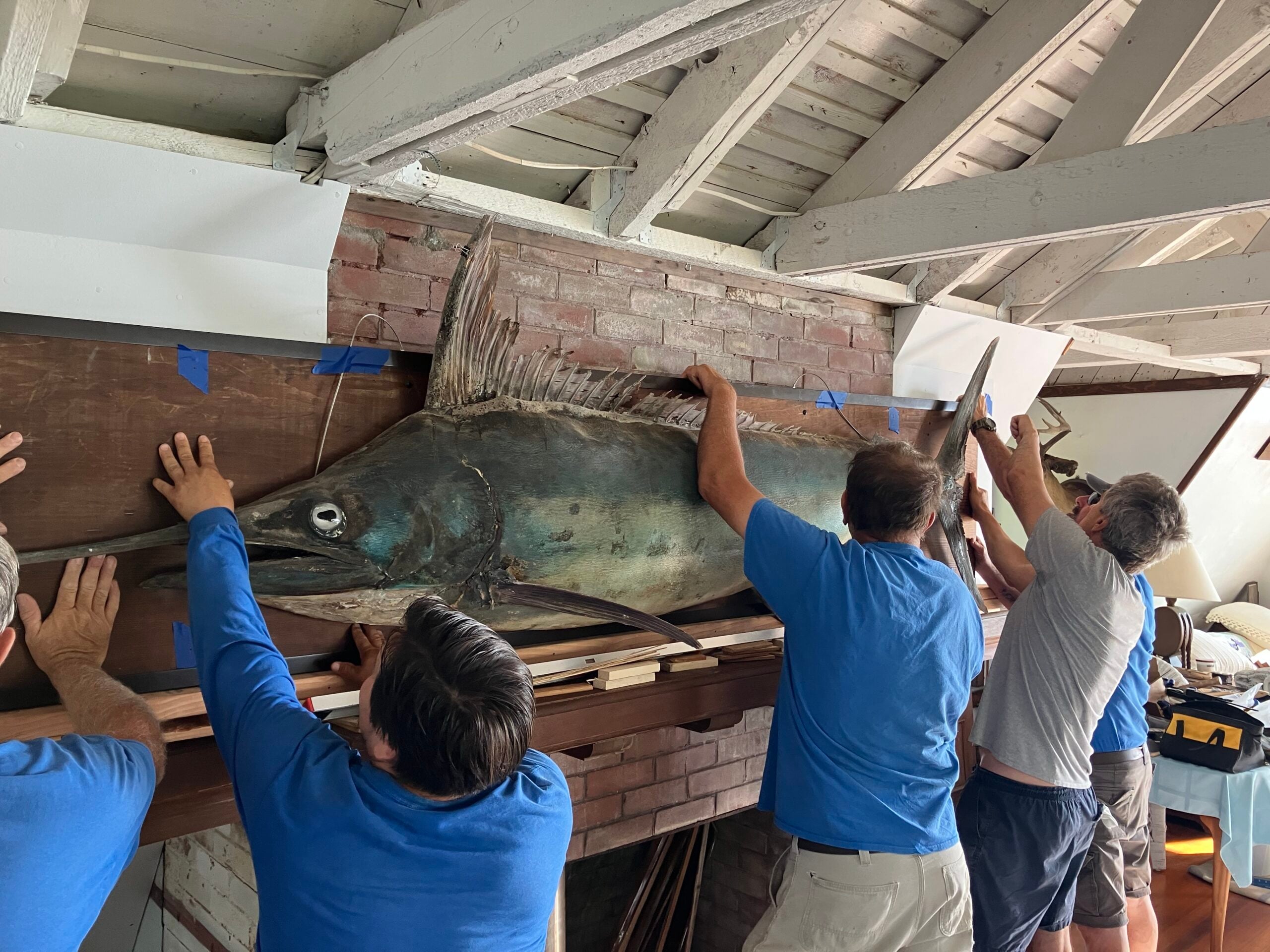
Ever since the marlin had returned from George’s studio, I had been over to the boathouse frequently, monitoring the process. The main issue was repairing and refortifying the wall above the fireplace, and strengthening the board in which the fish was mounted. Wes did this work himself, hours of labor, while the marlin waited nearby, a foot off the floor on a makeshift rack.
Finally, things were in place to put the fish in its place. Once the crew arrived things moved fast. It was hot out, and everyone was sweating from the effort, including me, although my only job was to take photos. With the last screw in place, a thorough checking that everything was secure, we stepped back and admired the fish. The sight made us happy. And maybe vice versa. As Wes joked later, invited to tell the story on The Heart of the East End, a local radio show hosted by Gianna Volpe, “Once the marlin was safe on the wall you could see a small smirk on the side of his face. It looked glad to be back.”
On Gianna’s show, they also discussed taxidermy – the controversy and the conflict often associated with the practice. While the debate is complex, the consensus seems to be that it is unethical to kill an animal or a fish for the sole purpose of turning them into a trophy to display. As Wes related, “I felt sad walking into George’s studio and seeing all these specimens. But talking with him I realized the value of the work: that if we didn’t preserve them they would just be gone and no one could enjoy them and no one could start having these kind of conversations around conservation. Seeing them forces this type of dialogue. This is what we want.”
The most recognized theme in The Old Man and the Sea is that “man can be destroyed but not defeated.” This is embodied by Santiago, who at book’s end is drained of all energy and broken physically from his bout with the marlin. But he retains his bravery, his pride, the perseverance needed to recover from such a profound loss and continue on. By the last page, we know he will fish again.
This is how I feel about Farnum’s marlin. Whenever I look at it in the boathouse, I do not see something vanquished, something without spirit or without soul. I see strength, a miracle of nature, a formidable fish that glided through the water with force and fortitude, with colors as vibrant as that of any sea. Thanks to people like George, like Wes, this beautiful creature is not defeated. It will swim on in my dreams, and all those lucky enough in the years to come to enter the boathouse and witness its greatness.